
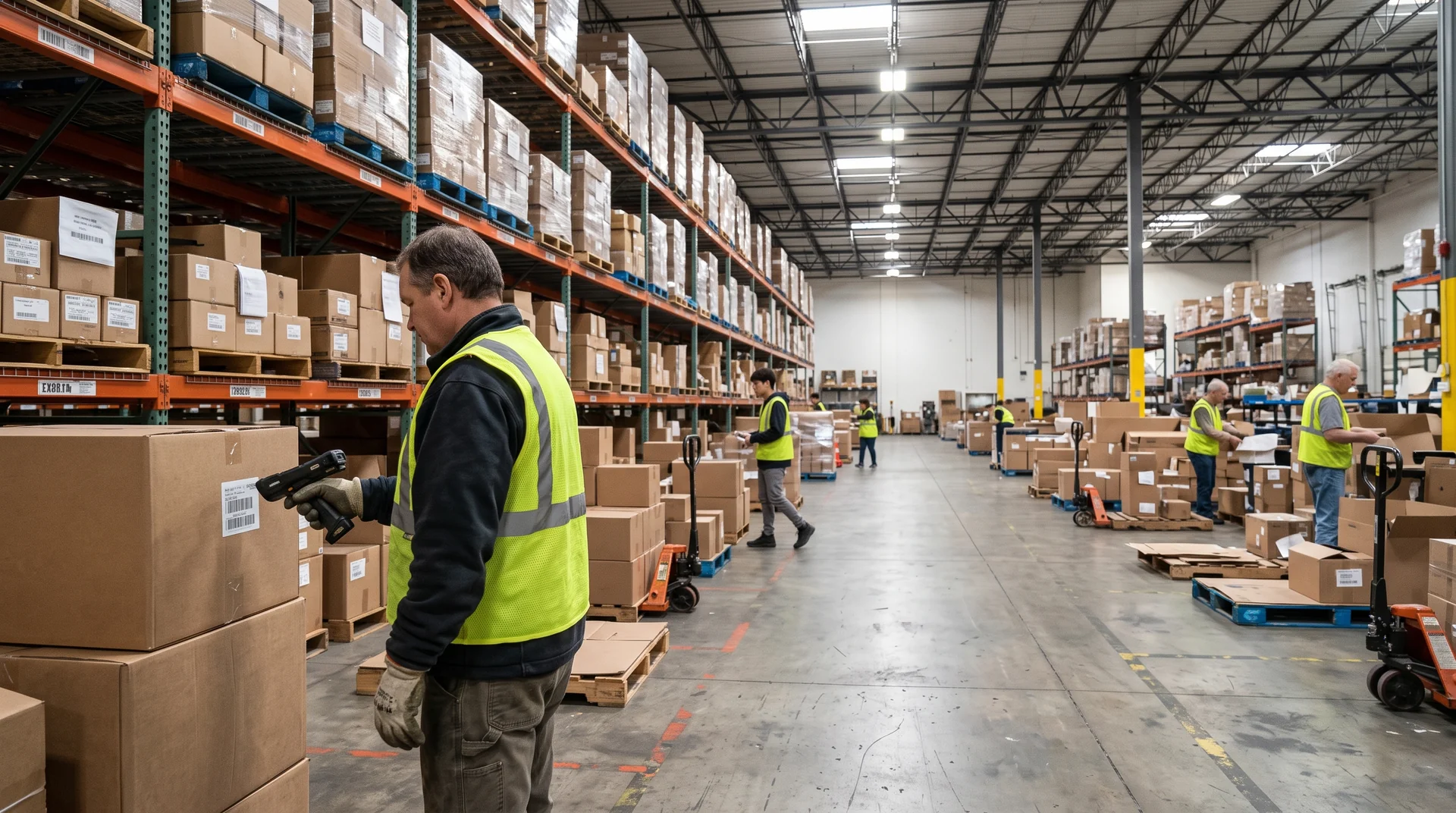

A barcode records that an item passed a scanner at the moment a person pointed one at it. An RFID tag records that an item came within a few metres of a reader. A camera records what is physically present in a scene, whether or not anything is labelled. These are three different questions. Most tracking projects that disappoint chose the sensor before deciding which question the operation needed answered.
THE DIFFERENCE
How The Three Methods Differ
Barcodes and RFID identify an item by reading a label attached to it. Computer vision recognises items by how they look in a camera image. That one difference decides what each method costs, what it covers, and what it can miss.
A barcode needs line of sight and, in most warehouses and stores, a person holding a scanner. The data is exactly as good as the scanning discipline behind it. A missed scan at receiving becomes phantom stock that nobody notices until a picker finds an empty bay.
Passive UHF RFID, the RAIN standard, removes the line of sight requirement and reads many tags at once. GS1 puts the typical read range at several metres, reaching 15 metres in very special cases (GS1). That bulk read is why item-level RFID raised retail inventory accuracy from an average of 63% to 95% in the Project Zipper research by the Auburn University RFID Lab and GS1 US (Just Style).
Computer vision needs no label at all. A trained model detects the classes it was taught, such as a pallet, a roll cage, a forklift, an empty rack slot or a person, and reports where they are and how many there are. It is strong at counting and locating things in view. It is weak at telling two identical cartons apart, and it cannot see inside a closed box or behind a stacked row.
THREE TECHNOLOGIES
Where Each Method Earns Its Place
Barcodes win on cost per item. RFID wins on identifying many items without handling them. Vision wins on seeing things that carry no label, or that only matter because of where they are.
Barcode: Cheapest Per Item, Slowest Per Count
The label costs little more than the ink, and most suppliers already print GS1 codes on their cartons. The cost is in labour. Every count is one scan at a time, done by a person, and a cycle count of a large site takes days. Barcodes suit stable inventories where the accuracy problems come from process gaps that training can close.
RFID: Bulk Identity Without Line Of Sight
Passive UHF labels cost cents rather than dollars, and the price falls with volume. RFID Journal gives an example of 100 labels at about 20 cents each against 10 cents each for 2 million (RFID Journal). Every item must still be tagged, and readers and portals must be designed. Metal surfaces and liquids detune standard tags, so metal assets need more expensive on-metal tags.
Computer Vision: Coverage Without Tagging
Cameras can watch stock, yards and docks without anything being attached to the assets, and many sites already have cameras installed. Vision also sees states that no tag reports: a pallet left in a fire lane, a bay that has been empty for six hours, a forklift working in a pedestrian zone. It depends on a clear view, enough light and enough pixels on the target. It identifies item types far more reliably than individual units.
THE NUMBERS
What Each Method Needs To Work
Each method has a physical limit that no software setting removes. A barcode needs a scan. An RFID tag needs a reader within range. A camera needs enough pixels across the object at the distance where it must be recognised.
| Factor | Barcode | Passive UHF RFID | Computer Vision |
|---|---|---|---|
| Identifies the individual unit | Yes, one scan at a time | Yes, many tags per read | Usually only the item type |
| Line of sight needed | Yes | No | Yes |
| Cost attached to every item | Printed label | Tag, roughly 10 to 20 cents at volume | None |
| Typical reach | Centimetres to a few metres | Several metres, up to 15 m in special cases | Tens of metres for large objects, depending on pixel density |
| Sees untagged items | No | No | Yes |
| Reads through cartons | No | Yes, with limits near metal and liquid | No |
| Main failure mode | Missed or duplicated scans | Reads at the wrong portal, metal and liquid interference | Occlusion, poor light, too few pixels |
| Infrastructure | Scanners and handhelds | Readers, antennas, portals | Cameras, network, on-site compute |
For cameras, the number that decides everything is pixels per metre at the target, written PPM. ARSA publishes these requirements in its camera standard, ARSA-CVS-001. With a standard 60 degree lens, a 2 MP camera meets the 67 PPM needed for vehicle detection out to 24.9 m, and the 113 PPM needed for person tracking out to 14.7 m. Reading a licence plate needs 325 PPM, which the same camera delivers only out to 5.1 m.
The standard does not cover pallets and cages, and the same pattern still holds. Recognising that a large object is present works at long range, and reading the small print on its label only works up close. For a custom class, the pixel requirement is set during the feasibility work.
Video is also heavy. A 2 MP camera at 2.48 Mbps produces about 26.7 GB per day. That is one reason ARSA processes video on site and sends only analytic metadata, such as counts and events, across the network.
COMBINING THEM
Why Most Sites End Up Using More Than One
Most mature tracking setups combine methods because each one covers the others’ blind spots. Barcodes or RFID supply identity. Cameras supply location, condition and the events that a tag never reports.
A dock door is the usual example. An RFID portal confirms which tagged pallets left the building, and a camera on the same door counts how many pallets physically passed through it. When the two numbers disagree, the gap itself tells you something. It may be an untagged pallet, a tag read from a pallet still standing near the portal, or a load that went out through a door with no reader. Neither sensor would show that discrepancy on its own.
Returnable assets work the same way. Roll cages, totes and containers carry a tag for identity, while cameras in the yard count how many are standing idle and where. Custom detection results can be routed into the systems operators already use, including the ERP, the VMS, access control and alerting, so the count reaches the person who can act on it.
DATA PROTECTION
What Cameras Change For Privacy Compliance
A camera over a working floor captures people as well as stock. That brings workplace monitoring rules into scope in a way that a barcode scanner or a tag reader does not.
In the United Kingdom, the ICO finalised its guidance on monitoring workers in October 2023, and it treats CCTV as monitoring. A data protection impact assessment is mandatory where monitoring is likely to be high risk and strongly recommended otherwise. The ICO also expects employers to seek workers’ views before introducing monitoring (Inside Privacy). Singapore’s PDPA and the UAE’s PDPL also apply to images of identifiable people, so buyers in those markets should have counsel review the camera plan.
Two design choices reduce the exposure. First, point cameras at bays, docks and yards instead of workstations, so the frame holds stock and vehicles more than faces. Second, process video on site, so footage stays on your network and only counts and events travel. ARSA builds to that second point by default.
CHOOSING
How To Choose For Your Site
Start from the question the operation needs answered. If you need to know which specific unit is where, use barcodes or RFID. If you need to know whether something is there, how many there are and what state they are in, computer vision is usually the better fit.
Then test the physical constraints. For RFID, ask how much of the inventory is metal or liquid, and who will tag inbound goods that suppliers send untagged. For cameras, ask whether existing positions give enough pixels at the distance that matters, whether racking blocks the view, and whether the light holds at night. The lens and field of view visualizer gives a first estimate of coverage before anyone visits the site.
ARSA’s paid engagements answer the camera questions in writing:
- Remote Camera Design Review: $1,500, one week. Each camera position is marked pass or fail against ARSA-CVS-001, with priced remediation.
- On-Site Camera Survey: $4,500 plus travel, covering up to 50 cameras.
- Feasibility assessment: $4,500, two weeks, ending in a go or no-go recommendation. If vision is the wrong tool for your problem, the assessment says so.
Each fee is deducted from the project fee if you contract within 90 days. The full sequence is set out on the services page.
Frequently Asked Questions
Can Computer Vision Replace RFID For Inventory Tracking?
For counting item types and tracking where they are, it often can. For identifying which specific unit is which, it usually cannot. A camera sees that twelve cartons of the same product are on a shelf, but without a visible distinguishing mark it cannot tell their serial numbers apart. That is what RFID and barcodes are built to do.
Can A Camera Read Barcodes Or Labels?
Yes, at short range, if the camera puts enough pixels across the code or text. Reading print is one of the most demanding camera tasks. It is comparable to reading licence plates, which in ARSA-CVS-001 need 325 PPM and reach only 5.1 m on a 2 MP camera. ARSA publishes no accuracy figure for reading printed codes or text, so any expected figure should be established in a feasibility assessment against your own camera positions.
Does RFID Work On Metal Assets And Liquids?
It works with the right tags, but standard UHF labels perform poorly on both. Metal reflects the signal and liquids absorb it. Metal assets need on-metal tags, which cost more, and tag placement on liquid-filled goods should be tested on site before rollout.
Do Our Existing CCTV Cameras Work For Asset Tracking?
Often, if they meet the minimum specification and are positioned for the task. ARSA’s minimum is 2 MP at 15 fps, with 4 MP recommended. The deciding factor is pixel density at the distance where detection must happen. Cameras placed for people to watch are often too high, too steep or too far away for machine detection, and a design review finds this before any commitment.
What Is The Difference Between Custom Computer Vision And An Off-The-Shelf Vision Service?
A custom model is trained on your classes and your conditions. A generic service recognises broad categories it learned elsewhere. For asset tracking, your roll cages, your pallet types and your lighting are rarely in a public dataset, so ARSA trains on your own footage where that improves accuracy. Your data remains yours, and model ownership is agreed before work starts.
Does ARSA Deliver Outside Indonesia?
Yes. International list prices are in USD, and invoicing is available in USD and EUR. Where visa conditions prevent ARSA engineers travelling, a qualified local partner installs under ARSA supervision.
NEXT STEP
Find Out Whether Cameras Can Track Your Assets
If your tracking problem is about presence, counts, location or the state of a space, a camera-based system may solve it without tagging a single item. ARSA’s Custom Computer Vision Development service starts with a written assessment of your site, your cameras and your question. It tells you plainly whether vision, tags or a combination of both is the right answer.