
Edge AI vs. Cloud: Which PPE Detection Solution Fits Your Business?
Workplace accidents in the construction industry are not just statistics; they represent significant human suffering, operational downtime, and substantial financial burdens. For CFOs evaluating strategic investments, the imperative to reduce workplace accidents with AI video analytics has become a critical consideration. Modern AI-powered safety systems promise to transform traditional, reactive safety protocols into proactive, intelligent monitoring. But with various deployment models, particularly edge AI versus cloud-based solutions, choosing the right architecture is paramount for maximizing impact and ensuring a strong return on investment.
This guide delves into the core differences between edge and cloud AI for Personal Protective Equipment (PPE) detection and site safety, offering a clear perspective on which solution best aligns with the demanding realities of construction environments. ARSA Technology, with its proven expertise in AI video analytics and edge computing, provides robust solutions designed for real-world operational challenges.
The Imperative to Reduce Workplace Accidents with AI Video Analytics in Construction
Construction sites are inherently dynamic and high-risk environments. Despite stringent regulations and dedicated safety officers, accidents continue to occur, leading to severe consequences. These include direct costs such as medical expenses, workers’ compensation claims, and legal fees, as well as indirect costs like project delays, equipment damage, reputational harm, and increased insurance premiums. For a CFO, these costs directly impact the bottom line.
Traditional safety monitoring often relies on manual inspections, which are prone to human error, limited in scope, and inherently reactive. By the time a safety violation is manually identified, an incident may have already occurred. This is where advanced AI video analytics steps in, offering continuous, unbiased, and real-time surveillance to identify risks before they escalate. The goal is not just to detect, but to prevent, thereby significantly improving safety records and operational efficiency.
Understanding AI-Powered PPE Detection: Edge vs. Cloud Architectures
At its core, PPE detection uses computer vision to automatically identify whether workers are wearing required safety gear (like hard hats, safety vests, or masks) and if they are operating within designated safe zones. The primary distinction in deployment lies between edge and cloud processing.
- Cloud-Based AI: In a cloud-based system, video footage from cameras is streamed over the internet to remote data centers for analysis. The cloud servers perform the AI inference, detect anomalies, and then send alerts back to the site. This model offers centralized management and potentially unlimited scalability, but it comes with inherent trade-offs.
- Edge AI: With edge AI, the processing power is brought directly to the source of the data – the construction site itself. Devices like ARSA’s AI Box Series perform AI inference on-site, analyzing video streams locally without sending raw footage to the cloud. This decentralized approach offers distinct advantages, especially for mission-critical applications like construction safety.
Edge AI for Construction Safety: Unmatched Speed, Privacy, and Cost Efficiency
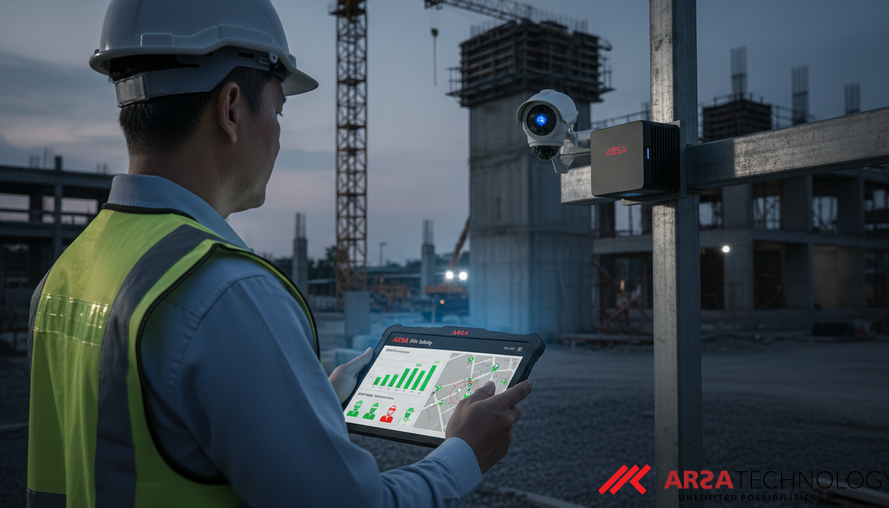
For construction sites, ARSA’s edge AI solutions, particularly the ARSA Basic Safety Guard (AI Box), present a compelling case. This plug-and-play system is engineered to deliver immediate value by processing video streams at the edge, ensuring instant insights without cloud dependency or complex infrastructure replacement.
- Real-Time Actionable Insights: The most critical advantage of edge AI is its ability to provide real-time alerts. When a worker enters a restricted area without a hard hat or safety vest, the system detects it instantly and triggers an alert. This immediate feedback is crucial for preventing accidents, allowing for intervention before an incident occurs. This demonstrates how AI CCTV reduces safety incidents by enabling proactive measures.
- Enhanced Data Privacy and Security: In an era of increasing data regulations (like GDPR and Indonesia PDPA), keeping sensitive video data on-premise is a significant benefit. ARSA’s AI Box processes all video streams locally, meaning raw footage never leaves your network unless explicitly configured. This full data ownership is vital for compliance and maintaining privacy, especially in environments with sensitive operational data.
- Predictable Cost Savings: Cloud-based solutions often incur unpredictable and escalating costs related to data transfer, storage, and continuous processing. Edge AI, by contrast, eliminates these recurring cloud fees. The ARSA AI Box operates with minimal IT overhead, offering a clear AI workplace safety system cost savings model. Once deployed, the operational costs are significantly lower, contributing to a better long-term cost benefit analysis AI safety system.
- Rapid, Flexible Deployment: The ARSA Basic Safety Guard is designed for a 5-minute setup. It integrates seamlessly with existing CCTV infrastructure, requiring only power and network connectivity. This plug-and-play installation means construction firms can rapidly deploy AI safety monitoring across multiple sites without replacing existing cameras or backend systems. The AI Box Series offers flexible hardware configurations, from a Mini PC model processing up to 3 cameras for distributed deployments to a Server model handling up to 30 cameras for centralized monitoring.
- Automated Compliance and Auditing: Beyond real-time alerts, the system automatically generates safety compliance reports, detailing PPE adherence, restricted area intrusions, and other safety violations. This automation significantly reduces the burden of manual safety inspections and provides irrefutable data for audits, potentially leading to lower insurance premiums due to a demonstrably safer workplace.
Cloud-Based PPE Detection: When Centralization Comes at a Cost
While cloud-based AI offers centralized management, its suitability for construction safety often falls short compared to edge solutions.
- Latency Issues: Sending video streams to the cloud for processing introduces latency. In critical safety scenarios, even a few seconds of delay can be the difference between a near-miss and a severe accident. Real-time intervention, a cornerstone of proactive safety, is compromised.
- Bandwidth Requirements: High-resolution video streams require substantial bandwidth, which can be costly and unreliable on many construction sites. Constant data upload can strain network infrastructure and incur significant data transfer fees.
- Data Privacy Concerns: Transmitting continuous video feeds to external cloud servers raises significant data privacy and security questions. For many enterprises and government entities, this is a non-starter, especially when dealing with sensitive operational footage.
- Unpredictable Costs: While initial setup might seem cheaper without dedicated hardware, the ongoing operational costs for cloud processing, storage, and data transfer can quickly accumulate, making the total cost of ownership higher in the long run. This can significantly skew the cost benefit analysis AI safety system away from cloud solutions.
Quantifying the Value: The ROI of AI Safety Monitoring in Construction
For a CFO, any investment must demonstrate a clear return. Implementing an AI workplace safety system, particularly an edge-based solution like ARSA’s, offers a powerful ROI. While the phrase “ROI of AI safety monitoring in manufacturing” is commonly used, the principles and benefits directly translate to the construction sector, often with even greater impact due to the higher risk profile.
- Direct Cost Reduction: By reducing workplace accidents by up to 60%, companies save millions in medical bills, legal settlements, and workers’ compensation. Fewer accidents mean less downtime, keeping projects on schedule and avoiding costly penalties.
- Lower Insurance Premiums: A demonstrably safer work environment, backed by comprehensive AI-generated safety reports, can lead to negotiations for reduced insurance premiums. Insurers value proactive risk mitigation.
- Automated Compliance: Eliminating manual safety inspections and automating compliance audits frees up valuable personnel time, allowing safety officers to focus on training and strategic initiatives rather than tedious monitoring. This operational efficiency contributes directly to cost savings.
- Enhanced Productivity: A safer workplace fosters greater employee morale and reduces disruptions, leading to improved productivity and project delivery.
- Reputation Protection: Avoiding major safety incidents protects the company’s brand and reputation, which is invaluable in securing future contracts and attracting top talent.
ARSA’s AI Box Series overview clearly outlines how these edge devices are designed to deliver these tangible business outcomes, ensuring that your investment in safety technology translates into measurable financial benefits.
Why ARSA’s Edge AI is the Strategic Choice for Construction Safety
ARSA Technology brings over seven years of deep engineering expertise, with solutions proven in demanding environments, including government and enterprise clients. Our commitment to accuracy, scalability, privacy, and operational reliability ensures that our AI solutions move beyond experimentation into measurable impact.
For construction firms, the ARSA Basic Safety Guard (AI Box) provides a robust, self-contained solution to reduce workplace accidents with AI video analytics. It offers:
- On-premise processing: Full control over data, ensuring no sensitive information leaves your site.
- Real-time alerts: Immediate detection of PPE violations and restricted area intrusions.
- Easy integration: Works with your existing CCTV cameras.
- Scalable hardware: Options for small sites (3 cameras) to large, complex operations (30 cameras).
- Comprehensive analytics: Automated reporting for compliance and continuous improvement.
Beyond safety, ARSA also offers other on-premise solutions like the ARSA Face Recognition & Liveness SDK, which can be deployed for secure access control, further enhancing overall site security without compromising data sovereignty. Explore all ARSA products to see how our AI and IoT solutions can address various operational needs.
Conclusion
For construction CFOs seeking to make strategic investments that genuinely reduce workplace accidents with AI video analytics, the choice is clear. Edge AI, with its inherent advantages in real-time processing, data privacy, and predictable cost structures, offers a superior solution compared to cloud-based alternatives. ARSA Technology’s Basic Safety Guard (AI Box) stands out as a practical, proven, and profitable investment, transforming passive CCTV systems into active, intelligent safety platforms. By embracing edge AI, construction companies can not only safeguard their workforce but also significantly improve their financial performance and operational resilience.
Ready to explore how ARSA Technology can transform your construction site safety and deliver a compelling ROI? Contact ARSA solutions team today for a consultation.
—
FAQ
What is the primary benefit of using edge AI for construction safety?
The primary benefit is real-time, on-site processing of video data, which enables instant detection of safety violations like missing PPE or restricted area intrusions. This allows for immediate intervention, significantly helping to reduce workplace accidents with AI video analytics and prevent incidents before they occur.
How does ARSA’s AI Box contribute to AI workplace safety system cost savings?
ARSA’s AI Box processes data locally, eliminating recurring cloud computing and data transfer fees. Its plug-and-play installation reduces setup costs, and by preventing accidents, it lowers expenses related to injuries, downtime, legal fees, and potentially reduces insurance premiums, offering substantial AI workplace safety system cost savings.
Can ARSA’s AI safety monitoring system help lower insurance premiums?
Yes. By providing concrete data on improved safety compliance, reduced incident rates, and proactive risk mitigation, ARSA’s AI safety monitoring system offers verifiable evidence of a safer workplace. This data can be leveraged with insurance providers to negotiate lower premiums, directly impacting the cost benefit analysis AI safety system.
Is the ROI of AI safety monitoring in manufacturing applicable to construction?
Absolutely. While the specific risks may differ, the fundamental principles of ROI from AI safety monitoring, such as reduced accidents, improved compliance, operational efficiency, and lower costs, are directly applicable and often even more pronounced in high-risk sectors like construction. ARSA’s solutions are designed to deliver these benefits across various industrial environments.
—
Stop Guessing, Start Optimizing.
Discover how ARSA Technology drives profit through intelligent systems.