
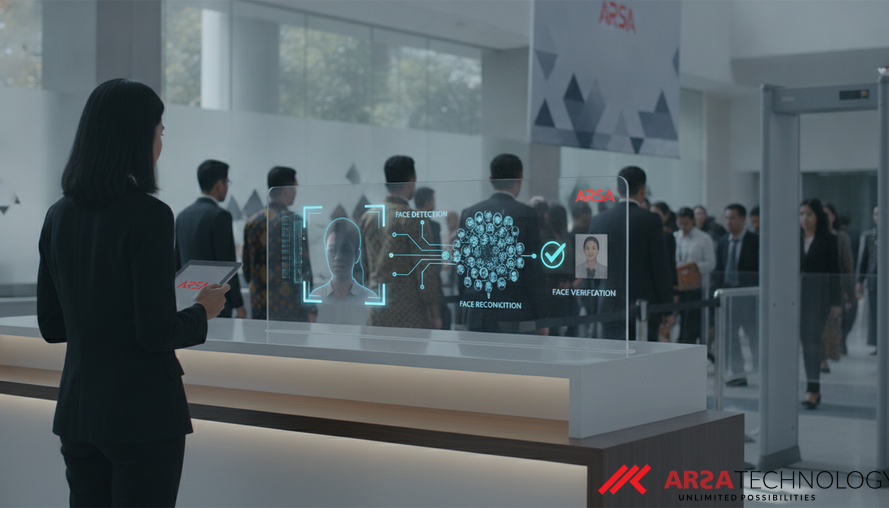

Face Detection vs Face Recognition vs Face Verification Explained: A Product Manager’s Guide for Event Management
In the rapidly evolving landscape of AI and biometrics, understanding the precise terminology is crucial for product managers, especially when designing solutions for high-stakes environments like event management. The terms “face detection,” “face recognition,” and “face verification” are often used interchangeably, yet they represent distinct processes with unique applications. This guide will provide a clear breakdown of face detection vs face recognition vs face verification explained, offering essential insights for those looking to leverage these powerful technologies effectively.
For event organizers, the ability to accurately and efficiently manage attendee access, enhance security, and personalize experiences hinges on a solid grasp of these core concepts. ARSA Technology, with its robust ARSA Face Recognition & Liveness API, offers a cloud-based solution that integrates these capabilities to address modern event challenges, from seamless entry to advanced security protocols.
Decoding the Core Concepts: Detection, Recognition, and Verification
While all three processes involve analyzing human faces, their objectives and methodologies differ significantly.
Face Detection: The First Step
Face detection is the foundational process. Its sole purpose is to identify the presence and location of human faces within an image or video stream. When a system performs face detection, it draws a bounding box around each detected face, indicating its coordinates and often a confidence score. It doesn’t care who the face belongs to, only that a face exists.
In event management, face detection is vital for:
- Crowd analysis: Identifying the number of people in a specific area, such as an entrance queue or a session hall.
- Camera focus: Guiding cameras to properly frame faces for subsequent biometric processes.
- Privacy-preserving analytics: When combined with techniques like anonymization, it can count attendees without identifying individuals, useful for tools like the ARSA Smart Retail Counter (AI Box) for footfall analysis.
Face Recognition (1:N Identification): Who Is This Person?
Once a face is detected, face recognition (also known as 1:N identification) takes the process a step further. This technology attempts to identify an unknown individual by comparing their detected face against a database of known faces. The “1:N” signifies comparing “one” unknown face to “N” (many) known faces in a database. The system returns a list of potential matches, ranked by similarity, or indicates no match if the face is not found.
For event managers, 1:N face identification is transformative for:
- VIP recognition: Instantly identifying registered VIPs or speakers upon arrival for personalized greetings.
- Watchlist screening: Discreetly flagging individuals on a security watchlist for enhanced monitoring, without impeding general attendee flow.
- Automated check-in: Allowing pre-registered attendees to enter simply by presenting their face, eliminating manual ticket scanning.
ARSA’s Face Recognition & Liveness overview highlights how its API enables efficient 1:N identification against isolated, per-account face databases, ensuring both speed and data privacy for event organizers.
Face Verification (1:1 Matching): Are You Who You Say You Are?
Face verification, or 1:1 face matching, is used to confirm an individual’s claimed identity. In this scenario, the system compares a live capture of a person’s face (the “probe”) against a single, pre-enrolled reference image associated with their asserted identity (the “gallery”). The system’s output is a binary “yes” or “no” – a match or a non-match – indicating whether the two faces belong to the same person.
This is critical for security and personalized access in event settings:
- Secure access control: Verifying an attendee’s identity against their registered profile for entry to restricted areas or premium lounges.
- Payment authentication: Confirming the identity of a user attempting a transaction at a concession stand or merchandise booth.
- Credential validation: Ensuring that the person using a digital badge or QR code is indeed the legitimate owner.
The ARSA Face Recognition & Liveness API excels in 1:1 face verification, offering configurable similarity thresholds to balance security and user experience.
The Critical Role of Liveness Detection in 2026
As facial recognition technologies become more sophisticated, so do the methods used to bypass them. This is where liveness detection becomes indispensable. Liveness detection determines whether the face being presented to the camera is from a live person or a spoofing attempt (e.g., a photo, video, or 3D mask).
It’s crucial to distinguish between different types of attacks. Presentation-attack detection (PAD), as covered by standards like ISO/IEC 30107-3 and iBeta Level 1/Level 2 testing, focuses on detecting physical artifacts used to spoof a camera. However, in 2026, liveness detection alone is no longer sufficient. Injection attacks, where malicious actors bypass the camera entirely to feed synthetic data directly into the system, and deepfakes, which create highly realistic but fabricated video or audio, pose advanced threats that PAD certification does not cover.
ARSA’s API provides both passive and active liveness detection, with active liveness incorporating challenge-response mechanisms like head movement instructions to robustly prevent photo and video replay attacks. This multi-layered approach is vital for meeting stringent KYC and AML obligations under frameworks like PSD2, eIDAS, FinCEN, and RBI V-CIP, protecting event organizers from sophisticated fraud attempts.
Why ARSA’s Cloud API is Ideal for Event Management Product Managers
For product managers in event technology, integrating advanced biometric capabilities needs to be fast, scalable, and secure. The ARSA Face Recognition & Liveness API, a cloud SaaS solution, is engineered precisely for these demands.
- Rapid Deployment: With a first API call achievable in under 5 minutes, product managers can quickly prototype and launch face-based features, drastically reducing time-to-market. The API utilizes simple x-key-secret authentication, making integration straightforward.
- Comprehensive Features: Beyond the core face detection vs face recognition vs face verification explained, the API offers a full suite of features: age and gender estimation, expression detection (neutral, happy, sad, surprise, anger), and robust passive and active liveness detection. It also supports multiple images per face ID for higher accuracy and handles JPEG/PNG images and MP4/WebM videos for active liveness.
- Scalability and Reliability: Hosted on a self-managed platform at faceapi.arsa.technology, the API boasts a 99.9% uptime target, ensuring consistent performance even during peak event traffic. Pricing is usage-based, allowing organizations to pay only for what they use, without managing complex infrastructure.
- Data Privacy and Compliance: Each account benefits from an isolated, per-account face database, ensuring strict data privacy and tenant separation. This design helps organizations meet critical data protection requirements without the overhead of on-premise deployments.
- Developer-Friendly: Extensive Face Recognition API documentation provides cURL, Python, and JavaScript code examples, accelerating developer workflows. A free Basic tier (100 calls/month, 100 face IDs, no credit card required) allows for easy experimentation before committing to Pro ($29/mo), Ultra ($149/mo), or Mega ($1,290/mo) plans, all of which include every feature. Product managers can monitor usage via a dedicated developer dashboard with analytics.
Real-World Impact in Event Management
Consider an international conference. Attendees could use the ARSA API for:
- Expedited Entry: Face verification at turnstiles, reducing queues and improving the attendee experience.
- Personalized Access: 1:1 verification for entry into exclusive workshops or VIP lounges.
- Enhanced Security: 1:N identification to discreetly screen against a security watchlist, ensuring a safe environment for all participants.
- Sponsor Engagement: Anonymous face detection for audience measurement at digital signage, providing valuable data to sponsors on exposure and engagement.
By understanding the distinct functionalities of face detection, recognition, and verification, product managers can design more secure, efficient, and user-friendly event experiences. ARSA Technology empowers this transformation, offering a powerful and flexible platform that bridges the gap between complex AI concepts and practical, impactful solutions. For more insights into how AI can enhance operational intelligence, explore our Face Recognition API blog.
Frequently Asked Questions
What is the primary difference between face detection and recognition?
The primary difference between face detection and recognition is their objective: face detection identifies if a face is present and its location, while face recognition (1:N identification) identifies who that face belongs to by comparing it against a database of many known faces.
How does 1:N face identification differ from 1:1 face verification?
1:N face identification (recognition) compares one unknown face to many faces in a database to find a match, answering “Who is this?”. In contrast, 1:1 face verification compares one live face to a single claimed identity’s reference image, answering “Are you who you say you are?”.
Why are face recognition concepts for beginners important for product managers?
Understanding face recognition concepts for beginners is crucial for product managers to accurately define requirements, evaluate vendor capabilities, and communicate effectively with engineering teams and stakeholders. It ensures that the right biometric solution is chosen for specific use cases, avoiding costly misunderstandings and ensuring optimal system design.
How does ARSA’s API help prevent fraud in event management?
ARSA’s Face Recognition & Liveness API helps prevent fraud in event management through its robust active and passive liveness detection, which thwarts presentation attacks using photos or videos. This ensures that only live individuals can gain access or authenticate, bolstering security for critical operations like access control and identity verification.
Ready to Transform Your Event Experience?
The distinctions between face detection, face recognition, and face verification are fundamental to building secure and efficient identity solutions. With ARSA Technology, product managers can confidently integrate these advanced capabilities into their event platforms. Our Face Recognition & Liveness API offers a production-ready, scalable, and privacy-conscious solution designed to meet the demands of modern enterprises.
To explore how ARSA Technology can help you leverage AI for your next event, contact ARSA solutions team today or create a free Face API account and start building. For a comprehensive overview of all our offerings, visit all ARSA products.
Stop Guessing, Start Optimizing.
Discover how ARSA Technology drives profit through intelligent systems.