

Face Detection vs Face Recognition vs Face Verification Explained: A Product Manager’s Guide
In the rapidly evolving landscape of AI and biometrics, understanding the nuances of facial technologies is crucial for product managers. When building secure and efficient identity solutions, grasping the core differences between face detection vs face recognition vs face verification explained is not just academic—it’s foundational. These terms are often used interchangeably, but each represents a distinct capability with unique applications, particularly in privacy-sensitive sectors like healthtech.
ARSA Technology, a leader in AI video analytics and face recognition, provides robust solutions that leverage these distinct capabilities. Our ARSA Face Recognition & Liveness API offers a comprehensive identity layer, designed for quick integration and high performance in demanding enterprise environments.
The Foundational Step: What is Face Detection?
Face detection is the most basic capability in the facial technology stack. Its primary goal is to identify the presence of human faces within an image or video stream and return their location. Think of it as drawing a bounding box around every face it finds. It doesn’t care whose face it is, only that a face exists.
For a product manager, understanding face detection means recognizing its role as the prerequisite for any further facial analysis. Before you can recognize or verify a person, you first need to find their face. This technology is critical for:
- Counting people: Estimating crowd density or footfall in retail environments.
- Privacy masking: Automatically blurring faces in surveillance footage to protect identities.
- Focusing cameras: Ensuring that camera systems correctly frame subjects for optimal image capture.
ARSA’s Face Recognition & Liveness API includes robust face detection with bounding boxes, ensuring that subsequent recognition and verification processes are initiated accurately.
Identifying Individuals: What is 1 to N Face Identification (Face Recognition)?
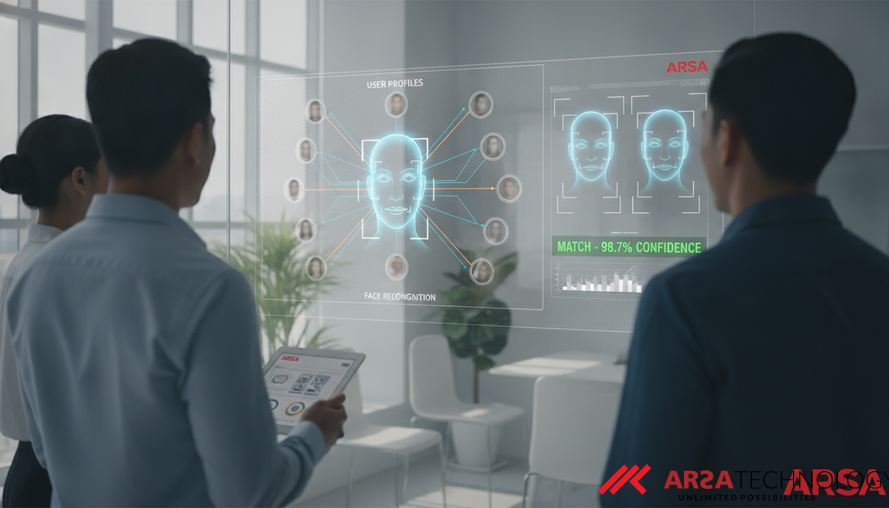
Once a face is detected, the next logical step might be to identify who that person is. This is where face recognition, often referred to as 1:N (one-to-many) identification, comes into play. Face recognition compares a detected face against a database of known faces to find a match. The “1:N” signifies that one input face is compared against ‘N’ number of faces in a database.
The process involves:
1. Feature extraction: The system analyzes unique facial features (e.g., distance between eyes, shape of the nose, jawline) to create a unique mathematical template, or “faceprint.”
2. Database comparison: This faceprint is then compared against a database of enrolled face IDs.
3. Matching: If a sufficiently close match is found, the system identifies the individual.
This capability is vital for applications requiring broad identification or watchlist screening. For instance, in healthtech, face recognition could be used for secure access control in restricted areas of a hospital or to quickly identify staff members for shift management. The Face Recognition & Liveness overview highlights how ARSA’s API facilitates this, allowing for real-time identification against isolated per-account face databases, ensuring data privacy and tenant separation.
The global healthcare biometrics market is experiencing significant growth, projected to reach USD 39.02 billion in 2026 and expand to USD 272.81 billion by 2035, driven by the need for secure patient identification and staff verification. Over 65% of large healthcare facilities already utilize biometrics, contributing to a reduction in identity-related delays by more than 40%, with accuracy levels exceeding 95% in these settings (Global Growth Insights, 2026). This underscores the increasing demand for reliable 1:N face identification solutions.
Confirming Identity: What is 1 to 1 Face Verification?
In contrast to identification, face verification, or 1:1 (one-to-one) face matching, is about confirming a person’s claimed identity. Here, a detected face is compared against a single reference image or template that the person claims to be. The system’s goal is to answer a simple yes/no question: “Is this person who they claim to be?”
Common use cases for 1 to 1 face verification include:
- Login and authentication: Verifying a user’s identity when they log into an application.
- e-KYC (Know Your Customer) and digital onboarding: Comparing a selfie to a government-issued ID photo during account creation.
- Access control: Confirming an individual’s identity at a secure entry point.
ARSA’s Face Recognition & Liveness API excels in 1:1 face verification, offering configurable similarity thresholds for precise authentication. This is crucial for meeting stringent regulatory obligations like PSD2, eIDAS, FinCEN, and RBI V-CIP, which demand robust identity checks.
The Critical Role of Liveness Detection
In 2026, simply matching faces is no longer enough. The rise of sophisticated spoofing techniques necessitates advanced liveness detection. Liveness detection ensures that the face being presented to the camera is from a live person, not a photo, video, or 3D mask (presentation attack detection, or PAD). It’s a vital component in preventing fraud and maintaining the integrity of identity systems. It’s important to distinguish PAD, which is covered by standards like ISO/IEC 30107-3, from injection attacks or deepfakes that bypass the camera entirely and are not addressed by PAD certification. Liveness detection is a necessary, but no longer solely sufficient, layer of security.
ARSA’s API incorporates both passive and active liveness detection. Passive liveness analyzes subtle cues without user interaction, while active liveness employs challenge-response mechanisms, such as asking the user to perform specific head movements. This multi-layered approach helps prevent presentation attacks and synthetic identity fraud.
The Difference Between Face Detection and Recognition in Practice
To summarize the core distinctions, consider a security camera at a hospital entrance.
- Face Detection: The camera’s AI identifies that there are five faces in the lobby, drawing a box around each one.
- Face Recognition (1:N Identification): The system then compares each of those five detected faces against a database of all authorized hospital staff. It identifies “Dr. Smith” and “Nurse Jones” and flags two unknown individuals, while one person is identified as a returning patient.
- Face Verification (1:1 Matching): When Dr. Smith attempts to access a restricted pharmacy, the system captures her face and compares it only to her pre-enrolled biometric template, confirming “Is this Dr. Smith?” before granting access.
This clear delineation is essential for product managers to design systems that accurately address specific security and operational needs.
Building Secure Identity Solutions with ARSA Technology
For product managers looking to integrate these powerful capabilities, the ARSA Face Recognition & Liveness API offers a seamless, cloud-based SaaS solution. Key features include:
- Comprehensive Functionality: From face detection with bounding boxes to 1:N face recognition against a database and 1:1 face verification, alongside passive and active liveness detection. The API also provides age and gender estimation, and expression detection (neutral, happy, sad, surprise, anger).
- Rapid Deployment: With a first API call achievable in under 5 minutes, you can launch face login or e-KYC solutions in days, not months.
- Scalable & Cost-Effective: A pay-as-you-go model with various pricing plans (Basic free tier, Pro $29/mo, Ultra $149/mo, Mega $1,290/mo) ensures you only pay for what you use, with all features included on every plan. This eliminates infrastructure management overhead.
- Data Privacy & Compliance: Isolated per-account face databases ensure data privacy and tenant separation, crucial for industries with strict regulations. The API is designed to help you meet KYC and AML obligations under frameworks like GDPR, EU AI Act (for high-risk biometric systems), FinCEN, and RBI V-CIP.
- Developer-Friendly: Supports JPEG/PNG images and MP4/WebM video for active liveness, with cURL/Python/JavaScript code examples in the Face Recognition API documentation. A developer dashboard provides usage analytics, and multiple images per face ID can be enrolled for higher accuracy. ARSA targets 99.9% uptime for reliable service.
The regulatory landscape for biometric data is complex and constantly evolving. As of March 2026, many US states have dedicated biometric privacy laws or provisions within broader data privacy statutes, often requiring written informed consent and publicly available data retention policies (PrivacyLawMap, 2026). Solutions like ARSA’s API are designed with these considerations in mind, supporting your compliance efforts.
For further insights into optimizing identity verification, explore our blog post on Optimizing Crypto Onboarding: A Face Recognition API for Crypto Exchange and Web3 KYC, which delves into similar challenges in a different industry. Another relevant article, What Face Recognition & Liveness Actually Costs in 2026, provides valuable context on the economic aspects of these technologies.
Frequently Asked Questions
What is the difference between face detection and recognition for beginners?
Face detection simply finds faces in an image or video, drawing a box around them without identifying anyone. Face recognition, on the other hand, takes a detected face and compares it against a database of known faces to determine who that person is (1:N identification).
How does 1 to 1 face verification differ from 1 to N face identification?
1 to 1 face verification compares a live face to a single claimed identity (e.g., a photo on an ID) to confirm if they match. 1 to N face identification compares a live face to many faces in a database to find out who the person is without a prior claim of identity.
Why is liveness detection crucial in modern face recognition systems?
Liveness detection is crucial to prevent fraud by ensuring the face presented is from a live person, not a spoofing attempt like a photo, video, or mask. This protects against presentation attacks and enhances the security of identity verification processes.
Can ARSA’s Face Recognition & Liveness API be used for healthtech applications?
Yes, ARSA’s API is ideal for healthtech, enabling secure patient identification, staff authentication, and digital onboarding for services like the ARSA Self-Check Health Kiosk. Its focus on data privacy and compliance support makes it suitable for sensitive healthcare environments.
Conclusion
Understanding the distinct roles of face detection, face recognition, and face verification is paramount for product managers navigating the complex world of biometric identity. Each technology plays a vital part in building robust, secure, and user-friendly systems. ARSA Technology provides a comprehensive Face Recognition & Liveness API that integrates these capabilities, empowering businesses to deploy advanced identity solutions quickly and compliantly. With features designed for scalability, privacy, and ease of use, ARSA helps organizations, particularly in healthtech, enhance security, streamline operations, and meet regulatory demands without the burden of managing complex infrastructure.
Ready to transform your identity management? Create a free Face API account today and experience the power of ARSA’s enterprise-grade biometric solutions. For more detailed information, explore our Face API pricing plans or contact ARSA solutions team for a tailored consultation.
Stop Guessing, Start Optimizing.
Discover how ARSA Technology drives profit through intelligent systems.