

Cloud API vs On-Premise SDK: Which 1:N face recognition against database Approach Fits Your Stack?
For SaaS startups, integrating advanced identity verification is no longer a luxury but a necessity. The challenge often lies in navigating the technical complexities and, crucially, the associated costs. This article provides a comprehensive face recognition API pricing comparison for SaaS startups, helping CTOs make informed decisions between cloud-based APIs and on-premise SDKs, especially when considering 1:N face recognition against a database. The right choice can mean the difference between rapid innovation and being bogged down by infrastructure.
In the fast-paced world of digital banking and other high-growth SaaS sectors, speed to market, scalability, and cost-efficiency are paramount. While on-premise solutions offer ultimate control, a cloud-based Face Recognition & Liveness API often presents a more agile and economically viable path for early-stage companies.
Cloud API vs. On-Premise SDK: A Strategic Choice for Startups
The decision between a cloud API and an on-premise SDK for face recognition hinges on several factors, including data sovereignty, infrastructure capabilities, and budget. For SaaS startups, particularly those in digital banking, the cloud API model typically offers significant advantages. It allows for quick integration and scalability without the heavy upfront investment and ongoing maintenance of dedicated hardware and software.
On-premise SDKs, like the ARSA Face Recognition & Liveness SDK, are ideal for highly regulated environments or organizations with strict air-gapped network requirements, such as government or defense sectors, where zero data exposure is non-negotiable. However, for most SaaS startups, the flexibility and lower total cost of ownership (TCO) offered by a cloud API are far more appealing.
Why Cloud Face Recognition APIs Win for SaaS Startups
When evaluating the face recognition API pricing comparison for SaaS startups, several key benefits of cloud APIs stand out:
1. Ease of Integration & Rapid Deployment
A cloud API, such as the ARSA Face Recognition & Liveness API, is designed for developers. With simple x-key-secret API key authentication and comprehensive Face Recognition API documentation, you can achieve your first API call in under 5 minutes. This plug-and-play approach means you can launch face login in days, not months, accelerating your product roadmap and user acquisition.
2. Cost-Effectiveness and Scalability
One of the primary concerns for any startup CTO is cost. When looking for the cheapest face recognition API 2026, it’s crucial to consider not just the sticker price but the overall value. Cloud APIs eliminate infrastructure management, reducing operational overhead significantly. ARSA’s Face Recognition & Liveness API offers transparent Face API pricing plans designed to scale with your business:
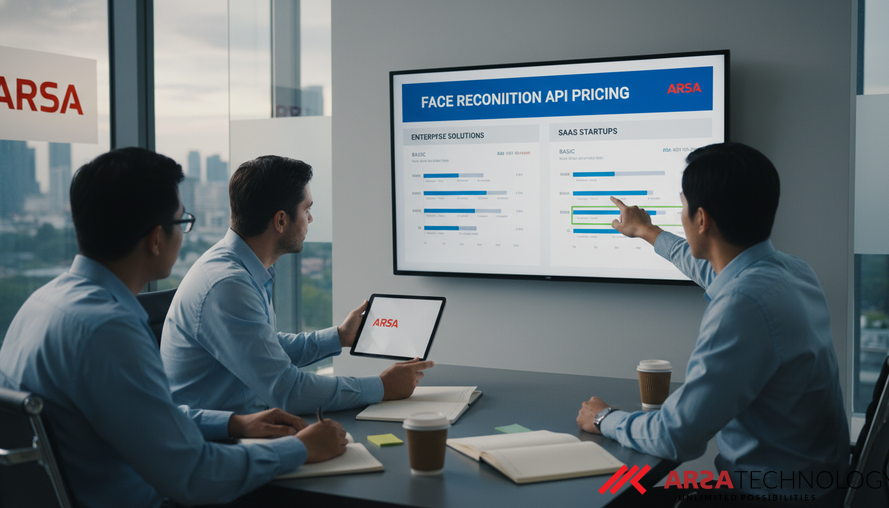
- Basic Free Tier: Start with 100 API calls/month and 100 Face IDs, with no credit card required for a 30-day trial. This is perfect for initial testing and proof-of-concept.
- Pro Startup Tier: For just $29/month, get 5,000 API calls and 5,000 Face IDs.
- Ultra Scale-up Tier: At $149/month, expand to 50,000 API calls and 50,000 Face IDs.
- Mega Enterprise Tier: For larger operations, $1,290/month provides 500,000 API calls and 500,000 Face IDs.
All features are included across every plan, ensuring you pay only for what you use. This clear face recognition API cost per call model, managed via PayPal monthly subscription billing, provides predictable expenses and allows startups to conserve capital. For a deeper dive into evaluating ROI, consider reading our article on Face Recognition API Pricing Comparison for SaaS Startups: What to Evaluate for ROI.
3. Comprehensive Features for Digital Banking
The ARSA Face Recognition & Liveness API offers a complete identity layer crucial for digital banking and other sensitive applications. Key functions include:
- 1:N face recognition against database: Identify users against a large database of enrolled faces for seamless access control or personalized experiences.
- 1:1 face verification: Confirm a user’s identity by comparing a live capture to an enrolled image, essential for login and transaction authentication.
- Face detection with bounding boxes: Accurately locate faces within images or video streams.
- Passive liveness detection: Verify a live person without user interaction, protecting against simple spoofing attempts.
- Active liveness with head movement challenges: Engage users in challenge-response verification to prevent sophisticated photo and video replay attacks, aligning with ISO 30107-3 standards.
- Age estimation, gender classification, and expression detection: Gain valuable demographic and emotional insights (neutral, happy, sad, surprise, anger).
- Face database management: Easily enroll, update, and remove identities, with support for multiple images per face ID for higher accuracy.
- Per-account isolated databases: Ensure robust data privacy and tenant separation, critical for multi-tenant SaaS platforms.
These robust capabilities ensure that your platform is equipped with enterprise-grade biometric security. You can explore a more detailed comparison in our article, Unlocking Value: A Face Recognition API Pricing Comparison for SaaS Startups in 2026.
4. Ensuring Compliance and Data Privacy
For digital banking, meeting regulatory obligations like KYC (Know Your Customer) and AML (Anti-Money Laundering) under frameworks such as PSD2, eIDAS, and FinCEN is non-negotiable. The ARSA Face Recognition & Liveness API is engineered to support these requirements, helping you prevent presentation attacks and synthetic identity fraud. With isolated per-account face databases, ARSA ensures data privacy and tenant separation, giving you peace of mind regarding sensitive user information and compliance with global data protection regulations like GDPR.
ARSA Face Recognition & Liveness API: Your Partner in Growth
ARSA Technology, with over 7 years of experience in AI and IoT solutions, understands the needs of growing enterprises. Our Face Recognition & Liveness overview demonstrates our commitment to practical, production-ready AI. The self-hosted ARSA platform at faceapi.arsa.technology provides a robust and reliable service. The developer dashboard with usage analytics gives you full visibility into your API consumption, making it easy to manage your face verification API pricing tiers. We support JPEG/PNG images and MP4/WebM video for active liveness, with cURL/Python/JavaScript code examples readily available to streamline your integration process.
For startups, the ability to rapidly integrate and scale without managing complex infrastructure is a game-changer. ARSA’s cloud API allows you to focus on your core product while leveraging world-class biometric security. If your needs extend beyond standard offerings, our ARSA Custom AI Solution team is ready to discuss bespoke requirements.
The On-Premise SDK Alternative (Briefly)
While this article focuses on the advantages of cloud APIs for SaaS startups, it’s important to acknowledge the role of on-premise SDKs. For organizations with extreme data sovereignty demands, such as national security agencies or highly specialized industrial operators, an on-premise SDK provides complete control over data within their private infrastructure. However, for most startups, the operational overhead and initial investment of an SDK outweigh the benefits compared to the agility and cost-efficiency of a cloud API. ARSA offers a full range of all ARSA products, including both cloud and on-premise solutions, to cater to diverse enterprise needs.
Frequently Asked Questions
What is the typical face recognition API cost per call for SaaS startups?
The cost per call for face recognition APIs for SaaS startups varies significantly by provider and volume. ARSA offers competitive face recognition API pricing tiers, starting with a free tier and scaling up to enterprise plans, where the effective cost per call decreases with higher usage, making it highly efficient for growing businesses.
How can I find the cheapest face recognition API 2026 for my startup?
To find the cheapest face recognition API 2026, evaluate providers based on their transparent pricing models, included features, and scalability. Look for free trials or basic tiers to test functionality without commitment. ARSA’s free tier allows you to start with 100 API calls and 100 Face IDs per month at no cost.
What should I look for in face verification API pricing tiers for early-stage startups?
Early-stage startups should prioritize flexible face verification API pricing tiers that offer a free or low-cost entry point, clear usage-based billing, and the ability to scale up seamlessly. Look for providers that include all core features across plans, so you don’t incur hidden costs as you grow. ARSA’s plans are designed with this flexibility in mind.
Does ARSA’s Face API support 1:N face recognition against a database?
Yes, the ARSA Face Recognition & Liveness API fully supports 1:N face recognition against database functionality. This allows your application to identify a person from a live capture against a large collection of enrolled faces, crucial for various identity management and access control use cases.
Conclusion
For SaaS startups aiming to integrate robust identity verification, a cloud-based face recognition API offers an unparalleled blend of speed, scalability, and cost-efficiency. By carefully considering the face recognition API pricing comparison for SaaS startups, CTOs can select a solution that not only meets their immediate technical requirements but also supports long-term growth and compliance. The ARSA Face Recognition & Liveness API provides a powerful, developer-friendly, and cost-effective solution to secure your applications and enhance user experience. Ready to transform your identity management? Create a free Face API account today or contact ARSA solutions team to discuss your specific needs.
Stop Guessing, Start Optimizing.
Discover how ARSA Technology drives profit through intelligent systems.