
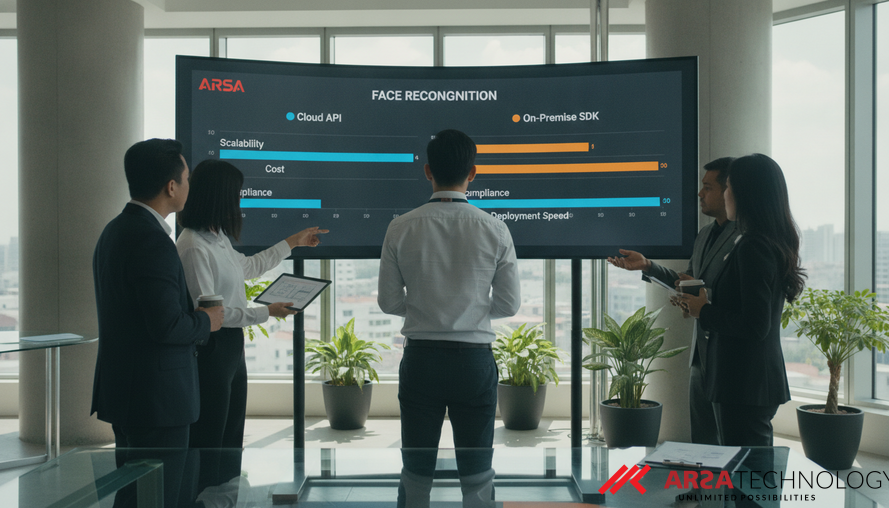

Face Recognition API vs On-Premise SDK: Which to Choose for SaaS in 2026?
For Chief Technology Officers (CTOs) building or scaling Software-as-a-Service (SaaS) platforms, the decision of whether to implement a face recognition API vs on premise SDK which to choose for SaaS is a critical architectural choice. This quickstart guide is designed to help you navigate the complexities of biometric integration, weighing the benefits of cloud-based solutions against self-hosted deployments, particularly within the HR-tech sector. As digital transformation accelerates, selecting the right foundation for secure identity verification and seamless user experiences can significantly impact your time-to-market, operational costs, and compliance posture.
ARSA Technology, with over seven years of experience delivering AI video analytics and face recognition solutions to governments and enterprises, understands these architectural dilemmas. We’ve seen firsthand how the right deployment model can unlock efficiency and security, while the wrong one can introduce unnecessary overhead and risk. This article will provide a clear face recognition deployment comparison, focusing on the practical implications for SaaS businesses.
Cloud Face API vs Self-Hosted SDK: Understanding the Core Differences
At its heart, the choice between a cloud face API and a self-hosted SDK boils down to control versus convenience.
A cloud face API (Application Programming Interface) offers face recognition capabilities as a service, hosted and managed by a third-party provider like ARSA Technology. Your SaaS application integrates with this service via a simple REST API, sending data for processing and receiving results. This model eliminates the need for you to manage underlying infrastructure, handle software updates, or scale hardware. It’s a pay-as-you-go approach, ideal for rapid development and flexible scaling.
Conversely, an on-premise SDK (Software Development Kit) provides the face recognition software and libraries for you to deploy and manage entirely within your own data centers or private cloud infrastructure. This gives you absolute control over data, security, and operational environments, making it suitable for highly regulated industries or air-gapped systems. However, it also means your team is responsible for all aspects of deployment, maintenance, and scaling.
For SaaS companies, especially those in the HR-tech space, the implications of this choice are profound, touching on everything from development cycles to long-term operational expenses.
When to Use Face Recognition API Instead of SDK for SaaS
For most SaaS providers, particularly those focused on HR-tech, a cloud-based face recognition API often presents a more compelling value proposition. Here’s when to use face recognition API instead of SDK:
1. Rapid Time-to-Market and Development Velocity:
Integrating a cloud API is typically much faster than deploying and configuring an SDK. With ARSA’s Face Recognition & Liveness API, for example, developers can make their first API call in under 5 minutes. This speed allows HR-tech platforms to launch new features like secure employee login, identity verification for onboarding, or time and attendance solutions in days, not months. The API handles complex backend processes such as 1:N face recognition against a database, 1:1 face verification, and passive and active liveness detection, abstracting away the underlying AI complexities. For a deeper dive into API integration, consider reading our guide on How to Integrate a Face Recognition API in Node.js and Express.
2. Scalability and Elasticity:
SaaS platforms thrive on scalability. A cloud API is inherently designed for elastic scaling, effortlessly handling fluctuating user loads without requiring your team to provision new hardware or manage infrastructure. As your HR-tech platform grows from hundreds to hundreds of thousands of users, the API provider manages the scaling, ensuring consistent performance. This is a significant advantage over an on-premise SDK, where scaling requires substantial upfront investment and ongoing IT resources. Our article on Scaling Face Recognition API Rate Limits provides further insights into managing high-traffic scenarios.
3. Reduced Operational Overhead and Cost Efficiency:
With a cloud API, you offload the burden of server maintenance, security patching, and infrastructure management to the provider. This translates to lower operational costs, as you don’t need dedicated IT staff for biometric system upkeep. The ARSA Face Recognition & Liveness API operates on a transparent, usage-based pricing model, allowing you to pay only for what you use. Plans range from a Basic free tier (100 calls/month, 100 Face IDs) to Mega ($1,290/mo for 500,000 calls, 500,000 Face IDs), with all features included across every plan. This predictable, subscription-based expense model is often more favorable for SaaS businesses than the significant capital expenditure and ongoing operational costs associated with an on-premise SDK. According to NGTECO’s 2026 analysis, cloud attendance systems offer superior payroll accuracy and compliance with lower upfront costs compared to on-premise solutions, a principle that extends to broader HR-tech biometric deployments. Source: NGTECO.
4. Enhanced Security and Compliance (with caveats):
Reputable cloud API providers invest heavily in security infrastructure and expertise, often exceeding what individual SaaS companies can maintain. ARSA’s Face Recognition & Liveness API, for instance, is a self-hosted platform at faceapi.arsa.technology, offering isolated per-account face databases for robust data privacy and tenant separation. This architecture helps SaaS providers meet stringent data protection obligations under regulations like GDPR, CCPA, and the EU AI Act, which classify biometric systems as high-risk. While the API helps you meet these obligations, it’s crucial to understand that no cloud provider can “certify” your entire application. You remain responsible for your application’s overall compliance.
It’s vital to distinguish between presentation-attack detection (PAD), which is covered by standards like ISO/IEC 30107-3 and iBeta Level 1/Level 2 testing, and more sophisticated injection attacks or deepfakes that bypass the camera. While ARSA’s API includes robust active and passive liveness detection with head movement challenges to prevent presentation attacks, a comprehensive security strategy for 2026 must acknowledge that liveness alone is no longer sufficient against all forms of synthetic identity fraud.
The Case for On-Premise SDK: When Control is Paramount
While the cloud API offers significant advantages for most SaaS applications, there are specific scenarios where an on-premise SDK becomes the preferred choice. This is often the case for organizations with extreme data sovereignty requirements, such as government agencies, defense contractors, or critical infrastructure operators.
1. Absolute Data Sovereignty and Air-Gapped Environments:
For highly sensitive HR data, such as biometric records of government employees or defense personnel, the requirement for data to never leave a specific geographical boundary or even an air-gapped network is non-negotiable. ARSA offers a Face Recognition & Liveness SDK specifically for these scenarios, enabling self-hosted deployment with zero external network dependency. This ensures that all biometric templates and processing remain entirely within the customer’s controlled infrastructure.
2. Deep Customization and Integration with Legacy Systems:
An SDK provides granular control over the biometric system, allowing for deep customization and integration with complex legacy systems that might not be compatible with standard API calls. While ARSA’s API offers extensive features like age estimation, gender classification, and expression detection (neutral, happy, sad, surprise, anger), an SDK allows for bespoke modifications at the core level.
3. Predictable Costs for Extremely High-Volume, Stable Deployments:
In rare cases of extremely high-volume, stable deployments where the cost of per-call API usage might eventually exceed the capital expenditure and maintenance of an on-premise system, an SDK could offer long-term cost predictability. However, this calculation must factor in the significant ongoing costs of hardware, software licenses, IT staffing, security audits, and disaster recovery. Ottica AI highlights that while cloud processing often means lower upfront spend, on-premise means investing in a local server with predictable ongoing costs, which for a busy venue can be more favorable over the life of a deployment. Source: Ottica AI.
For a more detailed comparison of these deployment models, particularly for enterprise use cases, you can refer to our article on Self-hosted Face Recognition SDK vs Cloud API for Enterprise.
ARSA Face Recognition & Liveness API: The SaaS Advantage
For HR-tech SaaS providers looking for an efficient, scalable, and secure API vs SDK biometric integration, the ARSA Face Recognition & Liveness API stands out. It’s engineered to empower your platform with robust identity capabilities without the infrastructure burden.
Key advantages for SaaS include:
- Comprehensive Feature Set: Beyond basic face detection with bounding boxes, the API offers 1:N identification, 1:1 verification, active and passive liveness detection, age estimation, gender classification, and expression detection. It also supports multiple images per face ID for higher accuracy.
- Developer-Friendly: With simple `x-key-secret` API key authentication, extensive Face Recognition API documentation, and cURL/Python/JavaScript code examples, integration is streamlined.
- Flexible Pricing: Start with a free trial (100 calls/mo, 100 face IDs, no credit card required) by creating a free Face API account. Scale up with Pro, Ultra, or Mega plans, all billed monthly via PayPal. Check out the full Face API pricing plans.
- Robust Performance: Designed for 99.9% uptime, the API supports JPEG/PNG image formats and MP4/WebM video for active liveness challenges, ensuring reliable service for your users.
- Business Outcomes: The API helps HR-tech platforms meet KYC and AML obligations under frameworks like PSD2, eIDAS, FinCEN, and RBI V-CIP, enabling secure digital onboarding and preventing presentation attacks and synthetic identity fraud. With ARSA, you can launch face login in days, not months, and focus on your core product while we manage the biometric infrastructure.
Frequently Asked Questions
What are the main considerations for face recognition deployment comparison in SaaS?
The primary considerations for face recognition deployment comparison in SaaS involve balancing development speed, scalability, operational costs, and data control. Cloud APIs typically offer faster integration, elastic scalability, and lower infrastructure overhead, while on-premise SDKs provide maximum data sovereignty and customization for highly regulated or air-gapped environments.
How does a cloud face API help with compliance in HR-tech?
A cloud face API, such as ARSA’s, can significantly help HR-tech platforms meet compliance obligations by providing robust identity verification and liveness detection capabilities. The API’s isolated per-account face database and secure infrastructure support data privacy requirements under regulations like GDPR and the EU AI Act, helping prevent fraud and ensuring secure onboarding processes.
When is a self-hosted SDK a better choice than a cloud face API for biometric integration?
A self-hosted SDK is generally a better choice for biometric integration when an organization requires absolute data sovereignty, operates in air-gapped environments, or needs deep, low-level customization that a standard API cannot provide. This is often the case for government, defense, or critical infrastructure sectors where data must never leave the internal network.
What are the cost implications of choosing a cloud face API vs self hosted SDK?
Choosing a cloud face API vs self hosted SDK has distinct cost implications. Cloud APIs typically involve lower upfront costs and a predictable, usage-based subscription model, reducing capital expenditure and IT management overhead. On-premise SDKs require significant upfront investment in hardware, software licenses, and ongoing IT resources for maintenance, security, and scaling, though they may offer predictable costs for extremely high-volume, stable deployments over the very long term.
Conclusion
The decision between a face recognition API vs on premise SDK which to choose for SaaS is a strategic one that shapes the future of your HR-tech platform. For most SaaS companies, the ARSA Face Recognition & Liveness API offers an unparalleled combination of rapid deployment, scalable performance, cost efficiency, and robust security features. It empowers you to integrate advanced biometric capabilities, from 1:1 verification to sophisticated liveness detection, allowing your team to focus on innovation rather than infrastructure management.
By leveraging a cloud-based solution, you can accelerate your product roadmap, ensure compliance with evolving regulations, and deliver a seamless, secure experience for your users. Ready to transform your HR-tech platform with intelligent identity solutions? Contact ARSA Technology today to discuss your specific needs or create a free Face API account to get started in minutes. Explore all ARSA products and our Face Recognition API blog for more insights.
Stop Guessing, Start Optimizing.
Discover how ARSA Technology drives profit through intelligent systems.