

How to Reduce Workplace Injuries with Predictive Safety Analytics in Manufacturing
For plant safety managers, the goal is clear: a zero-incident workplace. Achieving this, however, often feels like an uphill battle against reactive measures. The conventional approach typically involves responding to incidents after they occur, analyzing what went wrong, and then implementing changes. But what if you could anticipate risks before they materialize? This article will explore how to reduce workplace injuries with predictive safety analytics, transforming your safety strategy from reactive to proactive, especially within dynamic manufacturing environments.
Workplace safety in manufacturing is undergoing a significant transformation, moving beyond traditional incident reporting to leverage advanced AI and data. By 2026, organizations are increasingly adopting technologies that enable a shift from merely reacting to incidents to actively predicting and preventing them. This paradigm shift is critical, as even a single serious lost-time injury can incur substantial direct and indirect costs, making proactive prevention a clear driver of ROI.
Leading Indicators Versus Lagging Indicators in Safety
Understanding the difference between leading and lagging indicators is fundamental to predictive safety. Lagging indicators, such as injury rates, lost-time incidents (LTIs), and workers’ compensation claims, tell you what has already happened. While essential for historical analysis and compliance reporting, they offer little opportunity for intervention before harm occurs.
In contrast, leading indicators are proactive, forward-looking metrics that reveal conditions or behaviors that could predict future incidents. Examples include near-miss reports, safety observation counts, completion rates of safety training, audit findings, and even environmental factors. By focusing on these indicators, organizations gain the ability to intervene and mitigate risks before they escalate into serious incidents. The EHSLeaders.org highlights that a new era of workplace safety is emerging, driven by technologies that shift safety management from mainly reactive to more predictive and even prescriptive, with AI at the heart of this transformation.
Using Historical Safety Data to Predict Incidents
The power of predictive safety analytics lies in its ability to analyze vast amounts of historical safety data to uncover patterns that precede incidents. This involves feeding machine learning models with years of incident records, near-miss reports, audit results, and other operational data. These models learn to identify specific combinations of hazardous conditions, behaviors, and environmental factors that historically led to accidents.
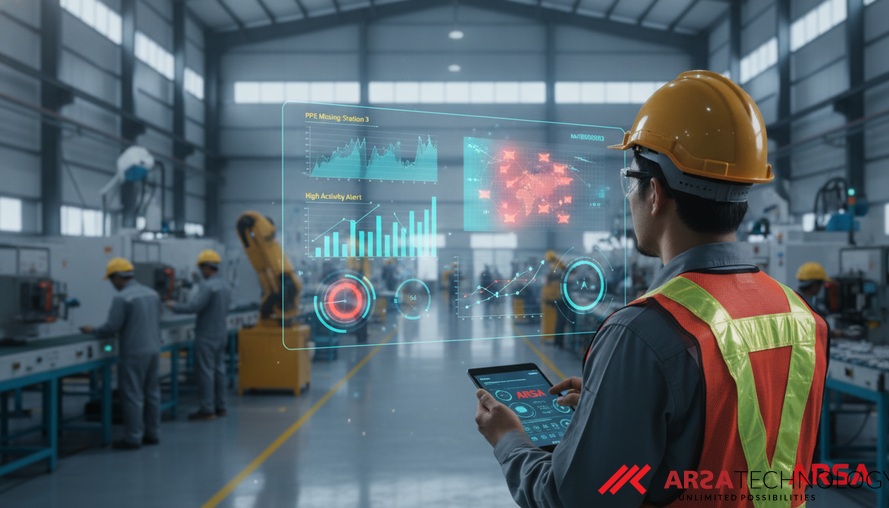
For example, ARSA Technology’s AI Video Analytics Software overview, specifically the ARSA Basic Safety Guard (Software), can be deployed on your existing servers to continuously monitor video streams from CCTV cameras. This self-hosted solution, with no cloud dependency, captures real-time data on critical leading indicators such as PPE compliance and restricted area intrusions. The software processes video streams at the edge, ensuring low latency and full data ownership, which is crucial for privacy-sensitive environments and compliance requirements like ISO 45001.
The SmartQHSE.com blog notes that meaningful predictive models typically require 2–3 years of consistent, high-quality safety data. By leveraging this historical context, and continuously feeding new data, AI systems can issue early warnings when similar high-risk patterns begin to emerge in current operations, allowing for timely interventions.
Root Cause Analysis for Workplace Risk Assessment with AI
Traditional root cause analysis often begins after an incident, aiming to understand “why it happened.” While vital, AI-powered predictive analytics can elevate this process by enabling a more proactive and data-driven root cause analysis for workplace risk assessment. By identifying patterns in leading indicators, AI can pinpoint potential systemic issues before they result in an injury.
For instance, if the ARSA Basic Safety Guard consistently detects a decline in hard hat usage in a specific zone or an increase in unauthorized entries into a restricted area, these are not just isolated events. They are symptoms that, when analyzed by AI, can point to underlying issues like inadequate training, poor signage, or insufficient supervision in that area. The system provides real-time alerts and event logs, allowing safety managers to investigate and address these root causes proactively.
ARSA’s PPE Detection Explained for Manufacturing outlines how AI video analytics can automatically identify when workers are not wearing required personal protective equipment, turning existing CCTV infrastructure into smart safety monitoring systems. This capability is a powerful leading indicator, enabling immediate corrective action and informing deeper root cause investigations.
A Case Study Reducing Injuries with Proactive Safety Insights
Consider a large manufacturing facility that historically struggled with a high rate of minor cuts and scrapes in its assembly line area. Traditional methods involved reviewing incident reports and conducting periodic safety audits. However, these reactive measures only addressed problems after they occurred.
By implementing ARSA Basic Safety Guard (Software), the facility began leveraging AI video analytics to monitor key areas for PPE compliance (e.g., safety gloves) and adherence to safe operating procedures. The on-premise solution, deployed on existing servers, connected to their existing CCTV system. The system’s PPE detection capabilities immediately flagged instances of workers operating machinery without gloves. Simultaneously, restricted area monitoring identified unauthorized personnel in hazardous zones.
The AI system generated safety violation alerts in real-time, allowing supervisors to intervene instantly. Over time, the collected event logging data, combined with historical incident records, was used to identify specific shifts and workstations with higher rates of non-compliance. This proactive insight allowed the safety team to implement targeted retraining programs, adjust workstation layouts, and increase supervision in high-risk areas.
The result? Within 18 months, the facility saw a significant reduction in minor cuts and scrapes, demonstrating a tangible improvement in safety outcomes. This aligns with external findings, where published case studies report 20–40% reductions in recordable incident rates within 2–3 years of implementing predictive analytics programs, as noted by SmartQHSE.com. This Reduce Workplace Injury Rates in Mining with On-Premise AI Safety Analytics article further illustrates how ARSA’s solutions drive similar success in other demanding industries.
ARSA Basic Safety Guard: Your Partner in Predictive Safety
ARSA Technology’s ARSA Basic Safety Guard (Software) is engineered to empower plant safety managers with the tools needed to implement effective predictive safety analytics. As a fully self-hosted, on-premise software platform, it offers:
- No Cloud Dependency: All video streams, inference results, and metadata remain entirely within your infrastructure, ensuring full data ownership and compliance readiness.
- Hardware-Agnostic Deployment: Deploy on your existing servers, private data centers, or edge compute infrastructure, eliminating the need for dedicated AI appliances. It supports both NVIDIA Jetson and x86 inference.
- Real-Time Operational Intelligence: Transform raw CCTV video streams into actionable insights, including real-time alerts for PPE violations, restricted area breaches, and other safety concerns.
- Scalable by Design: Easily scale analytics capacity by allocating compute resources, adapting to the evolving needs of your manufacturing operations.
- Integration Ready: Integrate seamlessly with existing dashboards, alerting systems, and data pipelines using a robust REST API, allowing for centralized safety monitoring across global sites.
- Audit-Ready Compliance Reports: Generate comprehensive reports based on collected safety data, simplifying compliance audits and demonstrating a commitment to proactive safety.
This on-premise deployment model is particularly beneficial for organizations with strict data residency requirements or those operating in air-gapped environments, ensuring zero data exposure. While ARSA also offers solutions like the ARSA Face Recognition & Liveness SDK for identity verification in regulated environments, the Basic Safety Guard focuses specifically on video analytics for operational safety.
Frequently Asked Questions
What are the key benefits of using predictive safety analytics to reduce workplace injuries?
Predictive safety analytics shifts the focus from reactive incident response to proactive prevention. By analyzing leading indicators and historical data, it helps identify potential hazards before they cause harm, leading to reduced injury rates, improved compliance, and significant cost savings through avoided incidents.
How does ARSA Basic Safety Guard (Software) help with proactive safety in manufacturing?
ARSA Basic Safety Guard (Software) uses AI video analytics to monitor existing CCTV streams for critical safety indicators like PPE detection and restricted area monitoring. It provides real-time alerts, event logging, and compliance reports, all processed on-premise, enabling plant safety managers to intervene proactively and address root causes.
What kind of data is needed to implement predictive safety analytics effectively?
Effective predictive safety analytics relies on consistent, high-quality historical data, including incident records, near-miss reports, safety audit findings, safety observations, and operational data. A minimum of 2-3 years of such data is typically recommended to train robust machine learning models.
Is data privacy a concern with AI-powered safety monitoring?
ARSA Technology prioritizes data privacy with its on-premise solutions. The ARSA Basic Safety Guard processes all video streams and inference results locally within your infrastructure, ensuring full data ownership and no cloud dependency. This design helps organizations meet stringent privacy regulations and maintain control over sensitive operational data.
Conclusion
The journey to a safer manufacturing environment is evolving, and predictive safety analytics offers a powerful pathway forward. By embracing technologies that enable you to anticipate, rather than just react, you can significantly reduce workplace injuries with predictive safety analytics. Solutions like ARSA Basic Safety Guard (Software) provide the robust, on-premise AI video analytics capabilities needed to transform your existing CCTV infrastructure into an intelligent, proactive safety system.
Ready to transform your manufacturing safety program? Contact ARSA solutions team today to learn how our all ARSA products can be tailored to your specific operational needs and help you achieve your injury reduction goals.
Stop Guessing, Start Optimizing.
Discover how ARSA Technology drives profit through intelligent systems.