
How to Turn Existing CCTV into Smart Safety Monitoring for Construction Sites
Construction sites are dynamic environments, inherently prone to risks. Ensuring worker safety and maintaining compliance with stringent regulations like OSHA, EU-OSHA, and ISO 45001 is paramount, yet often a resource-intensive challenge. Many facility managers grapple with outdated security infrastructure, wondering how to turn existing CCTV into smart safety monitoring without a complete overhaul. The good news is that transforming your current surveillance system into a proactive, intelligent safety network is not only possible but also a cost-effective strategy to mitigate risks, enhance operational efficiency, and significantly reduce workplace injury rates.
Traditional CCTV systems, while effective for recording incidents, are largely reactive. They provide footage for forensic review after an event has occurred. The real value, however, lies in preventing incidents before they happen. This is where AI-powered video analytics steps in, allowing you to add AI analytics to existing security cameras and elevate your safety protocols from reactive to predictive.
The Challenge: Bridging the Gap Between Surveillance and Proactive Safety
For years, construction companies have invested heavily in CCTV infrastructure. These cameras capture vast amounts of data, but without intelligent processing, this data remains largely untapped for real-time safety insights. Manual monitoring is inefficient, prone to human error, and simply cannot keep pace with the complexities of a large construction site. Key pain points include:
- High Cost of Manual Monitoring: Employing dedicated personnel to constantly watch multiple camera feeds is expensive and often ineffective.
- Delayed Incident Response: Without real-time alerts, safety breaches or accidents are often discovered too late, leading to more severe consequences.
- Inconsistent Compliance: Manual checks for PPE compliance or restricted area intrusions can be inconsistent, leaving gaps in safety enforcement.
- Burden of Reporting: Generating detailed safety compliance reports for regulatory bodies is a time-consuming administrative task.
- High Workers’ Compensation Premiums: A history of workplace injuries directly impacts insurance costs.
These challenges highlight the urgent need for a solution that can automate safety monitoring, provide real-time alerts, and streamline compliance reporting, all while leveraging existing investments.
The Solution: Retrofit CCTV with PPE Detection and AI Analytics
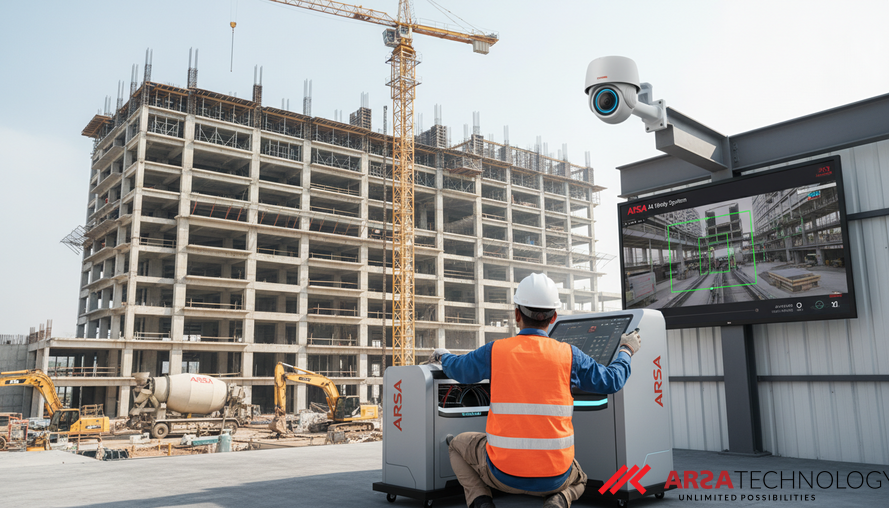
ARSA Technology offers a powerful and practical solution to retrofit CCTV with PPE detection and advanced AI analytics: the ARSA Basic Safety Guard (AI Box). This innovative edge computing device transforms your standard CCTV cameras into an intelligent safety system, delivering real-time insights directly at the source. It’s designed for rapid deployment and minimal disruption, making it an ideal upgrade path for facility managers in the construction sector.
How ARSA Basic Safety Guard Works
The ARSA Basic Safety Guard is part of the AI Box Series, a line of pre-configured edge AI systems. It operates on the principle of edge processing, meaning all AI analysis happens directly on the device, close to your cameras. This eliminates the need for constant cloud connectivity, ensuring low latency, enhanced data privacy, and reduced bandwidth consumption.
The setup is remarkably simple: a 5-minute plug-and-play installation. You connect the AI Box to power, your network, and your existing ONVIF and RTSP compatible CCTV cameras. Once configured, the device immediately begins processing video streams, turning passive footage into active intelligence.
Core Functions and Capabilities:
- PPE Detection: The system automatically detects if workers are wearing required Personal Protective Equipment, such as hard hat detection and safety vest detection. This ensures adherence to safety protocols across the site.
- Restricted Area Monitoring: Define virtual boundaries on camera feeds. The AI Box will issue intrusion alerts if unauthorized personnel enter these zones, critical for securing hazardous areas or sensitive equipment.
- Real-Time Alerts: Receive instant notifications via dashboards or integrated alert systems when a safety violation or intrusion is detected, enabling immediate response.
- Safety Compliance Reporting: The system automatically logs all detected events, providing comprehensive data for safety compliance reporting and audits, simplifying adherence to ISO 45001 standards.
- No Cloud Dependency: All AI processing occurs on-device, ensuring data sovereignty and operational reliability even in environments with limited or no internet connectivity.
- Scalable Hardware: Available in two configurations: a Mini PC model capable of processing up to 3 cameras, perfect for distributed deployments, and a Server model for centralized monitoring, handling up to 30 cameras simultaneously.
By deploying the ARSA Basic Safety Guard, you effectively convert IP cameras to an AI safety system, leveraging your existing hardware investment while gaining advanced capabilities. This approach is not just about detection; it’s about creating a safer, more compliant, and ultimately more productive work environment.
Tangible Business Outcomes and ROI
The implementation of ARSA Basic Safety Guard translates directly into significant business advantages for construction companies:
- Reduce Workplace Injury Rates: Proactive monitoring and real-time alerts help prevent accidents, leading to a safer environment for workers.
- Automate OSHA / EU-OSHA / ISO 45001 Reporting: The system generates detailed event logs and compliance reports, drastically reducing the manual effort and potential for error in regulatory documentation.
- Lower Workers’ Compensation Insurance Premiums: A demonstrable reduction in incidents and a robust safety program can lead to favorable insurance rates.
- Eliminate Manual Safety Inspections: While human oversight remains valuable, the AI Box automates routine checks, freeing up safety officers to focus on more complex issues and training.
- Enhanced Operational Efficiency: By minimizing downtime due to accidents and streamlining compliance, projects can stay on schedule and within budget.
For a deeper dive into how AI can enhance safety monitoring, you might find our article on What Is PPE Detection? How AI Video Analytics Software Delivers Smart Safety Monitoring particularly insightful. Additionally, understanding the broader business implications of such upgrades is crucial, as explored in Understanding How to Turn Existing CCTV into Smart Safety Monitoring: A Business Leader’s Guide. Even though the context might vary, the principles of PPE detection for industrial safety are universally applicable across demanding environments.
Beyond Safety: The Versatility of ARSA AI Box
While the Basic Safety Guard focuses on critical construction safety, the underlying AI Box Series is a versatile platform. For instance, ARSA also offers solutions like the ARSA DOOH Audience Meter (Software), demonstrating the breadth of AI video analytics applications beyond traditional security. This highlights ARSA Technology’s expertise in delivering practical AI solutions across various industries.
Frequently Asked Questions (FAQ)
Q: How can I upgrade CCTV with AI safety detection without replacing my cameras?
A: ARSA’s AI Box Series, specifically the Basic Safety Guard, is designed to integrate seamlessly with your existing ONVIF and RTSP compatible CCTV cameras. It acts as an edge processing unit, adding AI capabilities without requiring new camera hardware.
Q: What are the main benefits of using AI to retrofit CCTV with PPE detection on a construction site?
A: Key benefits include real-time alerts for PPE non-compliance and restricted area intrusions, automated compliance reporting for standards like ISO 45001, reduced workplace injury rates, and potential savings on workers’ compensation insurance premiums.
Q: Does ARSA’s smart safety monitoring system require a constant internet connection or cloud storage?
A: No, the ARSA Basic Safety Guard operates on an edge computing model. All AI processing and data analysis occur locally on the device, ensuring no cloud dependency for core operations. Cloud connectivity is optional for centralized dashboards if desired, but not required for functionality.
Q: Can ARSA’s AI Box monitor multiple cameras simultaneously for safety?
A: Yes, the ARSA AI Box Series offers flexible hardware configurations. The Mini PC model can process up to 3 camera streams, while the Server model (high-density) is capable of analyzing up to 30 camera streams simultaneously in real-time, making it scalable for various site sizes.
Conclusion
Transforming your existing CCTV infrastructure into a smart, proactive safety monitoring system is no longer a futuristic concept but an immediate, achievable reality. For facility managers seeking to enhance safety, ensure compliance, and drive operational efficiency on construction sites, understanding how to turn existing CCTV into smart safety monitoring is a critical step. ARSA Technology’s Basic Safety Guard (AI Box) offers a robust, edge-powered solution that delivers real-time intelligence, automates critical safety tasks, and provides a clear return on investment through reduced risks and streamlined operations. Don’t let your existing cameras be passive recorders; empower them to be active guardians of your workplace safety. To explore how ARSA solutions can be tailored to your specific needs, we invite you to contact ARSA solutions team today or explore all ARSA products.
Stop Guessing, Start Optimizing.
Discover how ARSA Technology drives profit through intelligent systems.