
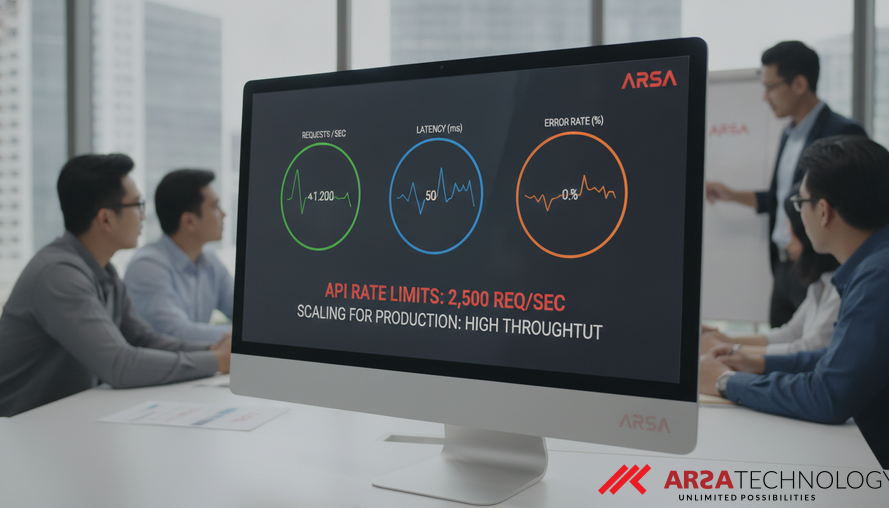

Mastering Face Recognition API Rate Limits and Scaling for Production Apps
In the rapidly evolving landscape of digital identity, deploying a robust face recognition solution is paramount. However, for senior engineers planning capacity, a critical consideration often overlooked until it becomes a bottleneck is effectively managing face recognition API rate limits and scaling for production apps. High-traffic applications, especially in sectors like digital banking, e-KYC, and secure access, demand an API that can not only deliver accurate biometric verification but also handle immense transaction volumes without compromising performance or user experience. ARSA Technology’s Face Recognition & Liveness API is engineered precisely for these enterprise-grade demands, offering a cloud-based SaaS solution designed for scalability and reliability.
Understanding Face API Rate Limit Tiers and Throughput
Effective API management begins with a clear understanding of the provider’s rate limit structure. Many face recognition APIs, like other cloud services, implement tiered rate limits to ensure fair usage and system stability. For instance, some providers might offer a free tier with a modest 20 transactions per minute (TPM), while standard and enterprise tiers could scale to 10 transactions per second (TPS) with regional caps of 200 TPS, as seen with other major cloud platforms. Exceeding these limits typically results in a `429` “Too Many Requests” error, which can severely impact a production application’s functionality and user trust.
ARSA’s Face Recognition & Liveness API is built with production-grade scaling in mind. Our pricing model directly reflects anticipated usage, offering clear Face API pricing plans that directly correlate to API call volumes and face ID storage. From a free tier designed for initial exploration to enterprise-level plans, our infrastructure is designed to support significant face API throughput for enterprise applications.
Core Capabilities for High-Volume Digital Identity
The ARSA Face Recognition & Liveness API provides a comprehensive identity layer, not just a simple comparison endpoint. This suite of capabilities is crucial for applications that need to scale face recognition API for high traffic:
- Face Database Management: Securely enroll, update, and remove identities within isolated, per-account face databases, ensuring data privacy and tenant separation. This is vital for compliance with regulations like GDPR and FinCEN.
- Face Search & Identification (1:N): Identify a person against a large face database with ranked matches and confidence scores, ideal for access control and monitoring.
- Face Matching Verification (1:1): Confirm identity for logins and step-up authentication with configurable similarity thresholds.
- Active + Passive Liveness Detection: Crucial for preventing presentation attacks (PAD) using photos or video replays. Our API incorporates both passive liveness and active liveness with head movement challenges, adding a robust layer of anti-spoofing. It’s important to note that while liveness detection is essential for presentation attack detection (covered by standards like ISO/IEC 30107-3), it does not inherently protect against injection attacks or deepfakes that bypass the camera feed entirely. For comprehensive security in 2026, a multi-layered approach is increasingly necessary.
- Age Estimation, Gender Classification, and Expression Detection: Beyond core identification, the API offers analytics for age, gender, and expressions (neutral, happy, sad, surprise, anger), providing valuable insights for various applications, from smart retail to demographic analysis.
These features, combined with support for multiple images per face ID for higher accuracy, ensure that even under heavy load, the API delivers reliable and precise results.
Optimizing Face Recognition API Production Limits
For senior engineers, optimizing face recognition API production limits involves more than just selecting a higher-tier plan. It requires strategic integration and monitoring. ARSA’s cloud SaaS deployment model means you benefit from a managed infrastructure, eliminating the need to manage servers or underlying compute resources. This allows your team to focus on application development rather than infrastructure scaling.
Our API supports standard JPEG/PNG image formats and MP4/WebM video for active liveness, ensuring broad compatibility. With simple `x-key-secret` API key authentication, integration is streamlined, allowing developers to make their first API call in under 5 minutes. The developer dashboard provides usage analytics, offering transparency into your API consumption and helping you anticipate scaling needs.
When planning for high traffic, consider the following:
- Predictive Scaling: Monitor your usage patterns closely. ARSA’s dashboard provides the data needed to understand your peak loads and average consumption.
- Error Handling: Implement robust error handling for `429` responses using strategies like exponential backoff and retry mechanisms to gracefully manage temporary throttling.
- Batch Processing (where applicable): For non-real-time tasks, consider batching requests to optimize API calls and reduce the frequency of hitting rate limits.
- Tier Selection: Choose an ARSA Face API pricing plan that aligns with your projected face API rate limit tiers and anticipated growth. Our tiers, from Pro ($29/mo for 5,000 calls) to Mega ($1,290/mo for 500,000 calls), offer flexibility to match your application’s demands. For specific enterprise requirements beyond the Mega tier, our solutions team can discuss custom arrangements.
For further insights into handling API rate limits gracefully, a 2026 guide on API rate limiting strategies highlights the importance of proactive measures and provider-specific approaches, emphasizing that understanding your provider’s policies is key to avoiding production issues (APIScout). Similarly, a comparison of AI API rate limits in 2026 across major providers underscores that a low RPM (requests per minute) or TPM (tokens per minute) ceiling can quickly lead to `429` errors in production, even if the price seems attractive (devtk.ai). This reinforces the need for transparent and scalable API offerings like ARSA’s.
Business Impact: Launching and Complying at Scale
The business impact of a well-scaled face recognition API is significant. For digital identity platforms, it means the ability to launch face login in days, not months, and to meet stringent KYC (Know Your Customer) and AML (Anti-Money Laundering) obligations under frameworks like PSD2, eIDAS, FinCEN, and RBI V-CIP. ARSA’s API helps prevent presentation attacks, injection attacks, and synthetic identity fraud, bolstering the security posture of your applications.
With a 99.9% uptime target, ARSA Technology ensures that your critical identity workflows remain operational. The pay-as-you-use model, with monthly PayPal subscriptions, offers financial flexibility without large upfront investments. The per-account isolated face database further enhances data privacy, a crucial factor in today’s regulatory environment.
For those considering integrating face recognition into their applications, ARSA offers a Basic free 30-day trial, providing 100 calls per month and storage for 100 face IDs, with no credit card required to create a free Face API account. This allows senior engineers to thoroughly evaluate the API’s capabilities and ease of integration before committing to a paid plan. You can also explore our Face Recognition API documentation for cURL, Python, and JavaScript code examples.
For organizations requiring full data sovereignty and air-gapped deployments, ARSA also offers an on-premise Face Recognition & Liveness SDK, providing the same powerful AI capabilities within your own infrastructure. This demonstrates ARSA’s commitment to flexible deployment models, catering to diverse enterprise needs.
Frequently Asked Questions
What are the typical face recognition API rate limits and scaling considerations for enterprise applications?
Enterprise applications often require significantly higher transaction per second (TPS) rates than standard tiers. Providers typically offer tiered pricing with increasing rate limits, and for very high volumes, custom agreements or support requests for limit increases are common. Effective scaling involves understanding these limits, monitoring usage, and implementing robust error handling.
How do ARSA’s face API rate limit tiers support high-traffic production environments?
ARSA’s Face Recognition & Liveness API offers tiered pricing plans, from a free tier for evaluation to a Mega Enterprise Tier supporting up to 500,000 API calls per month and 500,000 Face IDs. These tiers are designed to accommodate varying levels of face API throughput for enterprise, with options for custom solutions for even higher demands.
What strategies can be employed to scale face recognition API for high traffic?
To scale face recognition API for high traffic, engineers should leverage their provider’s tiered plans, implement efficient error handling for `429` responses (e.g., exponential backoff), consider batch processing for non-real-time tasks, and continuously monitor API usage to anticipate and adjust capacity. ARSA’s cloud-based solution manages the underlying infrastructure scaling, allowing developers to focus on application logic.
How does ARSA’s API help prevent fraud and meet compliance obligations in digital identity?
ARSA’s API includes both active and passive liveness detection to prevent presentation attacks, which is crucial for meeting KYC and AML obligations under regulations like PSD2, eIDAS, FinCEN, and RBI V-CIP. While liveness detection addresses presentation attacks, a comprehensive security strategy for 2026 should also consider other fraud vectors like injection attacks and deepfakes.
Conclusion
Successfully integrating face recognition into production applications hinges on a deep understanding of face recognition API rate limits and scaling for production apps. ARSA Technology provides a robust, scalable, and secure Face Recognition & Liveness API designed to meet the rigorous demands of enterprise digital identity. By offering clear rate limit tiers, comprehensive features, and a focus on data privacy and compliance, ARSA empowers senior engineers to build high-performance, trustworthy identity solutions. Ready to transform your digital identity workflows? Contact ARSA solutions team today to discuss your specific requirements and explore how our API can drive measurable business impact.
Stop Guessing, Start Optimizing.
Discover how ARSA Technology drives profit through intelligent systems.