
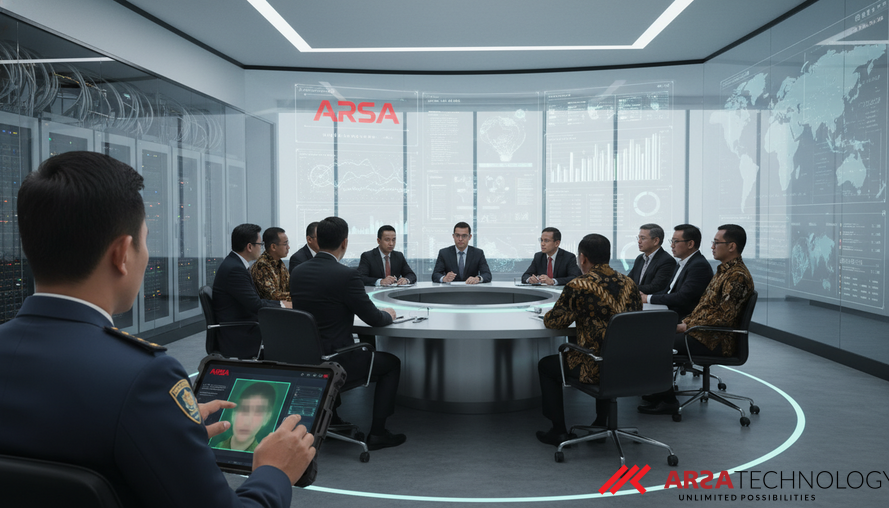

Maximizing Security and Compliance: The ROI of an On-Premise Face Recognition SDK for Government and Defense
In an era where digital threats are constantly evolving, government and defense sectors face unparalleled pressure to secure sensitive data and critical infrastructure. The deployment of robust identity management solutions is no longer optional but a strategic imperative. For organizations demanding the highest levels of data sovereignty, privacy, and operational control, an on-premise face recognition SDK for government and defense offers a compelling return on investment (ROI) by mitigating risks, ensuring compliance, and streamlining secure access.
Traditional cloud-based biometric systems, while convenient, often introduce unacceptable data exposure risks for sensitive government and defense applications. ARSA Technology understands these unique challenges, providing a self-hosted biometric identification system specifically engineered for environments where data must remain entirely within the organization’s control.
The Imperative for On-Premise Biometrics in Government and Defense
Government and defense agencies handle some of the most sensitive data globally, ranging from national security intelligence to citizen identities. The implications of a data breach or unauthorized access can be catastrophic, leading to national security compromises, erosion of public trust, and severe financial penalties. This makes the choice of a biometric solution’s deployment model critical.
- Data Sovereignty and Residency: Regulations like GDPR (General Data Protection Regulation) and national data residency laws mandate that certain data types must be stored and processed within specific geographical boundaries. An on-premise solution ensures full control over where biometric data resides, eliminating concerns about cross-border data transfers or foreign government access.
- Zero Data Exposure Risk: With an air-gapped face recognition for defense and government, biometric templates and sensitive identity information never leave the organization’s private network. This drastically reduces the attack surface and eliminates reliance on third-party cloud providers, whose security postures may not meet stringent government standards.
- Operational Reliability in Critical Environments: Defense and government operations often occur in environments with limited or no internet connectivity. A face recognition SDK with no cloud dependency guarantees continuous operation, even in air-gapped or remote locations, ensuring mission-critical functions are never interrupted.
ARSA Face Recognition & Liveness SDK: Engineered for Sovereign Control
The ARSA Face Recognition & Liveness SDK is explicitly designed to meet the rigorous demands of government and defense. Unlike typical cloud APIs, this enterprise-grade SDK is deployed entirely within your existing infrastructure, providing the same high-accuracy AI capabilities as ARSA’s cloud offering but with absolute control over data, security, and operations.
This self-hosted software platform empowers organizations with:
- Full Biometric Data Ownership: All face collections, identity data, and API call logs are stored and managed exclusively within your environment. You define retention and access policies, aligning perfectly with internal security and compliance reviews. This ensures a truly sovereign face ID system for government.
- Advanced Identity Management: The SDK supports both 1:1 face verification for secure authentication (e.g., login, access control) and 1:N face identification against internal databases for rapid identity checks or watchlist monitoring. This comprehensive approach to identity management is crucial for high-security applications.
- Robust Anti-Spoofing with Active Liveness Detection: To counter sophisticated fraud attempts, the SDK incorporates active liveness detection. This challenge-response based verification mechanism requires users to perform guided actions, effectively preventing spoofing attacks using photos, videos, or 3D masks, and meeting standards like ISO 30107-3.
- No External Network Dependency: Critical infrastructure cannot afford downtime due to external network issues. The ARSA SDK operates without any external network dependency, making it ideal for restricted or air-gapped environments. This ensures that your biometric system remains operational and secure, regardless of internet availability. For more insights on this, read our article on Securing Sensitive Data: Why an On-Premise Face Recognition SDK for Government and Defense is Essential.
Measurable ROI Through Enhanced Security and Operational Efficiency
Investing in an on-premise face recognition SDK for government and defense yields significant ROI through several key areas:
1. Risk Mitigation and Compliance Cost Reduction:
By ensuring full data ownership and an air-gapped deployment, organizations drastically reduce the risk of data breaches, which can cost millions in fines, legal fees, and reputational damage. Compliance with stringent regulations such as GDPR Article 9 (processing of special categories of personal data), CCPA, eIDAS, and FinCEN guidelines becomes inherently easier when data never leaves your control. This proactive approach avoids costly penalties and complex legal battles.
2. Streamlined Secure Access and Operations:
Automating identity verification with 1:1 face verification for personnel access to restricted areas or secure systems improves efficiency while maintaining high security. For large-scale operations, 1:N face identification can quickly identify individuals against a database, speeding up processes at checkpoints or during investigations. This reduces manual intervention, human error, and associated labor costs, while enhancing overall security posture.
3. Future-Proofing and Scalability:
The ARSA SDK is designed for scalability within your existing infrastructure. As your operational needs grow, you can expand capacity by allocating compute resources, not by overhauling your entire system or incurring unexpected cloud usage fees. The built-in web dashboard, API call logs, and internal sandbox facilitate easy management, monitoring, and testing, ensuring the system remains adaptable and maintainable over its lifecycle. This allows for long-term planning and predictable budgeting, crucial for government procurement cycles. Our article Securing National Interests: The Essential On-Premise Face Recognition SDK for Government and Defense further elaborates on this.
4. Enhanced Trust and Public Confidence:
For government entities, maintaining public trust is paramount. By demonstrating a commitment to data privacy and security through the use of a sovereign, on-premise biometric system, agencies can bolster confidence among citizens and stakeholders. This trust is an intangible yet invaluable asset, contributing to smoother operations and public acceptance of new technologies.
Beyond Banking: Applicability Across Critical Sectors
While the focus here is on government and defense, the principles of data sovereignty and robust security extend to other critical sectors. For instance, the financial industry, with regulations like PSD2, also benefits immensely from secure, on-premise biometric solutions for e-KYC and transaction authentication. The need for controlled, private data environments is universal across highly regulated industries.
Making the Right Choice for Your Organization
Choosing a biometric solution requires careful consideration of security, compliance, and operational realities. For government and defense, the choice is clear: an on-premise face recognition SDK with no cloud dependency provides the ultimate control and protection. It transforms your existing infrastructure into a powerful, secure identity management platform, delivering tangible ROI through risk reduction, operational efficiency, and unwavering compliance.
To explore how ARSA Technology can tailor a Face Recognition & Liveness overview solution for your specific needs, or to learn more about all ARSA products, including our ARSA DOOH Audience Meter (AI Box) which also prioritizes edge processing, consider reaching out. For a deeper dive into deployment models, you might find our article On-Premise Face Recognition SDK for Government and Defense: Edge vs. Cloud for Secure Biometrics particularly informative.
Ready to secure your critical operations with a truly sovereign identity solution? Contact ARSA solutions team today for a consultation.
FAQ
What defines a self-hosted biometric identification system?
A self-hosted biometric identification system is deployed entirely within an organization’s own servers or private cloud infrastructure, ensuring that all biometric data, processing, and control remain within their network, without reliance on external cloud services. This is crucial for maintaining data sovereignty and minimizing external dependencies.
Why is an air-gapped face recognition for defense considered essential?
An air-gapped face recognition system for defense is essential because it operates without any external network connection, physically isolating sensitive biometric data from potential cyber threats originating from the internet. This provides the highest level of security for classified information and critical infrastructure, preventing unauthorized data exfiltration.
How does a face recognition SDK with no cloud dependency impact data privacy?
A face recognition SDK with no cloud dependency significantly enhances data privacy by ensuring that all biometric data processing and storage occur locally. This eliminates the need to transmit sensitive personal data to third-party cloud servers, allowing organizations to maintain full control over data residency, access policies, and compliance with privacy regulations like GDPR and CCPA.
What are the key benefits of a sovereign face ID system for government?
A sovereign face ID system for government offers complete control over identity data, ensuring compliance with national data residency laws and preventing foreign access to sensitive information. It provides enhanced security against external threats, guarantees operational continuity in isolated environments, and builds public trust through transparent data governance.
Stop Guessing, Start Optimizing.
Discover how ARSA Technology drives profit through intelligent systems.