

Privacy-First People Counting Without Facial Recognition: What Developers Need to Know
In 2026, the landscape of retail analytics is fundamentally shifting. For Data Protection Officers (DPOs) and privacy-conscious operators in the grocery sector, the demand for privacy-first people counting without facial recognition has become paramount. As global data protection regulations like GDPR and the evolving EU AI Act impose stricter controls on biometric data, retailers must adopt solutions that deliver actionable insights while safeguarding customer anonymity. This article delves into the technical and operational aspects of achieving truly anonymous footfall analytics, focusing on methods that prioritize privacy from the ground up.
Traditional people counting methods often relied on camera systems that could capture identifiable information, creating significant privacy risks. However, modern AI-driven solutions have evolved, moving beyond mere headcount to provide rich behavioral insights without compromising individual privacy. The key lies in advanced anonymization techniques, processed at the edge, ensuring that no personally identifiable information (PII) ever leaves the local sensor.
The Imperative for Anonymous Footfall Analytics
The digital transformation in retail has brought unprecedented opportunities for optimizing store layouts, staffing, and customer flow. Yet, this advancement comes with increased scrutiny over data collection practices. Regulators worldwide are tightening controls, making it crucial for businesses to justify data collection, minimize personal data usage, and ensure secure processing. The EU AI Act, for instance, further regulates how AI systems process and assess individuals, pushing enterprises to adopt solutions that are inherently privacy-preserving.
For grocery chains, understanding customer movement, peak hours, and queue dynamics is vital for operational efficiency and profitability. However, achieving these insights must not come at the expense of customer trust or regulatory compliance. This is where anonymous footfall analytics GDPR compliant solutions become indispensable. They enable retailers to gather valuable data on traffic patterns, dwell times, and conversion rates without ever identifying a single individual.
Skeleton-Based People Counting: The Core of Privacy
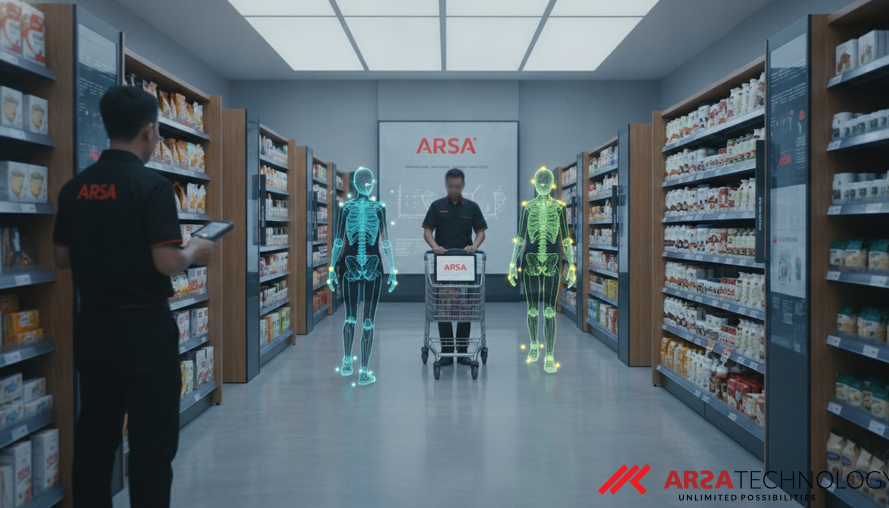
One of the most effective methods for achieving privacy-first people counting without facial recognition is through skeleton-based people counting retail analytics. Unlike systems that process and store facial images, skeleton-based approaches focus on detecting and tracking human figures by identifying key anatomical points – such as joints and limbs. This keypoint detection retail analytics privacy method creates a digital “skeleton” or stick figure representation of a person, completely abstracting away any unique facial features or other identifying characteristics.
The AI is trained to recognize the gait and skeletal structure of a human, allowing the system to distinguish between a shopper, a child, or even a shopping cart, while maintaining high accuracy. Crucially, with this approach, there is no face print stored, ensuring that the data collected cannot be reverse-engineered to identify an individual. This process typically happens directly on the device (at the “edge”), meaning raw video frames are processed and anonymized in milliseconds, often before they are even saved. This minimizes data exposure and significantly reduces the risk of privacy breaches.
ARSA Technology’s ARSA AI Video Analytics Software, specifically its Smart Retail Counter module, exemplifies this privacy-by-design philosophy. It provides robust people counting, queue monitoring, and heatmap analysis capabilities, all while operating on an on-premise deployment model. This ensures that all video streams, inference results, and metadata remain entirely within the client’s infrastructure, offering full data ownership and control.
Business Outcomes: Beyond Compliance to Competitive Advantage
Adopting privacy-first people counting without facial recognition isn’t just about avoiding penalties; it’s about unlocking new levels of retail intelligence and building a stronger brand. By focusing on aggregate patterns rather than individual journeys, retailers can gain profound insights into “Store Flow Harmonics” – understanding the collective movement and behavior of shoppers.
For grocery businesses, this translates into:
- Chain-wide retail intelligence: Centralized analytics dashboards provide a holistic view of performance across multiple locations, enabling informed decision-making.
- Optimized operations: Accurate data on footfall, queue lengths, and dwell times allows for dynamic staffing adjustments, efficient inventory management, and improved store layouts.
- Enhanced customer experience: By identifying bottlenecks and popular zones, retailers can create more intuitive and pleasant shopping environments.
- Seamless integration: Solutions with a robust REST API can integrate with existing POS and ERP systems, enriching business intelligence with real-time footfall data.
According to a 2026 report by PeopleCountingSoftware.com, modern people counting software has pivoted to ‘Privacy-by-Design’ using edge processing to discard PII instantly, with AI models maintaining 99% accuracy without ever seeing a real human face. This highlights the industry’s successful shift towards ethical data collection. Another source, Xpandretail.com, emphasizes that in 2026 and beyond, privacy compliance will not just be a legal checkbox; it will be a brand differentiator, leading to higher enterprise partnership trust and smoother expansion into regulated markets.
ARSA Technology, with its 7+ years of experience and partnerships with NVIDIA and Intel, offers proven solutions. The ARSA Smart Retail Counter (Software) is designed for organizations that prefer centralized AI processing and full ownership of infrastructure, making it an ideal choice for privacy-sensitive environments. You can explore more about its capabilities and business impact in our blog post: Inside ARSA Smart Retail Counter (Software): Capabilities, Endpoints, and Business Impact for Centralized People Counting Software for Multi-Store Retail Chains.
Deployment and Technical Highlights
The ARSA Smart Retail Counter (Software) is deployed on existing servers, private data centers, or edge compute, offering no hardware dependency and full data ownership. This on-premise AI approach is crucial for businesses operating under strict data residency and privacy requirements. The software’s capabilities include:
- People Counting: Accurate entry and exit counts.
- Queue Monitoring: Real-time analysis of queue lengths to optimize checkout efficiency.
- Heatmap Analysis: Visualizing high-traffic and low-traffic areas to inform store layout and product placement.
- Dwell Time Tracking: Understanding how long customers spend in specific zones.
- Conversion Analytics: Measuring the effectiveness of promotions and displays by correlating footfall with sales data.
All analytics run within your environment, preserving privacy, minimizing latency, and supporting compliance requirements. This contrasts with cloud-only SaaS workflows that may not be suitable for organizations without on-premise infrastructure or those with stringent data control needs. For more insights into cost-effective, on-premise solutions, read our article: The Best AI People Counter for Retail Stores Without Recurring Cloud Fees.
Frequently Asked Questions
What is skeleton based people counting retail analytics?
Skeleton-based people counting uses AI to detect and track human figures by identifying key anatomical points (like joints and limbs) rather than facial features. This method ensures privacy-first people counting without facial recognition by creating an anonymous digital representation, making it impossible to identify individuals.
How does anonymous footfall analytics GDPR compliant help businesses?
Anonymous footfall analytics allows businesses to gather crucial operational insights—such as traffic patterns, queue lengths, and dwell times—without collecting or storing personally identifiable information. This helps businesses comply with stringent data protection regulations like GDPR, reducing legal risks while still optimizing operations.
Why is keypoint detection retail analytics privacy important for grocery stores?
For grocery stores, keypoint detection ensures that valuable insights into customer behavior and store flow can be obtained without compromising shopper privacy. By not storing any face prints, it builds trust with customers and helps the business adhere to ethical data handling practices and regulations.
Can ARSA’s solution integrate with existing retail systems?
Yes, ARSA’s AI Video Analytics Software, including the Smart Retail Counter module, is designed to be integration-ready. It offers a REST API that allows seamless connection with existing dashboards, alerting systems, and data pipelines, such as POS and ERP systems, to provide comprehensive retail intelligence.
Conclusion
The future of retail analytics is undeniably privacy-first. For DPOs and operators in the grocery sector, embracing solutions that offer privacy-first people counting without facial recognition is not merely a compliance obligation but a strategic advantage. By leveraging technologies like skeleton-based people counting and on-premise AI, businesses can gain deep, actionable insights into customer behavior, optimize operations, and enhance the shopping experience, all while upholding the highest standards of data privacy.
ARSA Technology is committed to providing robust, privacy-engineered AI solutions that empower enterprises. To learn more about how our AI Video Analytics Software can transform your retail operations with anonymous footfall analytics, or to discuss your specific needs, we invite you to contact our solutions team. Explore all ARSA products, including our ARSA DOOH Audience Meter (AI Box) for other privacy-conscious measurement needs, and discover how practical AI can be deployed, proven, and profitable for your enterprise.
Stop Guessing, Start Optimizing.
Discover how ARSA Technology drives profit through intelligent systems.