
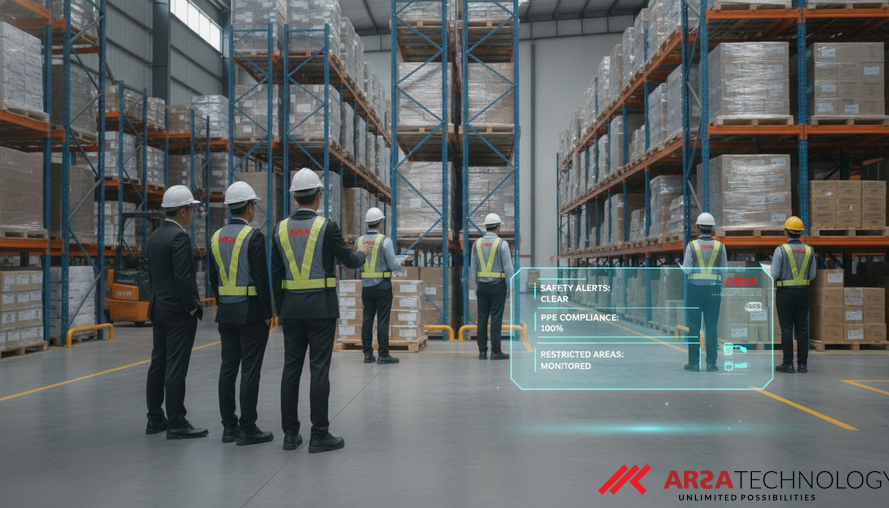

Reduce Workplace Accidents with AI Video Analytics: A CFO’s Guide to Software vs. Hardware for Warehouse Safety
For Chief Financial Officers (CFOs) overseeing warehouse operations, the imperative to reduce workplace accidents with AI video analytics is not just a matter of employee well-being; it’s a critical financial decision. Workplace incidents in warehouses carry substantial direct and indirect costs, impacting everything from insurance premiums and workers’ compensation claims to productivity and employee morale. In 2022, the U.S. warehousing and storage industry alone experienced 5.3 nonfatal occupational injury and illness cases per 100 full-time equivalent workers, with U.S. employers incurring $2.5 billion in workers’ compensation costs, alongside 1.2 million lost workdays due to injuries (Gitnux, 2026). These figures underscore the urgent need for effective safety solutions, and AI video analytics has emerged as a powerful tool to address these challenges.
This guide provides a commercial perspective, comparing the deployment models of AI video analytics – specifically focusing on software-only solutions like ARSA’s Basic Safety Guard versus integrated hardware systems – to help CFOs make informed investment decisions that deliver a tangible ROI of AI safety monitoring in manufacturing and logistics.
The Hidden Costs of Warehouse Accidents
Beyond the immediate medical expenses and workers’ compensation, warehouse accidents trigger a cascade of financial repercussions. These include:
- Lost Productivity: Injured workers are absent, and others may be distracted or demoralized, leading to reduced output.
- Investigation and Compliance Fines: Each incident requires investigation, and potential regulatory penalties, such as those from OSHA, can be significant.
- Increased Insurance Premiums: A history of accidents often leads to higher liability and workers’ compensation insurance rates.
- Equipment Damage: Accidents frequently involve damage to valuable machinery and inventory.
- Reputational Damage: Safety incidents can harm a company’s brand, affecting recruitment and client trust.
For instance, the average cost per warehouse Musculoskeletal Disorder (MSD) claim was $42,000 in 2021, and material handling equipment like forklifts were responsible for 25% of warehouse fatalities between 2011 and 2022 (Gitnux, 2026). Loading docks, in particular, are high-risk zones, accounting for 25% of all warehouse accidents, with an alarming ratio of 600 near-misses for every injury (OSHA Online Center, 2026). These statistics highlight the critical need for proactive safety measures.
How AI Video Analytics Transforms Warehouse Safety
AI video analytics leverages existing CCTV infrastructure to provide real-time, automated safety monitoring. By continuously analyzing video feeds, these systems can detect potential hazards, identify safety protocol violations, and alert personnel instantly. This proactive approach is key to how AI CCTV reduces safety incidents before they escalate.
Key capabilities include:
- PPE Detection: Automatically identifies if workers are wearing required Personal Protective Equipment (PPE) such as helmets, vests, and masks in designated areas.
- Restricted Area Monitoring: Detects unauthorized entry into hazardous or restricted zones, triggering immediate alerts.
- Safety Violation Alerts: Flags unsafe behaviors, such as improper lifting techniques, speeding forklifts, or pedestrian-vehicle proximity violations.
- Compliance Reporting: Generates detailed logs and reports for auditing and demonstrating adherence to safety regulations like ISO 45001.
- Event Logging: Creates a comprehensive record of incidents and near-misses for root cause analysis and continuous improvement.
AI Video Analytics Software: The Flexible, Scalable Choice for Warehouses
When considering an AI workplace safety system, CFOs often weigh the benefits of a software-only solution against a hardware-integrated approach. For many large warehouse operations, particularly those with existing IT infrastructure and a preference for centralized control, AI video analytics software offers compelling advantages.
ARSA Technology’s ARSA AI Video Analytics Software, specifically its Basic Safety Guard module, is designed for exactly this scenario. It operates as a fully self-hosted, on-premise software platform, transforming existing CCTV streams into real-time operational intelligence without cloud dependency or vendor lock-in.
Key Advantages of ARSA AI Video Analytics Software:
1. No Hardware Dependency: Deploy on existing servers, private data centers, or edge compute infrastructure. This eliminates the need for significant capital expenditure on new, dedicated AI appliances, making it a cost-effective solution.
2. Full Data Ownership: All video streams, inference results, and metadata remain entirely within your infrastructure. This is crucial for privacy-sensitive environments and ensuring compliance with data residency regulations.
3. Flexible Deployment: The software can run on bare metal, virtual machines, or containerized environments, aligning seamlessly with your existing IT strategy.
4. Centralized Processing & Scalability: Analyze multiple camera streams from a central location, offering a unified view of safety across your entire warehouse network. Capacity can be scaled by allocating compute resources, not by installing new devices, providing a predictable cost benefit analysis AI safety system.
5. Integration Ready: With a robust REST API, ARSA AI Video Analytics Software integrates easily with existing dashboards, alerting systems, and data pipelines, allowing for a cohesive safety and operational intelligence platform. This supports integrating with existing IT and SCADA infrastructure.
This software-centric approach provides the flexibility and control that large enterprises demand. It contrasts with edge AI box solutions, which, while offering plug-and-play deployment for rapid site-level rollout, typically involve distributed processing and can be less ideal for organizations preferring centralized AI processing and software-only procurement. For a deeper dive into the financial aspects of custom AI projects in logistics, consider reading our article on Optimizing Logistics: Understanding the Custom AI Project Investment Range and ROI Timeline.
Achieving Compliance and Maximizing ROI
Implementing an AI workplace safety system like ARSA’s Basic Safety Guard helps organizations meet stringent safety standards. While ARSA Technology does not claim specific certifications, its on-premise deployment model and full data ownership capabilities are designed to support clients in meeting their obligations under frameworks such as ISO 45001 for occupational health and safety management. Our blog post, Achieving ISO 45001 Compliance with AI Safety Monitoring Software in Warehouses, provides further insights into how such systems can contribute to a compliant safety posture.
The cost benefit analysis AI safety system reveals significant long-term savings. By proactively identifying risks and preventing accidents, companies can drastically reduce direct costs associated with injuries (medical, legal, workers’ comp) and indirect costs (lost productivity, turnover, reputational damage). The investment in an AI Video Analytics Software solution pays dividends through enhanced safety, operational efficiency, and a stronger bottom line.
Conclusion
For CFOs seeking to strategically reduce workplace accidents with AI video analytics in their warehouse operations, ARSA Technology’s AI Video Analytics Software offers a powerful, flexible, and cost-effective solution. By leveraging existing infrastructure and providing comprehensive, real-time safety monitoring, it delivers a clear ROI of AI safety monitoring in manufacturing and logistics. This on-premise, hardware-agnostic platform ensures full data ownership and seamless integration, empowering enterprises to create safer, more efficient work environments.
Ready to transform your warehouse safety and unlock significant cost savings? Contact ARSA’s solutions team today to discuss how our AI Video Analytics Software can be tailored to your specific needs. You can also explore our full range of ARSA products for other AI and IoT solutions.
—
FAQ Section
1. What is the typical ROI for an AI workplace safety system in a warehouse?
The ROI of AI safety monitoring in manufacturing and warehousing can be substantial, driven by reductions in workers’ compensation claims, medical costs, legal fees, and productivity losses. While specific figures vary, proactive accident prevention through AI can lead to significant savings, often offsetting initial investment within a few years by minimizing costly incidents like the average $42,000 per MSD claim.
2. How does AI CCTV reduce safety incidents without replacing existing cameras?
ARSA’s AI Video Analytics Software integrates with your existing CCTV cameras (ONVIF/RTSP compatible), processing video streams in real-time. It uses advanced algorithms to detect PPE compliance, identify restricted area intrusions, and flag unsafe behaviors, providing immediate alerts to prevent incidents, thereby demonstrating how AI CCTV reduces safety incidents.
3. What are the main cost benefits of an AI safety monitoring system for warehouses?
The primary cost benefit analysis AI safety system reveals savings from fewer injuries, lower insurance premiums, reduced workers’ compensation payouts, minimized legal expenses, and increased operational uptime due to fewer disruptions. Additionally, improved compliance and a safer work environment contribute to better employee morale and retention.
4. Can ARSA’s AI workplace safety system integrate with our current IT infrastructure?
Yes, ARSA AI Video Analytics Software is designed for seamless integration. It is self-hosted and hardware-agnostic, running on your existing servers or private cloud. Its REST API allows for easy connection with current dashboards, alerting systems, and data pipelines, ensuring it complements your existing IT and SCADA infrastructure.
Stop Guessing, Start Optimizing.
Discover how ARSA Technology drives profit through intelligent systems.