
Safety AI vs. Traditional EHS Software: A Buyer’s Guide for Facility Management
For facility management teams, optimizing safety protocols and ensuring compliance is a continuous, critical challenge. As technology evolves, organizations are increasingly weighing the benefits of advanced solutions like safety AI against traditional EHS software. This comprehensive safety ai vs traditional ehs software buyers guide aims to equip procurement leads with the insights needed to make informed decisions that enhance workplace safety, streamline operations, and deliver measurable ROI.
Traditional EHS (Environmental, Health, and Safety) software has long been the backbone of safety management, offering structured systems for incident reporting, compliance tracking, and document management. However, the demands of modern industrial environments, coupled with the rapid advancements in artificial intelligence, are pushing the boundaries of what’s possible in proactive safety. ARSA Technology, with its robust ARSA Basic Safety Guard (Software), offers a powerful, on-premise AI video analytics solution designed to transform existing CCTV infrastructure into an intelligent safety monitoring system.
What Traditional EHS Software Still Does Well
Before diving into the transformative power of AI, it’s important to acknowledge what traditional EHS software still does well. These systems excel at providing a centralized repository for safety-related documentation, managing training records, scheduling audits, and generating reports for regulatory compliance. They are adept at handling reactive processes, such as recording incidents post-occurrence, tracking corrective actions, and maintaining a historical log of safety performance. For many years, these capabilities have been indispensable for meeting regulatory obligations and establishing a foundational safety framework.
However, traditional EHS solutions often operate on a reactive model. They primarily analyze data after an event has happened, making it challenging to prevent incidents in real-time. This reliance on manual data entry and retrospective analysis can lead to delays in identifying emerging risks and implementing preventative measures. As facilities grow in complexity and the volume of operational data explodes, the limitations of purely traditional approaches become more apparent.
The Shift to Predictive Safety: Why AI is Essential
The landscape of workplace safety is undergoing a significant transformation, moving from reactive incident management to proactive, predictive prevention. This shift is driven by the integration of AI, which allows for real-time monitoring and analysis of vast amounts of data that would be impossible for human operators to process manually. According to industry analysis, organizations leveraging predictive analytics for safety can see a substantial reduction in incident rates, potentially between 20-40%, by identifying risks before they escalate into serious incidents. This capability is particularly crucial in high-risk environments where serious injuries and fatalities (SIFs) remain a persistent concern, even as minor incidents decline.
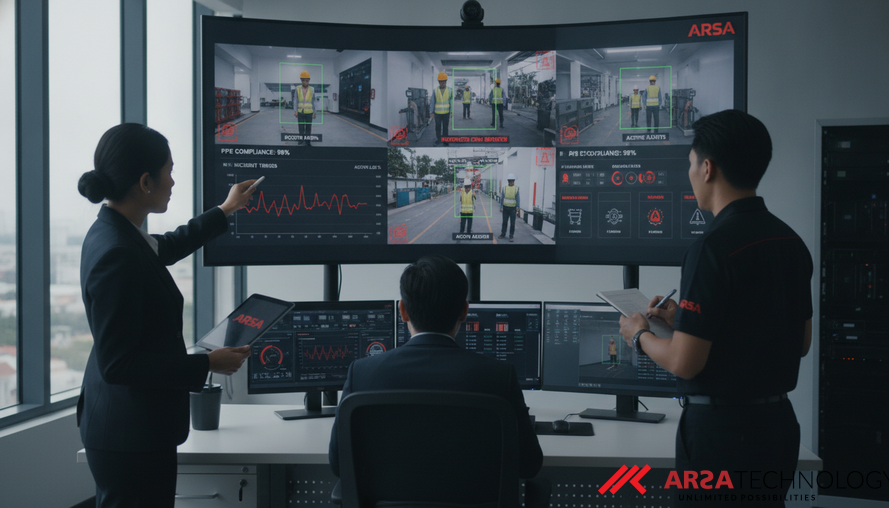
AI-powered solutions, like ARSA Basic Safety Guard (Software), convert passive CCTV feeds into active intelligence. This means instead of reviewing footage after an accident, the system can detect safety violations, monitor restricted areas, and identify PPE non-compliance as they happen, triggering immediate alerts. This real-time visibility is a game-changer for facility management, allowing for timely interventions and significantly reducing the potential for harm.
Key Safety AI Evaluation Criteria for Enterprise Buyers
For enterprise buyers, evaluating safety AI solutions requires a nuanced approach that goes beyond basic feature comparison. Here are critical safety ai evaluation criteria for enterprise buyers:
- Deployment Model and Data Ownership: Understand whether the solution is cloud-based, on-premise, or hybrid. For many enterprises, especially those in regulated industries or with sensitive operations, full data ownership and on-premise deployment are non-negotiable. ARSA Basic Safety Guard (Software) is a self-hosted, on-premise solution, ensuring all video streams, inference results, and metadata remain entirely within your infrastructure, offering complete data sovereignty and privacy.
- Hardware Agnosticism and Integration: Can the AI software integrate with your existing CCTV infrastructure? A hardware-agnostic solution minimizes upfront investment and simplifies deployment. ARSA’s AI Video Analytics Software is designed to work with existing ONVIF/RTSP compatible CCTV cameras and can be deployed on your existing servers or edge compute, including NVIDIA Jetson and x86 inference platforms. Its REST API facilitates seamless integration with existing dashboards, alerting systems, and data pipelines.
- Scalability and Performance: How easily can the system scale to cover multiple sites or a growing number of cameras? A truly scalable solution should allow you to expand analytics capacity by allocating compute resources, rather than requiring new hardware installations at every point. ARSA’s software is horizontally scalable, designed for centralized processing of multiple camera streams.
- Core Analytics Capabilities: Does the solution offer the specific safety functions your facility needs? For instance, PPE detection (helmets, vests, masks), restricted area monitoring, and real-time safety violation alerts are fundamental for industrial and manufacturing environments. ARSA Basic Safety Guard provides these core functions, along with compliance reporting and event logging.
- Accuracy and Reliability: While no system can claim 100% accuracy, understanding the performance metrics (e.g., accuracy rates for specific detections) is crucial. ARSA’s AI video analytics are engineered for high accuracy, delivering reliable real-time detections.
- Audit Trails and Compliance Reporting: The ability to generate audit-ready compliance reports and maintain detailed event logs is vital for demonstrating adherence to safety standards like ISO 45001 and local occupational safety regulations.
The ARSA Basic Safety Guard (Software) Advantage for Facility Management
ARSA Technology’s ARSA Basic Safety Guard (Software) stands out as a powerful solution for facility management teams seeking to elevate their safety posture. Unlike cloud-dependent alternatives, ARSA’s software is deployed fully on-premise, granting organizations complete control over their data and ensuring no sensitive information leaves their network. This is particularly beneficial for privacy-sensitive environments and those with strict data residency requirements.
Our software transforms existing CCTV systems into intelligent, proactive safety platforms. It offers:
- Real-time PPE Detection: Automatically identifies if personnel are wearing required Personal Protective Equipment (PPE) such as helmets, vests, and masks in designated zones.
- Restricted Area Monitoring: Instantly alerts security or operations teams when individuals enter unauthorized or hazardous areas.
- Safety Violation Alerts: Detects unsafe behaviors or conditions, providing immediate notifications to prevent incidents.
- Comprehensive Compliance Reporting: Generates detailed event logs and analytical reports that support compliance audits and demonstrate due diligence.
- Hardware-Agnostic Flexibility: Deploy on your existing servers, private data centers, or edge compute infrastructure, eliminating the need for dedicated AI appliances. This flexibility aligns with diverse IT strategies and budget considerations.
- Centralized, Scalable Processing: Analyze multiple camera streams from a central location, scaling analytics capacity by simply allocating more compute resources. This simplifies management across global sites.
By implementing ARSA Basic Safety Guard (Software), facility managers can achieve centralized safety monitoring across global sites, ensure full data ownership, and generate audit-ready compliance reports. The ability to integrate with existing IT and SCADA infrastructure via a REST API further enhances its value, making it a seamless addition to your operational ecosystem. For a deeper dive into how AI video analytics can deliver measurable ROI for facility management, read our article: How AI Video Analytics Software Delivers Measurable ROI for Facility Management.
Practical Pilot Structure for Evaluating Safety AI
For procurement teams considering a transition to AI-powered safety, a practical pilot structure for evaluating safety ai is essential. This phased approach allows for thorough testing and validation before a full-scale deployment.
1. Define Clear Objectives: Identify specific safety challenges you aim to solve (e.g., reducing PPE non-compliance in a specific area, preventing unauthorized access).
2. Select a Pilot Area: Choose a contained, representative area within your facility where the AI solution can be deployed without disrupting critical operations.
3. Establish Baseline Metrics: Before deployment, collect data on current incident rates, compliance levels, and response times in the pilot area.
4. Phased Deployment:
- Phase 1 (Setup & Integration): Deploy the ARSA Basic Safety Guard (Software) on existing servers and integrate it with a select number of CCTV cameras. Configure detection zones and alert rules.
- Phase 2 (Monitoring & Calibration): Run the system for a defined period (e.g., 4-6 weeks), monitoring its performance, fine-tuning detection parameters, and observing alert accuracy.
- Phase 3 (Evaluation & Reporting): Compare post-pilot metrics against your baseline. Assess the system’s impact on safety incidents, response times, and compliance. Gather feedback from safety officers and operational staff.
5. Cost-Benefit Analysis: Evaluate the ROI based on reduced incidents, improved compliance, and potential labor efficiencies.
This structured approach minimizes risk and provides concrete data to support your investment decision. Our article, Real Results: How On-Premise AI Safety Analytics with Full Data Sovereignty Transformed Logistics Operations, offers a case study on successful implementation.
Questions Procurement and IT Should Ask Safety AI Vendors
When engaging with vendors, procurement and IT teams must ask targeted questions procurement and it should ask safety ai vendors to ensure a comprehensive understanding of the solution and its fit within your enterprise architecture.
- Data Privacy and Security: How is data handled? Is it processed on-device, on-premise, or in the cloud? What encryption standards are used? How does the solution support compliance with regulations like GDPR or local data protection acts?
- Integration Capabilities: What APIs are available for integration with existing EHS platforms, SCADA systems, or enterprise resource planning (ERP) software? What level of technical expertise is required for integration?
- Scalability and Performance Guarantees: Can the system handle your projected camera count and data volume? What are the latency figures for real-time alerts? What are the performance implications for your existing IT infrastructure?
- Customization and Flexibility: Can the AI models be fine-tuned for specific environmental conditions or unique safety protocols within your facility?
- Support and Maintenance: What level of technical support is provided? Are software updates included? What is the typical uptime SLA?
- Pricing Model: Is the pricing based on the number of cameras, data volume, features, or a subscription model? Are there additional costs for hardware, integration, or custom development? ARSA Technology offers transparent pricing models for its software solutions; we encourage you to contact our solutions team for a tailored quotation.
- Proof of Concept (PoC) / Pilot Programs: Does the vendor offer pilot programs or PoCs to validate the solution in your specific environment?
Conclusion
The decision between traditional EHS software and advanced safety AI solutions represents a pivotal moment for facility management. While traditional systems provide essential foundational capabilities, the predictive power and real-time insights offered by AI are becoming indispensable for achieving truly proactive safety. A well-informed safety ai vs traditional ehs software buyers guide emphasizes the importance of data ownership, integration flexibility, and demonstrable ROI.
ARSA Technology’s Basic Safety Guard (Software) offers a robust, on-premise AI video analytics solution that empowers organizations to transform their safety operations. By leveraging existing infrastructure and ensuring full data control, ARSA provides a path to enhanced safety, compliance, and operational efficiency. Explore all ARSA products to discover how our AI solutions can meet your enterprise needs.
FAQ
What are the primary benefits of choosing AI-powered safety solutions over traditional EHS software?
AI-powered safety solutions, such as ARSA Basic Safety Guard (Software), offer real-time, proactive monitoring capabilities that traditional EHS software often lacks. They can detect safety violations, PPE non-compliance, and restricted area breaches as they happen, enabling immediate intervention and significantly reducing incident rates. This shifts safety management from a reactive to a predictive model, leading to better decision-making and risk prevention.
What traditional ehs software still does well in modern facility management?
Traditional EHS software remains strong in areas like centralized documentation, managing training records, scheduling audits, and generating reports for regulatory compliance. It provides a solid framework for reactive safety processes, incident logging, corrective action tracking, and maintaining historical safety performance data.
What are the key safety ai evaluation criteria for enterprise buyers when considering deployment?
Enterprise buyers should prioritize deployment model (on-premise for data ownership), hardware agnosticism, scalability, core analytics capabilities (e.g., PPE detection, restricted area monitoring), accuracy, and robust audit trails for compliance. Solutions like ARSA Basic Safety Guard (Software) emphasize on-premise deployment for full data control and hardware compatibility with existing CCTV systems.
How can procurement and IT teams structure a practical pilot for evaluating safety AI solutions?
A practical pilot structure involves defining clear objectives, selecting a representative pilot area, establishing baseline metrics, and conducting a phased deployment. This includes initial setup and integration, a monitoring and calibration period, and a final evaluation phase to compare results against baselines and perform a comprehensive cost-benefit analysis. This helps answer questions procurement and it should ask safety ai vendors regarding real-world performance.
Stop Guessing, Start Optimizing.
Discover how ARSA Technology drives profit through intelligent systems.