
What to Evaluate When Choosing a PPE Detection Provider for AI Restricted Area Monitoring in Oil and Gas Facilities
For EHS Directors in the demanding oil and gas sector, ensuring the utmost safety and compliance within hazardous operational zones is paramount. Traditional methods often fall short, leading to potential gaps in coverage, delayed incident response, and escalating costs. The rise of AI-powered solutions, particularly for AI restricted area monitoring for oil and gas facilities, presents a transformative opportunity. However, choosing the right PPE detection provider requires a meticulous evaluation of capabilities, deployment models, and long-term value. This guide will equip you with the critical criteria to make an informed decision that safeguards your workforce and optimizes operational efficiency.
The oil and gas industry, with its inherent risks and stringent regulations (such as ISO 45001), necessitates a proactive approach to safety. AI-driven systems move beyond passive surveillance, turning existing infrastructure into intelligent, real-time safety sentinels. The goal is not just to react to incidents but to prevent them, ensuring personnel adhere to safety protocols and do not enter unauthorized or dangerous areas.
The Imperative for Advanced Restricted Area Monitoring
Oil and gas facilities are complex ecosystems with numerous potential hazards, from high-pressure pipelines and volatile chemicals to heavy machinery and confined spaces. Unauthorized entry into these areas, or the failure to wear appropriate Personal Protective Equipment (PPE), can have catastrophic consequences. An effective intrusion detection system for hazardous zones is no longer a luxury but a fundamental requirement for operational integrity and worker well-being.
Manual inspections, while necessary, are inherently limited by human capacity and can be inconsistent. AI video analytics offer a scalable and continuous monitoring solution, providing an objective layer of oversight that significantly reduces human error. This constant vigilance is crucial for maintaining compliance and fostering a culture of safety.
Key Evaluation Criteria for AI Restricted Area Monitoring Solutions
When assessing potential PPE detection providers for your oil and gas operations, consider the following critical factors:
1. Deployment Model: Edge vs. Cloud for Data Sovereignty and Latency
The choice between edge and cloud deployment is fundamental, especially for privacy-sensitive and mission-critical environments. For oil and gas facilities, where network connectivity can be unreliable and data sovereignty is a major concern, edge computing offers distinct advantages.
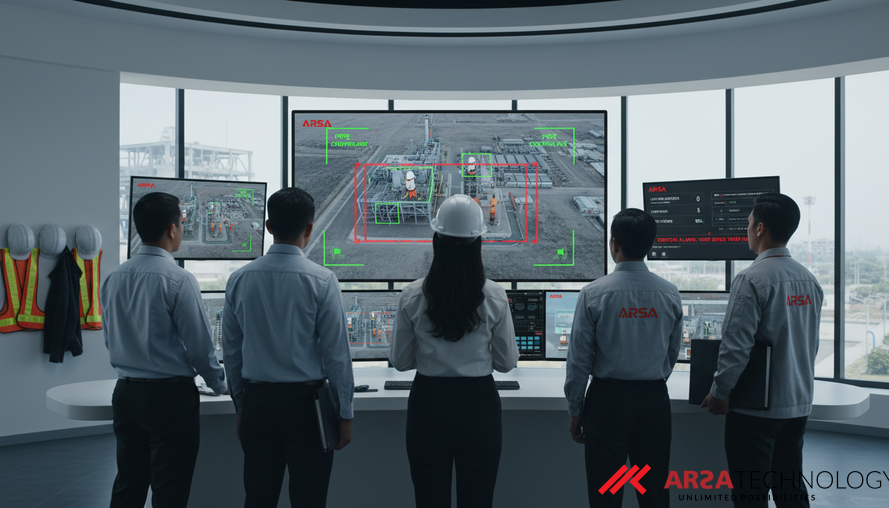
An edge-based system, like ARSA Technology’s AI Box Series, processes video streams directly on-site. This means all AI processing runs locally on the device, ensuring that sensitive video data and inference results never leave your network unless explicitly configured. This local processing is vital for environments requiring air-gapped systems or strict compliance with data protection regulations such as GDPR. Furthermore, edge processing minimizes latency, enabling real-time alerts and rapid response to critical events. Solutions that offer automated restricted zone alerts edge computing are essential for immediate action in hazardous situations.
- Questions to Ask: Does the solution offer true on-premise or edge processing? What are the data transfer protocols, and can data be kept entirely within our infrastructure? What are the latency implications for real-time alerts?
2. Core AI Capabilities: Beyond Basic Detection
A robust PPE detection system must accurately identify various types of PPE and monitor for restricted area breaches. Look for providers that offer comprehensive capabilities:
- PPE Detection: The system should reliably perform PPE detection, including hard hat detection and safety vest detection, across various lighting conditions and angles.
- Restricted Area Monitoring: The ability to define and monitor multiple custom restricted zones within camera views is crucial.
- Intrusion Alerts: Instant, actionable alerts for any unauthorized entry or PPE non-compliance are vital for rapid response.
- Behavioral Analytics: Advanced systems can detect unusual behaviors or loitering in sensitive areas, providing an additional layer of security.
ARSA’s Basic Safety Guard (AI Box), for instance, is specifically engineered for industrial environments, offering precise PPE detection and restricted area monitoring with real-time alerts and event logs. This directly contributes to reducing accidents and supporting compliance audits.
- Questions to Ask: What is the accuracy rate for PPE and intrusion detection? Can the system differentiate between authorized and unauthorized personnel? How configurable are the detection zones and alert rules?
3. Integration and Compatibility
Your chosen solution must seamlessly integrate with your existing security infrastructure. A provider that offers compatibility with standard CCTV cameras (e.g., ONVIF and RTSP) will save significant costs and deployment time by leveraging your current investment. Avoid solutions that force hardware lock-in.
- Questions to Ask: Is the system hardware-agnostic, or does it require proprietary cameras? What are the integration options with our existing VMS or security platforms? Does it offer a REST API for custom integrations?
4. Scalability and Ease of Deployment
Oil and gas facilities can range from compact processing units to vast, sprawling sites. The solution must be scalable to meet diverse needs. A plug-and-play installation minimizes downtime and technical complexity. ARSA’s AI Box, for example, boasts a 5-minute setup, allowing for rapid deployment. Whether you need a Mini PC model for up to 3 cameras or a Server model for up to 30 cameras, the system should adapt to your scale without extensive IT overhead. This is particularly beneficial for large-scale deployments or remote sites where an AI perimeter protection for mining sites or oil fields might require distributed processing.
- Questions to Ask: How quickly can the system be deployed? What are the hardware requirements and scalability options? Can it operate effectively in remote locations with limited infrastructure, offering safety zone monitoring without internet?
5. Business Outcomes and ROI
Ultimately, any technology investment must deliver tangible business value. For EHS Directors, this translates to measurable improvements in safety, compliance, and operational efficiency. Look for solutions that promise:
- Reduced Workplace Injury Rates: Proactive detection and alerts directly prevent accidents.
- Automated Compliance Reporting: Streamlined reporting for standards like OSHA, EU-OSHA, and ISO 45001 reduces administrative burden and ensures audit readiness.
- Lower Workers’ Comp Insurance Premiums: A demonstrable reduction in incidents can lead to significant cost savings.
- Elimination of Manual Safety Inspections: While human oversight remains critical, AI automates the continuous monitoring aspect, freeing up safety personnel for more strategic tasks.
Consider how a solution like ARSA’s AI Box can deliver measurable ROI for AI restricted area monitoring by transforming safety operations.
6. Vendor Expertise and Support
Partnering with an experienced vendor is crucial. Look for a company with a proven track record in industrial AI deployments, particularly in high-stakes environments. They should offer comprehensive support, from initial consultation to ongoing maintenance and updates. ARSA Technology, with over seven years of experience and deployments in government and enterprise sectors, exemplifies such expertise.
- Questions to Ask: What is the vendor’s experience in our industry? What level of technical support and training is provided? What is their roadmap for future features and updates?
Transforming Safety with ARSA Technology’s AI Box Series
ARSA Technology understands the unique challenges faced by EHS Directors in the oil and gas sector. Our ARSA Basic Safety Guard (AI Box) is a purpose-built, edge-computing solution designed to deliver robust AI restricted area monitoring for oil and gas facilities. It integrates seamlessly with existing CCTV, providing real-time PPE detection (including hard hats and safety vests) and intrusion alerts without cloud dependency. This ensures full data ownership and minimal latency, critical for immediate incident response.
The plug-and-play nature of the AI Box allows for a 5-minute setup, transforming passive CCTV into an active intelligence platform. Whether you need a Mini PC for smaller, distributed deployments or a Server model for centralized, high-density monitoring, the ARSA AI Box Series offers flexible hardware configurations to match your operational reality. This empowers organizations to achieve significant reductions in workplace injury rates, automate compliance reporting, and ultimately lower workers’ compensation insurance premiums. For more insights into how AI transforms safety, explore how smart safety monitoring for mining and other heavy industries can be achieved.
Frequently Asked Questions (FAQ)
Q: How does AI restricted area monitoring enhance safety in oil and gas facilities?
A: AI restricted area monitoring significantly enhances safety by providing continuous, real-time surveillance of hazardous zones. It automatically detects unauthorized entry and PPE non-compliance (like missing hard hats or safety vests), triggering immediate alerts to prevent incidents, reduce injury rates, and ensure adherence to safety protocols like ISO 45001.
Q: Can AI perimeter protection for mining sites operate without an internet connection?
A: Yes, solutions like ARSA’s AI Box Series are designed for edge computing, meaning all AI processing occurs locally on the device. This enables safety zone monitoring without internet connectivity, making it ideal for remote mining sites or other isolated environments where data sovereignty and operational reliability are critical.
Q: What are the benefits of an intrusion detection system for hazardous zones that uses edge computing?
A: An intrusion detection system for hazardous zones leveraging edge computing offers several benefits: minimal latency for real-time alerts, enhanced data privacy as video streams are processed on-site, reduced bandwidth requirements, and reliable operation even in environments with limited or no internet access. This ensures immediate response to potential safety breaches.
Q: How does ARSA Technology’s Basic Safety Guard (AI Box) support compliance reporting?
A: The ARSA Basic Safety Guard automates the collection of safety and event logs, including PPE non-compliance and restricted area intrusions. This data can be used to generate comprehensive reports, streamlining compliance with industry standards such as OSHA, EU-OSHA, and ISO 45001, and providing objective evidence for audits.
Conclusion
The decision to implement an AI restricted area monitoring for oil and gas facilities solution is a strategic one, impacting not only safety but also operational efficiency and financial performance. By carefully evaluating providers based on deployment flexibility, core AI capabilities, integration, scalability, and proven business outcomes, EHS Directors can select a system that truly transforms their safety posture. ARSA Technology is committed to delivering practical, proven, and profitable AI solutions that meet the rigorous demands of your industry. To explore how our products can be tailored to your specific needs, or to discuss a custom solution, we invite you to contact ARSA solutions team today.
Stop Guessing, Start Optimizing.
Discover how ARSA Technology drives profit through intelligent systems.