
Automated Employee Health Screening for Workplace Compliance: A Comprehensive Guide
In today’s dynamic work environments, ensuring employee well-being and maintaining stringent workplace compliance are paramount. Manual health screening processes, often time-consuming and prone to inconsistencies, present significant challenges for occupational health directors. The demand for efficient, accurate, and privacy-preserving solutions has led to a surge in interest in automated employee health screening for workplace compliance. This article explores how advanced AI and IoT technologies are revolutionizing health monitoring, offering a clear path to enhanced safety, reduced operational costs, and robust compliance.
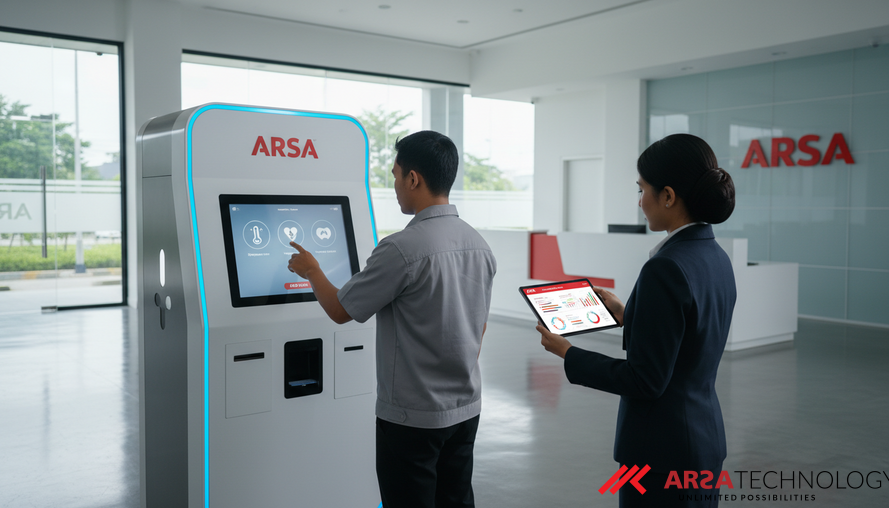
Traditional health screening methods can strain resources, create bottlenecks, and delay critical insights into workforce health. From pre-shift checks in manufacturing facilities to routine wellness assessments in corporate offices, the need for a scalable and reliable system is undeniable. ARSA Technology’s Self-Check Health Kiosk offers an innovative solution, transforming how organizations approach employee health and regulatory adherence.
The Evolving Landscape of Workplace Health and Compliance
Workplace health and safety regulations are becoming increasingly complex, requiring organizations to implement proactive measures to protect their workforce. This includes regular health assessments, particularly in industries with physical demands or specific safety protocols. The challenge lies in performing these screenings efficiently without disrupting operations or incurring exorbitant costs.
Occupational health directors are tasked with balancing employee privacy, data accuracy, and the logistical complexities of large-scale health monitoring. Manual processes often fall short, leading to:
- High Labor Costs: Dedicated medical personnel for routine checks are expensive.
- Inconsistency: Human error can lead to inaccurate data and missed early warning signs.
- Data Fragmentation: Paper records or disparate digital systems make trend analysis difficult.
- Operational Delays: Queues for screening can impact productivity.
Automated solutions, particularly those leveraging AI and IoT, address these pain points directly. They provide a streamlined, consistent, and data-rich approach to health monitoring, ensuring that organizations can meet their compliance obligations while fostering a healthier workforce.
Understanding Automated Health Screening Solutions
Automated health screening systems come in various forms, but the most effective integrate advanced sensors with intelligent software. These systems typically involve self-service kiosks where employees can quickly measure vital signs.
Key Components of an Effective Automated Health Kiosk:
- Medical-Grade Sensors: For accurate measurement of blood pressure, heart rate, SpO2 (blood oxygen saturation), and temperature.
- AI-Powered Diagnostics: Beyond basic measurements, AI can analyze data for anomalies and even conduct specialized tests like the Romberg test for balance assessment.
- Secure Data Management: Encrypted storage and integration with health dashboards for aggregated, de-identified data analysis.
- User-Friendly Interface: Multi-language support and voice guidance to ensure accessibility for all employees.
- API Integration: Seamless connectivity with existing HR, access control, or EMR systems.
These kiosks empower employees to take ownership of their health while providing employers with valuable, aggregated data for population health management and compliance reporting.
ARSA Technology’s Self-Check Health Kiosk: A Deep Dive
The ARSA Self-Check Health Kiosk is a prime example of how AI and IoT can be deployed for practical, impactful workplace health solutions. Designed for corporate wellness programs, pre-shift screening, and public facilities, it offers a robust, self-service platform for vital sign measurement and health assessment.
Core Functions and Features:
- Comprehensive Vital Sign Monitoring: The kiosk accurately measures blood pressure, blood oxygen measurement (SpO2), and heart rate monitoring using FDA/CE-certified medical-grade sensors. This ensures reliable data for health assessments.
- AI-Powered Romberg Test Kiosk for Balance Assessment: A unique feature, the AI-powered Romberg test, assesses a person’s balance, which is crucial for roles requiring physical stability or for early detection of neurological issues.
- Identity Verification: Employees can identify themselves via face recognition or QR code, ensuring that screening records are accurately linked to individuals while maintaining privacy.
- Health Kiosk with Dashboard and Reporting: All collected vital user data is recorded and displayed on a secure, web-based dashboard. This centralized system provides real-time insights, historical analytics, and customizable reports, enabling occupational health directors to monitor trends, identify potential health risks, and demonstrate compliance.
- Smart Triage Alerts: The kiosk’s software intelligence automatically flags critical readings (e.g., hypertension, fever, low SpO2) against user-defined thresholds and can auto-route alerts to on-call physicians, significantly reducing emergency response times.
- Flexible Deployment and Data Sovereignty: ARSA offers on-premise or hybrid cloud deployment options, ensuring full compliance with data privacy regulations like EU GDPR and Indonesia PDPA. No biometric data leaves your infrastructure without explicit control.
This integrated approach makes the ARSA Health Kiosk an invaluable asset for organizations committed to proactive health management and regulatory adherence.
Comparison: ARSA Health Kiosk vs. Traditional Methods and Generic Solutions
When considering automated employee health screening for workplace compliance, it’s essential to evaluate the advantages of a specialized solution like ARSA’s over outdated methods or less comprehensive alternatives.
| Feature/Aspect | Traditional Manual Screening | Generic Automated Kiosk (Basic) | ARSA Self-Check Health Kiosk | Cost Efficiency | High (nurse salaries, manual processing, potential for fraud) | Moderate (some automation, but may lack depth in analytics) | High (replaces 2-3 FTE nurses per shift, ROI 14-18 months) |
| Data Accuracy | Variable (human error) | Good (sensor-based) | Excellent (medical-grade sensors, AI anomaly flagging) |
| Compliance & Privacy | Difficult to track/prove, privacy risks | Varies by vendor, often cloud-dependent | Superior (on-premise/hybrid cloud, GDPR/HIPPA compliant) |
| Employee Engagement | Low (inconvenient) | Moderate (self-service) | High (user-friendly UI, voice guidance, instant reports) |
| Actionable Intelligence | Limited, delayed | Basic metrics | Real-time alerts, historical trends, predictive insights |
| Scalability | Very limited | Limited by hardware/software architecture | High (single dashboard manages 1-1000 kiosks) |
ARSA’s solution stands out due to its commitment to data sovereignty, medical-grade accuracy, and comprehensive feature set. While a basic digital health kiosk for hospital visitor screening might offer simple temperature checks, ARSA provides a complete health assessment platform. Similarly, a generic self-service blood pressure kiosk for clinics might only offer one parameter, whereas ARSA’s kiosk provides multi-parameter screening with intelligent analysis.
Business Outcomes and ROI for Building Management
For building management companies, implementing an automated employee health screening for workplace compliance system like the ARSA Health Kiosk translates into tangible business outcomes and a clear return on investment.
1. Reduced Occupational Health Costs: By automating routine vital checks, organizations can significantly reduce reliance on medical personnel, leading to substantial labor cost savings. ARSA projects an ROI achieved in 14-18 months, primarily through labor reallocation.
2. Early Detection of Employee Health Issues: Continuous, accurate monitoring allows for the early identification of health anomalies, enabling timely intervention. This proactive approach can prevent minor issues from escalating into serious conditions, reducing absenteeism and long-term healthcare costs.
3. Automated Pre-Shift Health Screening: For industries like manufacturing, logistics, or construction, pre-shift health screening is critical for safety. The kiosk automates this process, ensuring all employees are fit for duty without causing operational delays. This also applies to managing visitor health in hospitals or other sensitive facilities, where a digital health kiosk for hospital visitor screening can streamline entry protocols.
4. Support Corporate Wellness Programs: The aggregated, de-identified data from the kiosks provides valuable insights for designing and evaluating corporate wellness initiatives. This data can also be leveraged for insurance premium reductions through data-backed wellness programs.
5. Enhanced Compliance and Risk Mitigation: The system provides verifiable audit trails for all screenings, demonstrating adherence to health and safety regulations. This minimizes legal and financial risks associated with non-compliance.
6. Improved Operational Efficiency: Fast, self-service screening (multi-parameters measured in 90 seconds) eliminates queues and bottlenecks, improving overall operational flow. This is particularly beneficial in high-traffic areas or during peak hours.
7. Data-Driven Decision Making: The robust health kiosk with dashboard and reporting capabilities offers a single pane of glass for monitoring population health trends, allowing for informed decisions regarding workplace policies, resource allocation, and preventive measures.
ARSA Technology has a proven track record of deploying mission-critical systems, from AI video analytics for restricted area security to intelligent vehicle registration platforms. Our expertise extends to creating solutions that address real-world operational challenges, ensuring that your investment delivers measurable impact. For instance, while the ARSA Traffic Monitor (Software) optimizes urban mobility, the Health Kiosk optimizes human capital.
Deployment and Integration
The ARSA Self-Check Health Kiosk is designed for straightforward on-site installation. It connects to existing networks via WiFi or Ethernet and offers robust REST API integration for seamless connectivity with your current IT infrastructure, including HR systems, access control platforms, or even custom web applications. The built-in web dashboard provides all necessary tools for operation, maintenance, and data review.
For organizations without extensive IT infrastructure, the plug-and-play nature of the kiosk makes it an ideal choice. For those with complex IT environments, ARSA’s consultative engineering approach ensures the solution integrates perfectly with existing systems, providing full control over data, privacy, and performance. You can explore all ARSA products to see our range of flexible deployment models.
Conclusion
Implementing automated employee health screening for workplace compliance is no longer a luxury but a strategic imperative for modern organizations. The ARSA Self-Check Health Kiosk offers a comprehensive, accurate, and privacy-preserving solution that addresses the multifaceted challenges faced by occupational health directors. By leveraging AI and IoT, ARSA Technology empowers businesses to foster healthier workforces, streamline compliance, and achieve significant operational efficiencies.
Ready to transform your workplace health and safety protocols? Don’t let manual processes hold you back. Contact ARSA solutions team today for a consultation and discover how our Self-Check Health Kiosk can deliver measurable ROI for your organization.
—
FAQ
What vital signs can the ARSA Self-Check Health Kiosk measure?
The ARSA Self-Check Health Kiosk measures multiple parameters, including blood pressure, heart rate, SpO2 (blood oxygen saturation), and body temperature. Optional modules can also be integrated for glucose and cholesterol measurements, providing comprehensive health data in approximately 90 seconds.
How does the AI Romberg test kiosk for balance assessment work?
The AI Romberg test kiosk uses AI-powered analysis to assess a person’s balance and postural stability. This non-invasive test is guided by the kiosk’s multi-language UI and voice guidance, providing objective data crucial for evaluating physical fitness, especially for roles requiring high levels of balance or coordination.
Can the health kiosk with dashboard and reporting integrate with existing systems?
Yes, the ARSA Health Kiosk is designed for seamless integration. It features a web-based health kiosk with dashboard and reporting for centralized data management and offers robust REST API integration to connect with existing HR systems, access control platforms, or other enterprise applications, ensuring data flow and operational synergy.
Is the ARSA Self-Check Health Kiosk suitable for a digital health kiosk for hospital visitor screening?
Absolutely. The ARSA Self-Check Health Kiosk is ideal for a digital health kiosk for hospital visitor screening. Its fast, contact-minimal screening, medical-grade sensors, and identity verification features (face recognition or QR code) ensure efficient and secure entry protocols, helping to manage patient flow and maintain a healthy environment within healthcare facilities.
Stop Guessing, Start Optimizing.
Discover how ARSA Technology drives profit through intelligent systems.