
Evaluating a Real-Time Congestion Detection System for Urban Traffic Planning: A Comprehensive Buyer’s Guide
Urban centers worldwide grapple with the persistent challenge of traffic congestion. Beyond mere inconvenience, it leads to significant economic losses, increased pollution, and reduced quality of life. For smart city project managers, the imperative to implement effective solutions is paramount. A real-time congestion detection system for urban traffic planning is no longer a luxury but a fundamental necessity for modern cities aiming for sustainable mobility and operational efficiency. But with a myriad of options available, how do you choose the right system that delivers measurable impact?
This guide outlines the critical factors to evaluate when selecting an AI-powered traffic management solution, ensuring your investment translates into tangible improvements for urban infrastructure and citizen experience.
The Growing Need for Advanced Traffic Intelligence
Traditional traffic management relies on historical data and reactive measures, often falling short in dynamic urban environments. The rise of smart cities demands proactive, predictive capabilities. This is where AI-driven video analytics steps in, transforming passive CCTV networks into intelligent sensors. These systems provide granular data on vehicle movements, pedestrian flows, and potential incidents, enabling city operators to make informed decisions rapidly.
Key Evaluation Criteria for a Real-Time Congestion Detection System
When assessing potential solutions, smart city project managers should consider the following core aspects:
1. Accuracy and Reliability of Detection
The foundation of any effective traffic management system is its ability to accurately detect and classify vehicles, people, and events. A system that frequently misidentifies objects or misses critical incidents can lead to flawed insights and misguided interventions. Look for solutions with high accuracy rates, especially in varying weather conditions and lighting. ARSA Technology’s AI video analytics, for instance, boasts 99.7% accuracy, ensuring reliable data for critical urban planning decisions. This precision is crucial for effective `AI traffic flow optimization for smart cities`.
2. Real-Time Processing and Low Latency
For congestion detection, “real-time” is not just a buzzword; it’s a performance requirement. Delays in data processing mean delayed responses, rendering interventions less effective. Edge computing solutions, like the ARSA AI Box Series, process video streams directly at the source, minimizing latency. This allows for instant alerts on traffic anomalies, enabling city operators to respond to incidents as they unfold, rather than hours later. This capability is vital for `automated incident detection on highways` and urban roads.
3. Deployment Flexibility and Scalability
Urban environments are diverse, with varying infrastructure and connectivity challenges. A robust solution should offer flexible deployment models.
- Edge Deployment: Ideal for rapid rollout and areas with limited network bandwidth, edge devices like the ARSA AI Box process data locally. This plug-and-play approach minimizes IT overhead and allows for a 5-minute setup with existing CCTV cameras.
- On-Premise Software: For cities with existing robust server infrastructure, a software-only solution provides centralized processing and full data ownership.
- Cloud Integration (Optional): While edge processing is key for real-time insights, optional cloud connectivity can provide centralized visibility and control for large-scale deployments, without compromising local data privacy.
The system must also be scalable, capable of expanding from a few intersections to an entire city network without requiring a complete overhaul. ARSA’s AI Box Series offers both Mini PC models for up to 3 cameras (distributed edge processing) and Server models for up to 30 cameras (centralized monitoring for heavy workloads), providing options for any scale.
4. Comprehensive Analytics Capabilities
A mere congestion alert is insufficient. A truly valuable system provides a rich suite of analytics that supports proactive urban planning. Key capabilities include:
- Vehicle Counting and Classification: Differentiate between cars, trucks, motorcycles, and pedestrians.
- Traffic Flow Analysis: Understand speed, density, and directional movement across lanes.
- Congestion Detection: Identify bottlenecks, slow-downs, and gridlock in real-time.
- Lane Utilization: Monitor how effectively lanes are being used.
- Incident Detection: Automatically flag accidents, stalled vehicles, or unusual events.
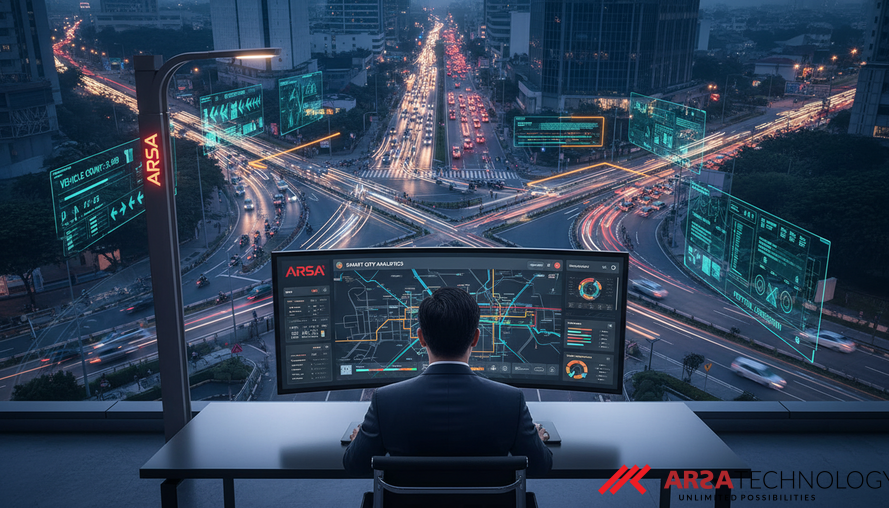
These capabilities feed into a `vehicle counting analytics dashboard for city operators`, providing a holistic view of traffic dynamics. ARSA’s Traffic Monitor (AI Box) provides all these core functions, empowering cities with actionable intelligence. You can explore the capabilities of the ARSA Traffic Monitor (AI Box) to see how it transforms raw video into operational insights.
5. Data Privacy and Compliance
In an era of increasing data scrutiny, ensuring data privacy is non-negotiable. Smart city solutions must comply with international regulations such as GDPR. Edge computing inherently enhances privacy by processing data locally, reducing the need to transmit sensitive video streams to the cloud. Look for systems that anonymize data at the source and offer full data ownership. ARSA Technology prioritizes data privacy, with solutions designed for local processing and control, aligning with stringent data protection frameworks. This commitment to privacy extends across all ARSA products, including our ARSA Face Recognition & Liveness SDK, which offers air-gapped deployment for sensitive environments.
6. Integration Readiness and Open APIs
A new traffic system should not operate in a silo. It must seamlessly integrate with existing smart city platforms, emergency response systems, and urban planning tools. Solutions offering robust REST APIs allow for easy integration with your current infrastructure, enabling a truly `data-driven traffic management system`. This ensures that traffic insights can inform broader city operations, from public transport scheduling to environmental monitoring.
7. Cost-Effectiveness and ROI
While the initial investment in a real-time congestion detection system for urban traffic planning can be significant, the long-term ROI is substantial. Consider factors like:
- Reduced Cloud Costs: Edge processing eliminates continuous cloud data transfer and storage fees.
- Optimized Resource Allocation: Data-driven insights enable more efficient deployment of traffic police, emergency services, and maintenance crews.
- Fuel and Time Savings: Reduced congestion directly translates to less fuel consumption and shorter travel times for citizens and commercial logistics.
- Environmental Benefits: Smoother traffic flow lowers vehicle emissions, contributing to sustainable city goals.
ARSA’s AI Box Series offers fixed bundle pricing, providing cost predictability and a clear path to ROI through operational efficiencies and reduced infrastructure costs.
ARSA Technology’s Approach to Smart Traffic Management
ARSA Technology understands the complexities of urban traffic. Our ARSA Traffic Monitor (AI Box) is engineered specifically for the demands of smart cities. It leverages cutting-edge edge computing to provide a powerful, privacy-preserving, and scalable solution for real-time traffic intelligence. By deploying our AI Box, city operators gain:
- Instant Insights: Real-time data on vehicle counting, classification, traffic flow, and congestion detection.
- Proactive Management: Automated alerts for incidents, enabling rapid response and minimizing disruption.
- Data for Planning: A comprehensive `vehicle counting analytics dashboard for city operators` that supports long-term urban development and sustainable mobility initiatives.
- Simplified Deployment: A plug-and-play system that integrates with existing CCTV infrastructure, requiring minimal IT expertise.
Our commitment is to deliver practical AI that is deployed, proven, and profitable, helping cities achieve their vision of a smarter, more efficient future.
Frequently Asked Questions
What are the primary benefits of an AI traffic flow optimization for smart cities?
AI traffic flow optimization significantly reduces congestion, minimizes travel times, lowers fuel consumption and emissions, and enhances overall urban mobility. It provides city operators with real-time insights to make proactive decisions, improving public safety and supporting sustainable urban development.
How does a data-driven traffic management system improve urban planning?
A data-driven traffic management system provides granular, real-time, and historical data on traffic patterns, vehicle types, and incident hotspots. This intelligence allows urban planners to identify areas needing infrastructure improvements, optimize public transport routes, and design more efficient road networks, leading to better resource allocation and long-term city development.
Can ARSA’s AI Box Series provide automated incident detection on highways?
Yes, the ARSA AI Box Series, specifically the Traffic Monitor module, is designed for `automated incident detection on highways` and urban roads. By processing video streams at the edge, it can identify anomalies like stalled vehicles, accidents, or unusual pedestrian presence in real-time, triggering immediate alerts for rapid response.
What kind of vehicle counting analytics dashboard for city operators does ARSA offer?
ARSA provides an intuitive, real-time `vehicle counting analytics dashboard for city operators` that displays key metrics such as vehicle counts, classification (cars, trucks, motorcycles), traffic density, average speeds, and congestion levels. This dashboard offers both live monitoring and historical reporting, enabling comprehensive analysis and data-driven decision-making.
Transform Your City’s Traffic with ARSA Technology
The journey towards a truly smart city begins with intelligent infrastructure. A real-time congestion detection system for urban traffic planning is a cornerstone of this transformation, offering the power to mitigate traffic challenges and build more livable, efficient urban environments. By carefully evaluating solutions based on accuracy, latency, deployment flexibility, comprehensive analytics, data privacy, and integration capabilities, smart city project managers can make strategic investments that yield significant returns.
ARSA Technology is your trusted partner in this endeavor, providing robust, edge-powered AI solutions designed for real-world impact. Ready to elevate your city’s traffic management? Contact ARSA solutions team today to discuss how our Traffic Monitor (AI Box) can transform your urban planning initiatives.
Stop Guessing, Start Optimizing.
Discover how ARSA Technology drives profit through intelligent systems.