
How to Implement AI Traffic Analytics with Existing CCTV Cameras: A Practical Guide for Public-Sector Builders
In the rapidly evolving landscape of smart cities, public-sector entities face the constant challenge of managing urban mobility efficiently. The good news is that you don’t need to overhaul your entire surveillance infrastructure to achieve this. This guide will walk you through how to implement AI traffic analytics with existing CCTV cameras, transforming passive video feeds into dynamic, actionable intelligence for better urban planning and operational efficiency.
For years, CCTV cameras have served primarily as security tools, recording footage for retrospective analysis. However, with advancements in artificial intelligence and edge computing, these same cameras can now be upgraded to powerful traffic sensors. This capability allows government IT procurement teams and urban planners to leverage their current investments while gaining real-time insights into traffic flow, congestion, and vehicle behavior. ARSA Technology, with its proven expertise in AI and IoT solutions, offers the ARSA Traffic Monitor (AI Box) as a robust solution for this transformation.
The Challenge: Bridging the Gap Between Surveillance and Intelligence
Traditional CCTV systems, while essential for security, fall short when it comes to providing proactive traffic management data. Manually reviewing hours of footage to understand traffic patterns, count vehicles, or identify congestion points is time-consuming, prone to human error, and simply not scalable for modern urban environments. Public-sector organizations need solutions that deliver immediate, accurate data to make informed decisions about infrastructure, public safety, and sustainable mobility initiatives. The key is to convert surveillance cameras to traffic sensors without massive capital expenditure.
Why Edge AI is the Answer for Existing CCTV Infrastructure
Integrating AI directly at the “edge”—meaning on-site, close to the data source—is a game-changer for public-sector builders looking to add AI traffic counting to security cameras. Edge computing ensures that video streams are processed locally, minimizing latency and reducing the need for constant cloud connectivity. This approach is particularly beneficial for sensitive public infrastructure, where data sovereignty and privacy (e.g., GDPR-friendly anonymous data) are paramount.
ARSA Technology’s AI Box Series, including the Traffic Monitor, exemplifies this edge-first philosophy. These pre-configured systems are designed for a 5-minute plug-and-play setup, integrating seamlessly with your existing CCTV cameras. This means no complex network overhauls or expensive camera replacements are necessary. You can literally upgrade traffic cameras with edge AI in a matter of minutes, turning them into intelligent data collection points.
Step-by-Step: Implementing AI Traffic Analytics with ARSA Traffic Monitor
Implementing ARSA Traffic Monitor is designed to be straightforward, even for large-scale public deployments.
1. Connect the ARSA AI Box
The first step is physical integration. Simply connect the ARSA AI Box to power, your local network, and your existing CCTV cameras. The system is hardware-agnostic, meaning it works with a wide range of camera models already in place. This ease of connection is crucial for rapid rollout across multiple sites.
2. Configure Analytics Modules
Once connected, the intuitive interface allows you to select specific analytics modules relevant to your traffic management needs. This includes defining detection zones, setting parameters for vehicle counting and classification, and establishing alert rules for anomalies like sudden congestion or stopped vehicles. The system can perform core functions such as vehicle counting, vehicle classification, traffic flow analysis, congestion detection, and lane utilization.
3. Monitor and Analyze Data
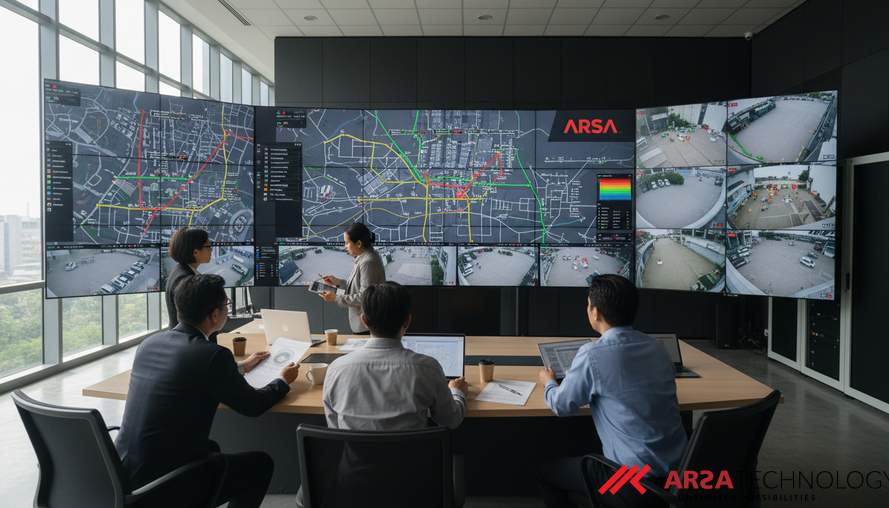
With configuration complete, the ARSA Traffic Monitor begins processing video streams in real-time. You can access comprehensive dashboards, alerts, and reports either locally or remotely. This provides public-sector teams with instant insights, enabling proactive responses and data-driven urban planning. For a deeper dive into how AI can enhance urban solutions, consider reading our article on Smart City AI Traffic Analytics.
Key Benefits for Public-Sector Operations
- Cost Efficiency: By leveraging existing CCTV infrastructure, public-sector organizations avoid the significant capital expenditure associated with new sensor networks. The edge processing model also eliminates recurring cloud data transfer costs.
- Real-Time Operational Intelligence: Gain immediate insights into traffic conditions, allowing for dynamic signal adjustments, rapid incident response, and optimized resource allocation. This is essential for reducing congestion and improving overall urban mobility.
- Data-Driven Urban Planning: Accurate, historical data on vehicle types, speeds, and flow patterns empowers planners to design more effective road networks, public transport routes, and pedestrian zones. This supports sustainable mobility programs and future infrastructure development.
- Enhanced Public Safety: Real-time incident detection, such as accidents or unusual traffic behavior, enables faster emergency response, improving safety for citizens.
- Data Privacy and Compliance: With local processing, all video streams and inference results remain within your infrastructure. This adherence to data sovereignty principles is critical for public-sector projects and ensures compliance with regulations like GDPR.
- Scalability: Whether you need to monitor a single intersection or an entire city, the ARSA AI Box Series offers flexible hardware configurations. The Mini PC Model processes up to 3 cameras, ideal for distributed deployments, while the Server Model (High-Density) can handle up to 30 cameras for centralized monitoring.
Retrofit CCTV for Vehicle Classification and Beyond
The ability to retrofit CCTV for vehicle classification is a powerful tool for public-sector agencies. Beyond simple counting, understanding the composition of traffic (e.g., cars, trucks, motorcycles) provides invaluable data for infrastructure maintenance, tolling strategies, and environmental impact assessments. ARSA Traffic Monitor delivers this granular data, helping cities move towards smarter, more responsive transportation systems. For more detailed insights into vehicle counting, you might find our guide on AI Vehicle Counting System particularly useful.
ARSA Technology has a seven-year track record of delivering production-ready AI and IoT systems for governments and enterprises. Our solutions are engineered for accuracy, scalability, privacy, and operational reliability, ensuring that public-sector investments yield measurable impact. From perimeter security for the Ministry of Defense to intelligent vehicle registration platforms for national police, ARSA’s experience demonstrates a deep understanding of mission-critical deployments. While our ARSA Face Recognition & Liveness SDK offers robust identity verification for regulated environments, the AI Box Series focuses on transforming physical spaces into intelligent environments.
Frequently Asked Questions
What are the core functions of ARSA Traffic Monitor for urban planning?
The ARSA Traffic Monitor provides real-time vehicle counting, vehicle classification, traffic flow analysis, congestion detection, and lane utilization data, all crucial for data-driven urban planning and optimizing traffic flow.
How does ARSA Traffic Monitor ensure data privacy and compliance?
By utilizing edge computing, all AI processing runs locally on the AI Box. Video streams are analyzed on-device and do not leave your network unless explicitly configured, ensuring full data ownership and compliance with privacy regulations like GDPR.
Can I upgrade traffic cameras with edge AI without replacing my existing hardware?
Yes, the ARSA Traffic Monitor is designed for plug-and-play installation and integrates with existing CCTV infrastructure. You can easily retrofit CCTV for vehicle classification and other analytics without replacing cameras or backend systems.
What kind of ROI can public-sector organizations expect from implementing AI traffic analytics?
Public-sector organizations can expect significant ROI through optimized traffic flow, reduced congestion, more efficient resource allocation, faster incident response times, and the ability to make data-driven decisions that lead to long-term cost savings in infrastructure and operational management.
Transform Your City with Intelligent Traffic Management
The ability to effectively manage urban traffic is a cornerstone of modern public service. By understanding how to implement AI traffic analytics with existing CCTV cameras, public-sector builders can unlock unprecedented levels of efficiency, safety, and responsiveness. ARSA Technology’s AI Box Series, particularly the Traffic Monitor, offers a practical, scalable, and privacy-conscious solution to achieve these goals.
Ready to transform your city’s traffic management? Explore all ARSA products or contact ARSA solutions team today to discuss how our edge AI systems can empower your public-sector projects.
Stop Guessing, Start Optimizing.
Discover how ARSA Technology drives profit through intelligent systems.