
Reduce Workplace Accidents with AI Video Analytics: A CFO’s Guide to ROI in Warehouse Safety
For Chief Financial Officers, the imperative to maintain a safe workplace extends far beyond ethical considerations; it directly impacts the bottom line. In 2026, the financial repercussions of workplace incidents in warehouses are more significant than ever, making it critical to find effective solutions that reduce workplace accidents with AI video analytics. This article provides a comprehensive financial justification for investing in advanced AI safety monitoring, demonstrating how it translates into tangible cost savings and improved operational efficiency for warehouse and logistics operations.
The warehousing and transportation sector faces unique safety challenges. The U.S. Bureau of Labor Statistics (BLS) reports that the warehouse injury rate typically ranges from 4.5 to 5 cases per 100 full-time workers. Forklift-related incidents alone account for approximately 85 fatalities and over 34,000 serious injuries annually across the United States, according to industry research. These aren’t just statistics; they represent substantial direct and indirect costs that erode profitability.
The True Cost of Workplace Accidents: Beyond the Obvious
When an accident occurs in a warehouse, the financial impact ripples through multiple departments. The National Safety Council estimates the average cost of a workplace injury involving days away from work to be over $44,000. For severe incidents like falls or forklift accidents, this figure can easily exceed $100,000, encompassing medical expenses, legal fees, regulatory fines, and the significant cost of lost productivity.
OSHA penalties further compound these costs. As of 2026, a single serious violation can incur fines up to $16,550, while willful violations can reach as high as $165,514 per instance. Beyond these direct expenses, hidden costs such as employee attrition due to a reputation for unsafe conditions, increased workers’ compensation insurance premiums, and the disruption to operational flow can severely impact a company’s financial health. Globally, the International Labour Organization (ILO) estimates that occupational accidents and diseases cost the world economy an astounding $3.94 trillion annually, representing 4% of global GDP.
How AI CCTV Reduces Safety Incidents: A Proactive Approach
Traditional safety protocols, while essential, often fall short in providing real-time, continuous monitoring. Manual inspections are infrequent, and conventional CCTV systems are primarily reactive, recording incidents for later review rather than preventing them. This is where AI video analytics offers a transformative advantage.
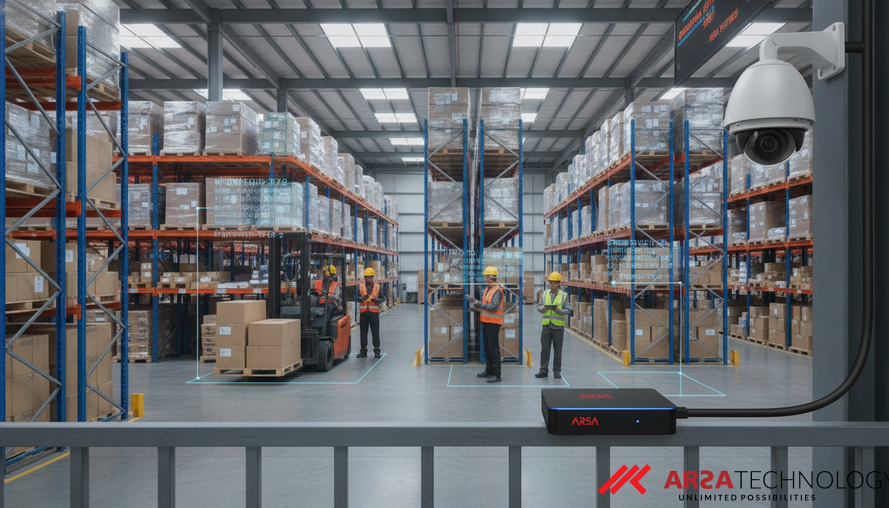
ARSA Technology’s Basic Safety Guard (AI Box) leverages edge computing to process video streams locally, delivering instant insights without cloud dependency. This plug-and-play solution integrates seamlessly with existing CCTV infrastructure (ONVIF and RTSP compatible), transforming passive cameras into active safety sensors. The AI analyzes every video frame in real-time, detecting potential hazards and non-compliance as they happen.
Key functions of the ARSA Basic Safety Guard include:
- PPE Detection: Automatically identifies if workers are wearing required personal protective equipment, such as hard hats and safety vests.
- Restricted Area Monitoring: Triggers alerts when unauthorized personnel enter hazardous zones.
- Intrusion Alerts: Notifies safety teams of unexpected movements or presences in critical areas.
- Safety Compliance Reporting: Automates the generation of reports on safety violations, aiding in compliance with standards like OSHA, EU-OSHA, and ISO 45001.
This proactive approach significantly reduces the likelihood of incidents. For instance, slips, trips, and falls account for 27% of all non-fatal warehouse injuries, and falls from elevated platforms contribute to 20% of fatal warehouse accidents. AI can detect these risks—like a worker entering a dangerous zone without a hard hat or a potential slip hazard—and issue real-time alerts, allowing for immediate intervention.
The Compelling ROI of AI Safety Monitoring in Manufacturing and Warehousing
For CFOs, the ROI of AI safety monitoring in manufacturing and warehouse environments is a critical consideration. Industry research indicates that over 85% of organizations achieve full ROI within 12 months of deploying AI video analytics for safety, with logistics firms often seeing payback in just 6 to 9 months. This rapid return on investment is driven by several factors:
1. Reduced Injury Rates and Associated Costs: By preventing even a few serious incidents annually, companies can save hundreds of thousands to millions of dollars in direct and indirect costs. A single prevented fatality, for example, can save an employer over $1.3 million, according to the National Safety Council.
2. Lower Workers’ Compensation Premiums: A demonstrably safer workplace with a reduced incident rate can lead to lower insurance premiums over time.
3. Automated Compliance and Reduced Fines: Automated safety compliance reporting and real-time alerts help organizations adhere to regulatory requirements, minimizing the risk of costly OSHA or other regulatory fines.
4. Increased Productivity: Fewer accidents mean less downtime, fewer investigations, and a more consistent operational flow. An efficient safety system contributes directly to overall productivity.
5. Enhanced Employee Morale and Retention: A commitment to employee safety fosters a positive work environment, improving morale and reducing turnover in a competitive labor market.
Consider a mid-sized warehouse operation. If an AI Box Series deployment prevents just two serious injuries per year, at a conservative $50,000 per incident, that’s $100,000 in avoided losses. When you factor in reduced OSHA citation risk, lower insurance premiums, and operational efficiency gains, the AI workplace safety system cost savings become undeniable.
ARSA Basic Safety Guard: Designed for Your Operational Reality
ARSA Technology, an NVIDIA Inception and Intel partner with over 7 years of experience, understands the demands of enterprise and government clients. The Basic Safety Guard (AI Box) is engineered for practical deployment in real-world industrial settings.
The ARSA AI Box comes in flexible hardware configurations: a Mini PC model capable of processing up to 3 cameras, ideal for distributed deployments, and a Server model that can handle up to 30 cameras for centralized monitoring of heavy workloads. Both options offer edge processing, ensuring data privacy and minimal latency without reliance on cloud infrastructure. This means your sensitive operational data remains entirely within your control.
For organizations seeking to transform their existing CCTV into smart safety monitoring, the ARSA Basic Safety Guard provides a robust and scalable solution. It helps automate OSHA, EU-OSHA, and ISO 45001 reporting by providing concrete data on safety compliance and incident prevention.
Frequently Asked Questions
What is the typical ROI for an AI workplace safety system?
Many organizations, particularly in logistics, achieve full ROI within 6 to 12 months of deploying AI video analytics for safety. This rapid return is driven by significant reductions in accident costs, insurance premiums, and regulatory fines, alongside improved productivity.
How does AI CCTV reduce safety incidents in a warehouse?
AI CCTV systems, like ARSA’s Basic Safety Guard, analyze video streams in real-time to detect safety violations such as missing PPE (hard hats, safety vests), unauthorized entry into restricted areas, and other hazardous behaviors. By issuing immediate alerts, these systems enable proactive intervention, preventing incidents before they cause injury or damage.
What are the key cost benefits of implementing an AI safety system?
The primary cost benefits include a reduction in direct accident costs (medical, legal), lower workers’ compensation insurance premiums, avoidance of OSHA and other regulatory fines, increased operational uptime due to fewer disruptions, and improved employee retention through a safer work environment. These factors contribute to substantial cost benefit analysis AI safety system results.
Can ARSA’s AI safety monitoring integrate with existing CCTV infrastructure?
Yes, ARSA’s AI Box Series, including the Basic Safety Guard, is designed for plug-and-play installation and is compatible with existing ONVIF and RTSP CCTV cameras. This eliminates the need for costly infrastructure replacement, allowing for rapid deployment and immediate safety enhancements. For more details on integrating AI with existing systems, you can explore our article on how to turn existing CCTV into smart safety monitoring.
Conclusion
In an era where operational efficiency and risk mitigation are paramount, the financial justification for AI video analytics in warehouse safety is clear. The ability to proactively reduce workplace accidents with AI video analytics offers a compelling value proposition for CFOs. By automating safety monitoring, ensuring PPE compliance, and providing real-time alerts, solutions like ARSA Basic Safety Guard not only protect your most valuable assets—your people—but also safeguard your financial health through significant cost savings and improved compliance.
To learn more about how ARSA Technology can help your organization achieve a safer, more profitable future, explore all ARSA products or contact our solutions team for a consultation. You can also read more about what is PPE detection and how it contributes to smart safety monitoring.
Stop Guessing, Start Optimizing.
Discover how ARSA Technology drives profit through intelligent systems.