
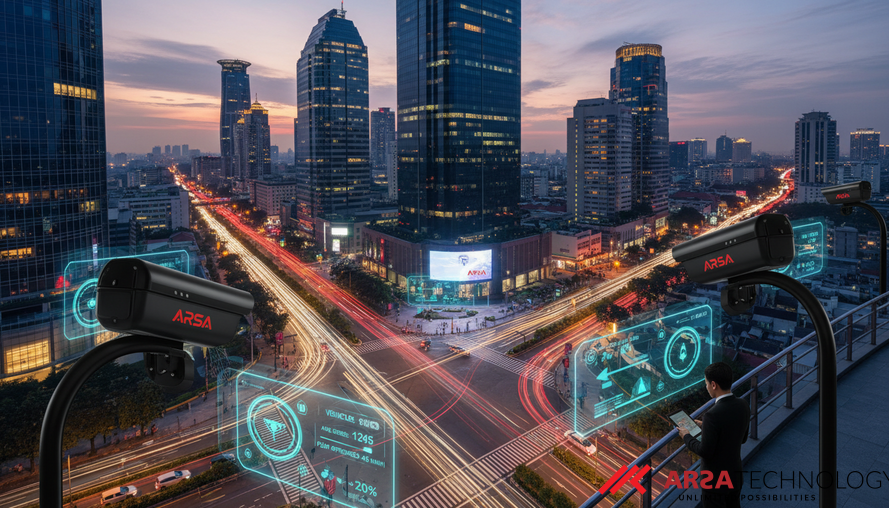
Understanding AI Vehicle Counting System for Smart City Traffic Management: A Business Leader’s Guide
In the rapidly evolving landscape of urban development, city transport planners face the constant challenge of optimizing traffic flow, reducing congestion, and ensuring public safety. The traditional methods of traffic analysis, often reliant on manual observation or outdated sensor technology, simply cannot keep pace with the dynamic nature of modern cities. This is where an AI vehicle counting system for smart city traffic management emerges as a transformative solution, offering unparalleled precision and real-time insights. Such systems leverage advanced artificial intelligence to convert passive CCTV footage into actionable intelligence, paving the way for more efficient and responsive urban planning.
The integration of AI into traffic infrastructure is not merely an incremental upgrade; it represents a fundamental shift in how cities understand and manage their circulatory systems. By automating the collection and analysis of traffic data, these systems provide a robust foundation for strategic decision-making, leading to significant improvements in urban mobility and environmental sustainability.
The Evolution of Traffic Monitoring: Beyond Traditional Sensors
For decades, traffic engineers have relied on inductive loops, pneumatic road tubes, and radar sensors to gather vehicle data. While these technologies have served their purpose, they often come with limitations: high installation and maintenance costs, vulnerability to weather conditions, and a lack of granular data beyond simple counts. They struggle to provide context, such as vehicle type, speed, or specific behavioral patterns.
Modern AI-powered systems overcome these limitations by utilizing existing CCTV infrastructure, transforming it into intelligent data collection points. This approach drastically reduces the need for expensive new hardware deployments and offers a richer, more comprehensive dataset for analysis.
How an AI Vehicle Counting System for Smart City Traffic Management Works
At its core, an AI vehicle counting system processes video streams from traffic cameras to identify, count, and classify vehicles. This is achieved through sophisticated computer vision algorithms trained on vast datasets of vehicle imagery. Unlike older systems, AI can differentiate between various vehicle types (cars, trucks, motorcycles, buses), track their movement, and even estimate their speed and direction.
The process typically involves:
1. Data Capture: High-definition video feeds from existing CCTV cameras are ingested.
2. AI Processing: Specialized AI models analyze each frame, detecting and tracking vehicles.
3. Classification: Vehicles are categorized based on their type, size, and other attributes. This is often referred to as automated vehicle classification using CCTV.
4. Data Aggregation: Counts, classifications, speeds, and trajectories are aggregated into meaningful metrics.
5. Reporting & Alerts: Real-time dashboards display current traffic conditions, while historical reports provide long-term trends and insights.
ARSA Technology’s ARSA Traffic Monitor (AI Box) exemplifies this capability. It’s a plug-and-play edge AI device designed to integrate seamlessly with existing CCTV cameras, providing instant traffic insights.
The Power of Real-Time Traffic Flow Analytics Edge Computing
One of the most significant advancements in AI traffic management is the shift towards edge computing. Instead of sending all video data to a centralized cloud server for processing, edge AI devices perform analysis directly at the source – near the cameras themselves. This approach offers several critical advantages for smart city applications:
- Reduced Latency: Processing data at the edge means insights are generated almost instantaneously. This is crucial for real-time traffic flow analytics edge computing, enabling immediate responses to incidents like accidents or sudden congestion.
- Enhanced Data Privacy: Raw video footage, which may contain sensitive information, does not need to be transmitted over public networks. Processing occurs locally, significantly bolstering data security and compliance.
- Lower Bandwidth Costs: By processing video locally and only sending metadata or aggregated results to a central dashboard, the demand on network bandwidth is dramatically reduced, leading to substantial cost savings.
- Offline Operation: Edge devices can continue to function and provide insights even if internet connectivity is temporarily lost, ensuring continuous monitoring.
ARSA’s AI Box Series, including the Traffic Monitor, is built on this principle, offering robust AI traffic monitoring without cloud dependency. This is particularly vital for critical infrastructure and government applications where data sovereignty and uninterrupted operation are paramount.
Key Benefits for City Transport Planners
Implementing an advanced AI vehicle counting system offers a multitude of benefits for urban environments:
- Optimized Traffic Flow: By understanding real-time traffic patterns, cities can dynamically adjust traffic light timings, reroute vehicles during peak hours, and manage lane usage more effectively. ARSA Traffic Monitor aims to optimize traffic flow by up to 40%.
- Proactive Congestion Management: Predictive analytics can anticipate congestion before it occurs, allowing planners to implement preventative measures.
- Data-Driven Urban Planning: Accurate historical data on vehicle counts, types, and flow provides invaluable insights for infrastructure development, road expansion projects, and public transport planning.
- Enhanced Safety: Rapid detection of incidents, such as stalled vehicles, wrong-way drivers, or pedestrian crossings in restricted areas, enables faster emergency response times.
- Cost Efficiency: Leveraging existing CCTV infrastructure and reducing manual labor for data collection translates into significant operational savings. The 5-minute setup of ARSA’s AI Box Series also minimizes deployment costs and time.
- Environmental Impact: Smoother traffic flow reduces idling time, leading to lower fuel consumption and decreased carbon emissions, contributing to a greener city.
Implementing a Smart Traffic Counting Device for Intersections
Intersections are often the choke points of urban traffic. Deploying a smart traffic counting device for intersections can dramatically improve their efficiency. These devices, like the ARSA Traffic Monitor, can monitor multiple lanes and directions simultaneously, providing a holistic view of intersection dynamics.
Consider a busy intersection where traffic lights are static or rely on simple loop detectors. An AI-powered system can:
- Detect queue lengths in real-time and extend green light phases for heavily congested lanes.
- Prioritize emergency vehicles by dynamically adjusting signals.
- Identify pedestrian crossings and ensure safe passage.
- Provide data on turning movements, helping planners design more efficient intersection layouts.
The ARSA Traffic Monitor, a part of the AI Box Series overview, is designed for rapid rollout projects, making it an ideal choice for quickly upgrading critical intersections. It supports up to 3 cameras per unit, offering comprehensive coverage without complex installations.
ARSA Technology’s Approach to Smart Traffic Management
ARSA Technology specializes in practical AI solutions that are proven and profitable. Our AI Box Series, particularly the ARSA Traffic Monitor, is engineered to deliver enterprise-grade video intelligence at the edge. Key features include:
- 5-Minute Setup: Designed for rapid deployment, minimizing disruption and technical overhead.
- Edge Processing: All analytics are performed locally, ensuring low latency and data privacy.
- Works with Existing CCTV: No need for costly camera replacements, integrating seamlessly into current infrastructure.
- Real-time Dashboards & Reports: Access critical insights through an intuitive web-based dashboard, allowing for instant monitoring and historical analysis. You can even try our online demo dashboard to see it in action.
- Comprehensive Analytics: Beyond counting, the system provides vehicle classification, congestion detection, lane utilization, and incident detection.
Our solutions are trusted by enterprises and public institutions, reflecting our commitment to accuracy, reliability, and data control. While our focus here is on traffic, ARSA also offers other robust AI solutions, such as the ARSA Face Recognition & Liveness SDK for secure identity management in regulated environments.
The Future is Intelligent Mobility
As cities continue to grow, the demand for efficient and sustainable transportation solutions will only intensify. An AI vehicle counting system for smart city traffic management is not just a tool for today; it’s an investment in the intelligent mobility of tomorrow. By providing precise, real-time, and actionable data, these systems empower city planners to create urban environments that are safer, more efficient, and more responsive to the needs of their citizens.
ARSA Technology is committed to building the future of industry with AI & IoT, delivering production-ready systems that move beyond experimentation into measurable impact.
Frequently Asked Questions
What are the primary advantages of automated vehicle classification using CCTV?
Automated vehicle classification using CCTV offers several advantages, including leveraging existing camera infrastructure, providing granular data on vehicle types, speeds, and behaviors, reducing manual labor, and enabling real-time analysis for dynamic traffic management.
How does real-time traffic flow analytics edge computing benefit urban planning?
Real-time traffic flow analytics edge computing minimizes latency by processing data locally, allowing for immediate insights and responses to traffic incidents. This enables dynamic traffic light adjustments, proactive congestion management, and more responsive urban planning decisions without relying on constant cloud connectivity.
Can ARSA’s AI traffic monitoring without cloud solutions integrate with existing city infrastructure?
Yes, ARSA’s AI traffic monitoring solutions, particularly the ARSA Traffic Monitor (AI Box), are designed for seamless integration with existing CCTV cameras and city infrastructure. They operate on-premise, requiring no cloud dependency for core functions, ensuring data sovereignty and minimal IT overhead.
What makes ARSA’s smart traffic counting device for intersections a superior choice?
ARSA’s smart traffic counting device for intersections offers plug-and-play deployment, processes data at the edge for low latency, works with existing CCTV, and provides comprehensive analytics including vehicle counting, classification, and congestion detection, all accessible via real-time dashboards for data-driven decision-making.
Ready to transform your city’s traffic management? Contact ARSA solutions team today to discuss how our AI solutions can drive efficiency and innovation for your urban environment. Explore all our AI and IoT solutions at ARSA products.
Stop Guessing, Start Optimizing.
Discover how ARSA Technology drives profit through intelligent systems.