
Cloud API vs On-Premise SDK: Which PPE Detection Approach Fits Your Stack?
For Operations Directors tasked with safeguarding personnel and assets, selecting the best AI safety monitoring system for manufacturing plants is a critical decision. The choice between a cloud-based API and an on-premise SDK or software solution profoundly impacts data control, security, and long-term operational efficiency. In industries like manufacturing and construction, where safety is paramount and regulatory demands are stringent, understanding these deployment models is key to implementing a robust and compliant safety program.
AI-powered safety solutions are transforming how industrial environments manage risks, moving beyond traditional, reactive measures to proactive, continuous monitoring. This guide will help you navigate the options, focusing on the benefits of self-hosted software like ARSA’s Basic Safety Guard for mission-critical operations.
Understanding AI Safety Monitoring Systems
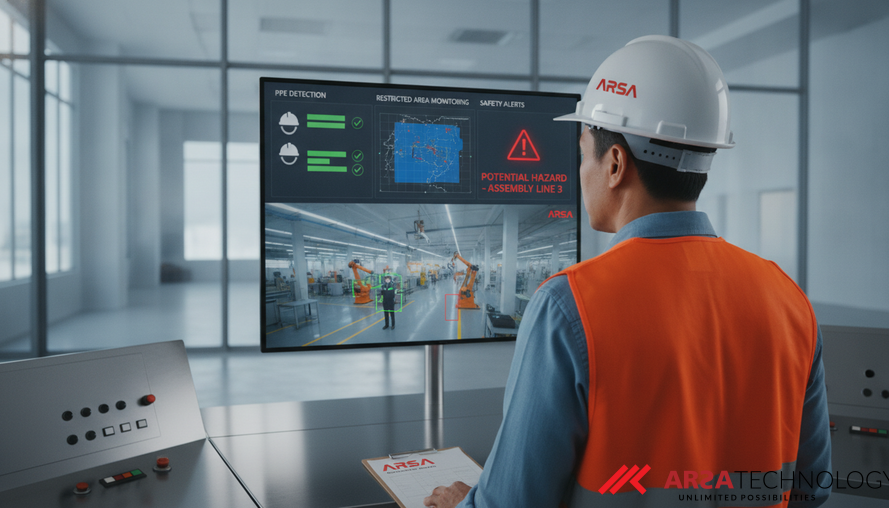
AI safety monitoring systems leverage computer vision to analyze video feeds from existing CCTV infrastructure, identifying potential hazards and ensuring compliance with safety protocols. These systems can detect missing Personal Protective Equipment (PPE), monitor restricted areas, and flag unsafe behaviors in real-time. The construction industry, for example, faces significant safety challenges; in 2022, construction fatalities accounted for 21% of all workplace fatalities despite employing only 7% of the workforce, highlighting the urgent need for effective safety measures (Bureau of Labor Statistics).
The adoption of AI in construction is accelerating, with 24% of engineering and construction firms globally reporting AI adopted at scale, according to the KPMG Global Construction Survey 2025/26. Safety and risk management is notably the fastest-growing AI application segment in construction, projected to grow at a 39.2% Compound Annual Growth Rate (CAGR) by Mordor Intelligence (2025). This growth underscores the increasing reliance on AI to enhance workplace safety.
Cloud API vs. On-Premise SDK: A Strategic Comparison
When evaluating the best AI safety monitoring system for manufacturing plants, the deployment model is a primary consideration. Both cloud APIs and on-premise SDKs/software offer distinct advantages and disadvantages, particularly for industries with strict data governance requirements.
Cloud API Advantages & Disadvantages
Cloud APIs offer rapid deployment and minimal infrastructure overhead. Developers can quickly integrate face recognition or PPE detection capabilities into existing applications via a REST API, benefiting from managed infrastructure and scalability provided by the service provider. This model is ideal for rapid SaaS prototyping or lightweight developer experiments. However, it means relinquishing direct control over data storage and processing, which can be a significant concern for privacy-sensitive environments or those subject to strict data residency laws. Data is processed and stored on external servers, introducing potential latency and dependency on internet connectivity.
On-Premise SDK/Software Advantages & Disadvantages
On-premise solutions, like ARSA’s AI Video Analytics Software, are deployed directly within an organization’s existing infrastructure. This model provides unparalleled control over data, security, and operations. All video streams, inference results, and metadata remain entirely within your network, ensuring full data ownership and supporting compliance with regulations like ISO 45001 (for occupational health and safety management) or regional data protection acts. While requiring existing servers or edge compute resources, on-premise software offers flexible deployment on bare metal, virtual machines, or containerized environments. It also supports air-gapped operations, crucial for highly sensitive or regulated sectors.
For a deeper dive into deployment options, you can explore ARSA’s comprehensive Edge AI vs. Cloud: How to Reduce Workplace Accidents with AI Video Analytics for Construction Safety.
Why On-Premise Software Excels for Manufacturing and Construction
For manufacturing plants and construction sites, an on-premise approach often represents the best AI safety monitoring system for manufacturing plants. ARSA’s Basic Safety Guard, delivered as software, is specifically designed for organizations that prioritize data sovereignty, low latency, and seamless integration with existing operational technology.
This self-hosted solution transforms existing CCTV systems into intelligent safety platforms without cloud dependency or vendor lock-in. Imagine a construction site where every camera acts as an edge AI safety camera for factory floor, continuously monitoring for PPE compliance and restricted area intrusions. The processing happens locally, providing real-time alerts without relying on external network connectivity. This is particularly vital for remote construction sites or large factory floors where internet bandwidth might be limited or unreliable.
The ability to run analytics within your environment preserves privacy, minimizes latency, and supports compliance requirements. For instance, new OSHA requirements effective January 13, 2025, mandate that all personal protective equipment properly fit each affected employee, and companies with 100 or more employees must electronically submit detailed injury and illness logs (Forms 300, 301, 300A). An on-premise CCTV safety compliance software with no cloud dependency can streamline the collection and reporting of this data, making it easier to meet these evolving regulatory demands.
Furthermore, an on-premise solution offers a scalable architecture. You can expand analytics capacity by allocating compute resources on your existing servers, rather than installing new devices at every point. This contrasts with a plug and play PPE detection device that might be limited in its processing power or scalability across a vast industrial complex.
Key Features of ARSA Basic Safety Guard (Software)
ARSA’s Basic Safety Guard (Software) is a powerful module within the ARSA AI Video Analytics Software suite, engineered for industrial environments. It provides:
- PPE Detection: Real-time identification of workers wearing or missing essential PPE such as helmets, vests, and masks. This proactive monitoring significantly reduces the risk of accidents.
- Restricted Area Monitoring: Automated alerts when personnel enter designated hazardous or off-limits zones, preventing unauthorized access and potential incidents.
- Safety Violation Alerts & Event Logs: Instant notifications for detected safety infractions, coupled with detailed event logs for incident review and compliance reporting.
- Compliance Reporting: Generate comprehensive reports to demonstrate adherence to safety regulations, crucial for audits and continuous improvement.
Technically, this software is self-hosted and hardware-agnostic, meaning it can deploy on existing NVIDIA Jetson and x86 inference hardware. Its REST API integration allows seamless connection with existing dashboards, alerting systems, and data pipelines, making it a flexible and powerful tool for centralized safety monitoring across global sites. To understand more about the core technology, read What Is PPE Detection? How AI Video Analytics Software Delivers Smart Safety Monitoring.
Achieving Measurable ROI with ARSA Technology
Implementing an advanced AI safety monitoring system like ARSA Basic Safety Guard translates directly into tangible business outcomes and a strong return on investment. By automating safety compliance, organizations can significantly reduce the incidence of accidents, lower insurance premiums, and avoid costly regulatory fines.
The ability to integrate with existing IT and SCADA infrastructure ensures that safety data contributes to a holistic operational intelligence picture. Centralized safety monitoring provides a unified view across all facilities, enabling Operations Directors to identify trends, optimize safety protocols, and allocate resources more effectively. With full data ownership, companies maintain complete control over their sensitive operational data, a crucial factor for audit-ready compliance reports and maintaining competitive advantage.
For organizations looking to transform their existing CCTV into smart safety monitoring, particularly for construction sites, ARSA offers robust solutions. Learn more about How to Turn Existing CCTV into Smart Safety Monitoring for Construction Sites.
In conclusion, while cloud APIs offer convenience, the on-premise software model, exemplified by ARSA Basic Safety Guard, provides the control, security, and compliance readiness essential for the best AI safety monitoring system for manufacturing plants and construction sites. It empowers Operations Directors to build resilient safety programs that protect workers, optimize operations, and drive measurable financial outcomes.
Ready to elevate your industrial safety? Contact ARSA’s solutions team today to discuss how our AI Video Analytics Software can be tailored to your specific needs. Explore our full range of ARSA products for comprehensive AI and IoT solutions.
FAQ
What makes ARSA Basic Safety Guard the best AI safety monitoring system for manufacturing plants?
ARSA Basic Safety Guard, as an on-premise software, offers full data ownership, no cloud dependency, and real-time PPE detection and restricted area monitoring. This ensures maximum control, privacy, and compliance, making it ideal for the stringent requirements of manufacturing and construction environments.
Can ARSA’s solution function as an edge AI safety camera for a factory floor?
Yes, ARSA’s AI Video Analytics Software can be deployed on edge compute devices, effectively turning existing CCTV cameras into intelligent edge AI safety cameras for factory floors. This local processing ensures low latency and reliable operation even without constant internet connectivity.
Is ARSA’s CCTV safety compliance software suitable for construction sites with no cloud access?
Absolutely. ARSA’s AI Video Analytics Software is designed for fully on-premise deployment, meaning it operates without cloud dependency. This makes it an excellent choice for CCTV safety compliance software with no cloud requirements, perfect for construction sites or other environments with limited or no internet connectivity.
How does ARSA’s AI box for construction site safety differ from the software-only solution?
The ARSA AI Box is a pre-configured, plug-and-play edge AI hardware device that comes with ARSA’s video analytics software pre-installed. It’s ideal for rapid deployment and distributed edge processing. The software-only solution, on the other hand, allows organizations to deploy ARSA’s AI analytics on their existing servers or edge compute infrastructure, offering more flexibility for centralized processing and software-based procurement. Both are effective for AI box for construction site safety, depending on your infrastructure preference.
Stop Guessing, Start Optimizing.
Discover how ARSA Technology drives profit through intelligent systems.