
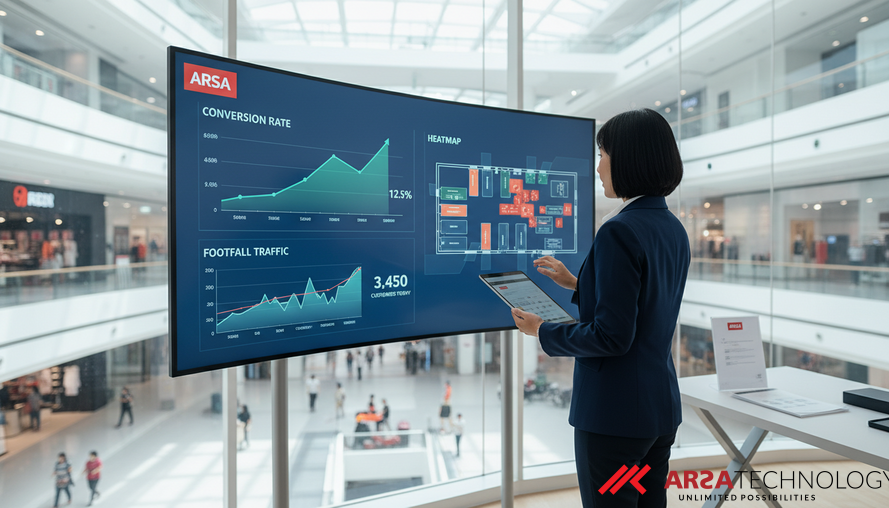
In today’s competitive landscape, understanding customer behavior is paramount for retail success. For operations managers, the critical question often revolves around how to measure retail store conversion rate with AI analytics effectively to drive tangible improvements. Traditional methods of gauging store performance often fall short, providing delayed or incomplete data. However, with the advent of advanced AI video analytics, retailers can now gain unprecedented, real-time insights into every aspect of their physical stores, from foot traffic patterns to purchasing decisions.
ARSA Technology offers robust, on-premise AI solutions designed to transform existing CCTV infrastructure into powerful intelligence hubs. Our ARSA Smart Retail Counter (Software) is a prime example, providing a comprehensive suite of tools for precise retail analytics without the need for cloud dependency or extensive hardware overhauls.
The Imperative of Measuring Retail Store Conversion Rate with AI Analytics
Measuring conversion rate in a retail environment is more than just counting transactions; it’s about understanding the journey from potential customer to purchaser. This metric, traditionally calculated by dividing the number of sales by the total number of visitors, becomes significantly more accurate and actionable when powered by AI. AI analytics provides the granular data needed to understand *why* customers convert or don’t, allowing operations managers to make data-driven decisions that directly impact the bottom line.
For shopping malls and multi-store retail chains, a centralized system is crucial. ARSA’s AI Video Analytics Software, specifically the Smart Retail Counter module, enables this by deploying on existing servers. This approach ensures full data ownership and compliance with stringent privacy regulations like GDPR and CCPA, as all video streams, inference results, and metadata remain entirely within your infrastructure.
Key AI Analytics for Enhanced Retail Performance
To truly understand how to measure retail store conversion rate with AI analytics, several core capabilities come into play:
- People Counting System for Retail Stores: At its foundation, an accurate people counting system is essential. ARSA’s Smart Retail Counter precisely tracks entry and exit numbers, providing reliable visitor counts for each store. This data forms the denominator for conversion rate calculations and offers crucial insights into peak hours, staffing needs, and marketing campaign effectiveness. For a deeper dive into how centralized people counting can benefit multi-store operations, see our article on ARSA Smart Retail Counter: Centralized People Counting Software for Multi-Store Retail Chains.
- AI Customer Footfall Tracking for Shopping Malls: Beyond simple entry/exit counts, AI can track customer movement patterns throughout an entire shopping mall or large retail space. This provides invaluable data on popular zones, underperforming areas, and bottlenecks. Understanding footfall allows for optimized store layouts, strategic product placement, and targeted promotional activities. This capability is vital for maximizing the potential of every square foot within a retail environment.
- Real-Time Queue Management Analytics: Long queues are a major deterrent to conversion and customer satisfaction. AI-powered real-time queue management analytics monitors queue lengths, wait times, and service efficiency. By identifying congestion points as they form, operations managers can deploy additional staff or open new registers proactively, significantly improving the customer experience and preventing lost sales. Our article on How to Reduce Queue Wait Times in Retail with AI Video Analytics offers further insights into this critical area.
- Store Heatmap Analysis Using Existing CCTV: Heatmaps visually represent customer density and dwell time within specific areas of a store. By analyzing these patterns, retailers can identify hot zones where products are generating interest and cold zones that might require attention. This analysis, generated from existing CCTV footage, helps optimize merchandising, promotional displays, and staff allocation, directly influencing purchasing decisions.
The ARSA Advantage: On-Premise, Centralized, and Actionable
ARSA Technology’s approach to retail analytics emphasizes control, privacy, and actionable intelligence. Our AI Video Analytics Software overview highlights the benefits of a self-hosted deployment model. By installing the software on your existing servers, you maintain full ownership of your data, eliminating concerns about cloud data exposure and ensuring compliance with data protection regulations. This is particularly important for large enterprises and government entities that handle sensitive information.
The ARSA Smart Retail Counter provides a centralized analytics dashboard, offering multi-store visibility from a single interface. This allows operations managers to compare performance across locations, identify best practices, and implement chain-wide strategies efficiently. Furthermore, the system’s REST API enables seamless integration with existing POS (Point of Sale) and ERP (Enterprise Resource Planning) systems, creating a unified data ecosystem for comprehensive retail intelligence. This integration transforms raw video data into business-outcome focused metrics, such as ROI from specific promotions or the efficiency gains from optimized staffing. For those considering the cost implications of such advanced solutions, our blog post on What AI Video Analytics Software Actually Costs in 2026 provides valuable context.
Beyond Conversion: Driving Business Outcomes
The ability to accurately measure retail store conversion rate with AI analytics extends far beyond a single metric. It empowers operations managers to:
- Optimize Operations Across Locations: Identify underperforming stores and understand the root causes, whether it’s staffing, layout, or marketing. Replicate successful strategies across the entire chain.
- Enhance Customer Experience: Reduce wait times, improve navigation, and personalize interactions based on observed behavior.
- Maximize Staff Efficiency: Allocate personnel strategically based on real-time footfall and queue data, ensuring optimal coverage during peak periods and reducing unnecessary labor costs during slower times.
- Improve Merchandising Effectiveness: Test different store layouts and product placements, using heatmap analysis to quantify their impact on customer engagement and sales.
- Ensure Compliance and Security: While focused on retail analytics, ARSA’s underlying AI video analytics platform also supports security applications, such as restricted area monitoring, which can be crucial in a shopping-mall environment.
ARSA Technology has a proven track record of deploying mission-critical systems for enterprise and government clients, ensuring accuracy, scalability, and operational reliability. Our solutions are production-grade, not experimental, built on seven years of deep engineering expertise.
Ready to transform your retail operations with intelligent AI analytics? Explore all ARSA products or directly learn more about the ARSA Smart Retail Counter (Software). For a personalized consultation on how our on-premise solutions can benefit your business, don’t hesitate to contact ARSA solutions team today.
***
Frequently Asked Questions
What is a people counting system for retail stores and how does it work?
A people counting system for retail stores uses AI video analytics to accurately detect and count individuals entering and exiting a defined area. It leverages existing CCTV cameras and ARSA’s on-premise software to provide real-time data on footfall, which is crucial for calculating conversion rates and understanding traffic patterns.
How can AI customer footfall tracking for shopping malls improve store layout?
AI customer footfall tracking provides detailed insights into customer movement, popular routes, and dwell times within a shopping mall. This data, often visualized through heatmaps, helps operations managers identify high-traffic areas and underperforming zones, allowing them to optimize store layouts, product placements, and promotional displays to maximize engagement and sales.
What are the benefits of real-time queue management analytics for retail?
Real-time queue management analytics uses AI to monitor queue lengths and wait times in real-time. This allows retail operations managers to proactively address congestion by deploying additional staff or opening new service points, significantly reducing customer wait times, improving satisfaction, and preventing potential lost sales due to long queues.
Can store heatmap analysis using existing CCTV help with merchandising?
Absolutely. Store heatmap analysis transforms existing CCTV footage into visual representations of customer density and engagement within different areas of a store. Merchandising teams can use these heatmaps to understand which displays attract attention, where customers linger, and how changes in layout impact interaction, leading to more effective product placement and promotional strategies.
Stop Guessing, Start Optimizing.
Discover how ARSA Technology drives profit through intelligent systems.