
Self-Check Health Kiosk for Public-sector: The Complete Solution Guide
In an era where public sector organizations face increasing pressure to optimize resources while ensuring employee well-being, finding innovative solutions to reduce occupational health costs with AI health kiosk technology is paramount. Traditional health screening methods are often resource-intensive, leading to bottlenecks, delays, and significant expenses. ARSA Technology introduces the ARSA Self-Check Health Kiosk, an AI and IoT-powered solution designed to revolutionize how public sector entities manage employee health, streamline operations, and achieve substantial cost savings. This guide explores how our advanced self-service health kiosks offer a comprehensive approach to preventive health monitoring, delivering tangible benefits for government agencies, public utilities, and other critical infrastructure operators.
The public sector, encompassing a vast array of services from administrative offices to large-scale industrial operations, grapples with unique challenges in occupational health. Ensuring a healthy workforce is not just a moral imperative but a critical factor in maintaining productivity, reducing absenteeism, and complying with stringent safety regulations. By deploying an intelligent health kiosk, organizations can proactively address health concerns, foster a culture of wellness, and significantly impact their bottom line.
The Economic Imperative: Why Public Sector Needs AI Health Kiosks
Public sector budgets are constantly under scrutiny, making every investment decision critical. Occupational health programs, while essential, can be a significant expenditure. Manual health checks require dedicated medical personnel, consume valuable staff time, and often result in fragmented data. This leads to delayed interventions, higher long-term healthcare costs, and decreased operational efficiency.
The introduction of an AI health kiosk directly addresses these challenges. By automating routine health screenings, public sector organizations can reallocate medical staff to more critical tasks, reduce administrative overhead, and provide employees with immediate, confidential access to vital health information. This shift not only enhances employee satisfaction but also provides leadership, such as CFOs and plant managers, with actionable data to make informed decisions about workforce health strategies.
Key Features of the ARSA Self-Check Health Kiosk
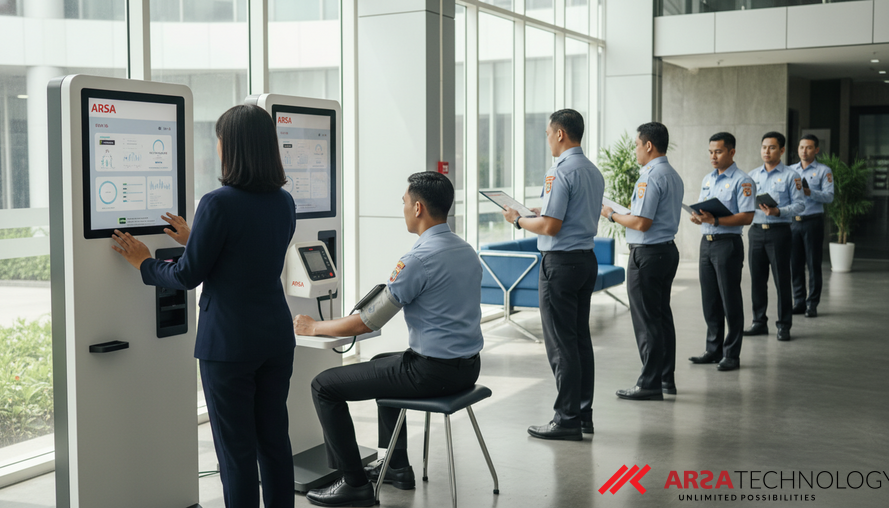
The Self-Check Health Kiosk overview from ARSA Technology is a robust, autonomous health screening station built with precision and ease of use in mind. It integrates cutting-edge AI and IoT technologies with medical-grade sensors to deliver accurate and rapid health assessments.
- Comprehensive Vital Sign Measurement: The kiosk is equipped with medical-grade sensors for precise blood pressure monitoring, blood oxygen measurement (SpO2), and heart rate monitoring. Optional modules can extend capabilities to include BMI, glucose, and cholesterol, providing a holistic health overview.
- AI-Powered Romberg Balance Test: A unique feature is the AI-powered Romberg balance test, which objectively assesses a person’s balance, crucial for roles requiring physical stability and for early detection of neurological issues.
- Secure Identity Verification: For seamless and secure record-keeping, the kiosk offers face recognition identification or QR-code based verification, ensuring data privacy and compliance with regulations like GDPR and HIPAA. This also enables integration with existing access control systems for pre-shift health screening.
- Self-Service and User-Friendly Interface: Designed for autonomy, the kiosk features a multi-language UI with voice guidance, making the health screening process intuitive for all users, regardless of technical proficiency. This self-service health check reduces clinic visits and staff intervention.
- Local Dashboard with Data Export & API Integration: All vital user data is recorded and displayed on a secure, web-based local dashboard. This data can be exported for internal analysis or integrated via REST API with existing health management systems, offering full data ownership and control. This capability is vital for organizations that prioritize data sovereignty and compliance.
Achieving ROI: How an AI Health Kiosk Can Drastically Reduce Occupational Health Costs
For CFOs and plant managers, the primary concern is often the ROI of employee health screening kiosk investments. The ARSA Self-Check Health Kiosk delivers a compelling return through several key mechanisms:
- Reduced Staffing Costs: By automating routine vital checks, the kiosk can free up a significant portion of healthcare staff time, potentially replacing the need for 2-3 full-time equivalent nurses per shift. This labor reallocation translates directly into substantial operational savings.
- Early Detection and Intervention: The kiosk facilitates early detection employee health issues technology, identifying critical readings such as hypertension, fever, or low SpO2. AI-powered smart triage alerts can automatically flag these anomalies and, if configured, route alerts to on-call physicians, reducing emergency response times by up to 73%. Proactive intervention prevents minor health issues from escalating into costly chronic conditions or emergencies.
- Enhanced Productivity and Reduced Absenteeism: A healthier workforce is a more productive workforce. By providing consistent preventive health monitoring for industrial workers and other public sector employees, organizations can reduce sick leave, improve overall morale, and ensure critical roles are adequately staffed.
- Compliance and Safety: For industrial and high-risk public sector environments, regular health screening is often a regulatory requirement (e.g., under ISO 45001). The kiosk simplifies compliance tracking, generating audit logs with tamper detection and ensuring role-based access control, aligning with internal security and compliance reviews.
- Scalability and Centralized Management: A single dashboard can manage hundreds or even thousands of kiosks across multiple sites, offering centralized firmware updates and predictive maintenance. This scalability ensures consistent health monitoring across an entire public sector entity without compromising data privacy or performance.
For a deeper dive into the financial benefits, you might find our article on How an AI Health Kiosk Can Drastically Reduce Occupational Health Costs in 2026 particularly insightful.
Deployment and Data Sovereignty in the Public Sector
Public sector entities often operate under strict data privacy and sovereignty requirements. The ARSA Self-Check Health Kiosk offers flexible deployment options, including on-premise or hybrid cloud configurations, ensuring full compliance with international data protection frameworks such as GDPR and Indonesia PDPA. All biometric data and health records remain entirely within the organization’s control, with no external data transfer unless explicitly configured. This commitment to data ownership is a cornerstone of ARSA Technology’s solutions, providing peace of mind for government and critical infrastructure operators.
Furthermore, the kiosk’s ability to integrate with existing systems via REST API means it can seamlessly become part of a broader digital transformation strategy. Whether it’s connecting to an employee management system or a centralized health database, the ARSA Health Kiosk is designed for interoperability.
For a comprehensive understanding of the financial implications and deployment considerations, consider reading What Self-Check Health Kiosk Actually Costs in 2026: A Guide to Automated Employee Health Screening for Workplace Compliance.
Beyond Health: Integrating with Broader AI Solutions
While the primary focus is on health screening, the underlying AI and IoT capabilities of ARSA’s products extend to a wide range of applications. For instance, the same principles of real-time data collection and analysis are applied in our ARSA DOOH Audience Meter (AI Box), which measures audience engagement for digital signage. This demonstrates ARSA’s versatile approach to practical AI deployment across various sectors. Our commitment is to deliver robust, production-grade solutions, not experimental prototypes.
Conclusion: A Healthier, More Efficient Public Sector
The imperative to reduce occupational health costs with AI health kiosk technology is clear for public sector organizations. The ARSA Self-Check Health Kiosk offers a powerful, cost-effective, and compliant solution for automating health screenings, enabling early detection of employee health issues, and supporting comprehensive corporate wellness programs. By embracing this innovative technology, public sector leaders can enhance workforce health, improve operational efficiency, and achieve significant long-term financial benefits.
Ready to transform your occupational health strategy and explore how ARSA Technology can help your organization? Contact ARSA solutions team today to discuss your specific needs or explore all ARSA products for a broader view of our AI and IoT offerings.
FAQ Section
What are the primary benefits of using an AI health kiosk in the public sector?
An AI health kiosk helps public sector organizations significantly reduce occupational health costs by automating routine screenings, reallocating medical staff, enabling early detection of health issues, improving productivity, and ensuring compliance with health and safety regulations.
How does ARSA’s Self-Check Health Kiosk ensure data privacy and compliance?
The ARSA Self-Check Health Kiosk supports on-premise or hybrid cloud deployment, ensuring full data ownership and compliance with international standards like GDPR and HIPAA. All biometric and health data remain within your infrastructure, with robust security features like AES-256 encryption and role-based access control.
Can the ARSA Health Kiosk integrate with existing public sector systems?
Yes, the ARSA Health Kiosk is designed for seamless integration. It offers API integration via REST API, allowing it to connect with existing employee management systems, health databases, or access control infrastructure, streamlining data flow and operational workflows.
What is the typical ROI for deploying an employee health screening kiosk?
The ROI of an employee health screening kiosk can be realized through reduced staffing costs (potentially replacing 2-3 FTE nurses per shift), decreased emergency response times due to smart triage alerts, lower long-term healthcare expenditures from early detection, and increased workforce productivity. Many organizations achieve ROI within 14-18 months.
Stop Guessing, Start Optimizing.
Discover how ARSA Technology drives profit through intelligent systems.