
Cloud API vs On-Premise SDK: Which AI Restricted Area Monitoring for Oil and Gas Facilities Approach Fits Your Stack?
For EHS Directors and operational leaders in the oil and gas sector, ensuring the highest level of safety and compliance in often hazardous environments is paramount. The challenge of effectively managing vast, complex sites with numerous restricted areas, critical infrastructure, and personnel movements is immense. This is where advanced AI restricted area monitoring for oil and gas facilities becomes indispensable, offering a transformative leap beyond traditional surveillance. However, a critical decision arises: should you opt for a cloud-based API solution or a self-hosted, on-premise SDK? This guide delves into the nuances of each approach, helping you determine the best fit for your operational realities, security mandates, and compliance requirements.
The Imperative for AI Restricted Area Monitoring in Oil and Gas Facilities
Oil and gas facilities, by their very nature, present unique safety challenges. From high-pressure pipelines and volatile chemical storage to heavy machinery and remote drilling sites, the potential for incidents is ever-present. Human error, unauthorized access, or overlooked safety protocols can lead to catastrophic consequences, both in terms of human life and environmental impact. Traditional security measures, often reliant on manual patrols and reactive monitoring, struggle to keep pace with the dynamic nature of these operations.
This is why an intelligent `intrusion detection system for hazardous zones` is no longer a luxury but a necessity. AI-powered video analytics can continuously monitor vast areas, identify anomalies, detect unauthorized personnel, and even verify PPE compliance in real-time. Such systems provide an unparalleled layer of proactive protection, significantly reducing risks and enhancing overall operational safety. For a comprehensive guide for EHS Directors on this topic, consider reading The EHS Director’s Guide to AI Restricted Area Monitoring for Oil and Gas Facilities.
Cloud API for Restricted Area Monitoring: Agility with Caveats
Cloud-based AI solutions, typically offered as APIs, promise rapid deployment and minimal infrastructure overhead. They allow organizations to leverage powerful AI models without significant upfront hardware investment or ongoing maintenance of complex servers. For certain applications, particularly those with less stringent data sovereignty requirements or where internet connectivity is consistently robust, a cloud API can offer a quick path to implementing AI capabilities.
However, for the oil and gas industry, relying solely on cloud APIs for critical safety functions like `AI restricted area monitoring for oil and gas facilities` introduces significant caveats:
- Data Sovereignty and Privacy: Sending sensitive video feeds and operational data to external cloud servers can raise serious concerns regarding data ownership, privacy, and compliance with international regulations like GDPR, CCPA, and industry-specific mandates.
- Internet Dependency: Remote oil and gas sites often have unreliable or non-existent internet connectivity. A cloud-dependent system would be vulnerable to outages, leading to critical safety blind spots.
- Latency: Real-time alerts are crucial in hazardous environments. The time taken for video data to travel to the cloud, be processed, and for an alert to return can introduce unacceptable delays.
- Recurring Costs: While initial setup might be low, ongoing cloud usage fees can escalate, especially with high volumes of video data processing.
On-Premise SDK: The Foundation for Secure AI Perimeter Protection for Mining Sites and Oil & Gas
For mission-critical environments like oil and gas facilities, an on-premise SDK (Software Development Kit) provides the control, security, and reliability that cloud solutions often cannot match. ARSA Technology’s AI Video Analytics Software overview, exemplified by the ARSA Basic Safety Guard (Software), is specifically engineered for such demanding deployments.
An on-premise SDK means the entire AI processing engine runs within your existing infrastructure – on your servers or edge devices. This approach offers several compelling advantages:
- Full Data Ownership and Control: All video streams, inference results, and metadata remain entirely within your corporate network. This ensures complete data sovereignty, simplifies compliance with regulations like ISO 45001, and eliminates concerns about third-party access. For insights into compliance, refer to this article on ISO 45001 compliant AI safety monitoring software.
- No Cloud Dependency: Operations continue uninterrupted even in environments with limited or no internet access. This is vital for `safety zone monitoring without internet` in remote drilling platforms or pipelines.
- Minimal Latency: Processing at the edge or on local servers ensures real-time analysis and instant `automated restricted zone alerts edge computing`, enabling immediate response to safety violations or intrusions.
- Enhanced Security: An air-gapped or tightly controlled network environment significantly reduces cybersecurity risks associated with external data transfers.
- Hardware-Agnostic Flexibility: ARSA’s software can be deployed on your existing servers, private data centers, or edge compute infrastructure, avoiding the need for dedicated AI appliances and ensuring a flexible deployment architecture.
- Seamless Integration: With a robust REST API, the on-premise software integrates effortlessly with your existing dashboards, alerting systems, and critical operational platforms like SCADA, providing a unified view of safety intelligence. Learn more about integrating custom solutions with ARSA Custom Web Application.
ARSA Basic Safety Guard (Software): Tailored for Oil & Gas Operations
ARSA’s Basic Safety Guard, part of our comprehensive AI Video Analytics Software suite, is an enterprise-grade solution designed to transform passive CCTV systems into active, intelligent safety platforms. It’s built for organizations that prioritize centralized AI processing, software-based procurement, and full ownership of their infrastructure.
Key capabilities include:
- PPE Detection: Automatically identifies if personnel are wearing required Personal Protective Equipment (PPE) such as helmets, vests, and masks, issuing real-time alerts for non-compliance.
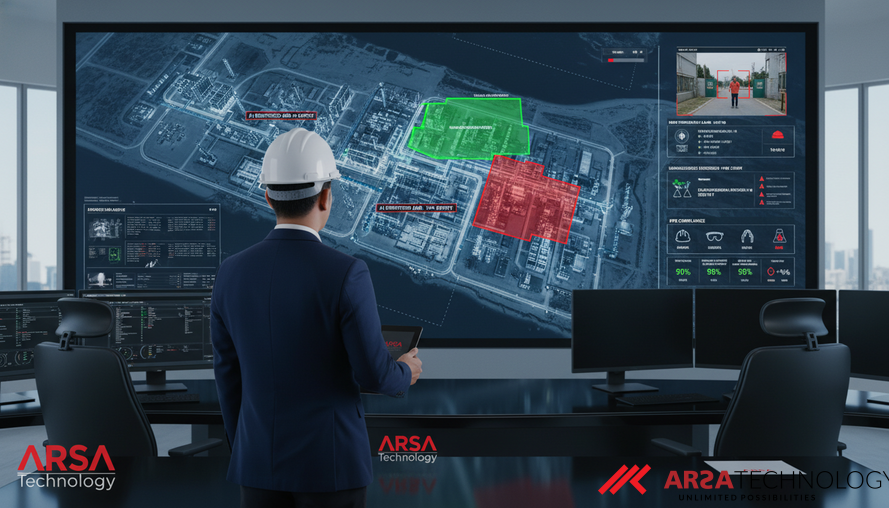
- Restricted Area Monitoring: Defines virtual perimeters and triggers instant alerts upon unauthorized entry or loitering in hazardous zones.
- Safety Violation Alerts: Detects specific unsafe behaviors or conditions, allowing EHS teams to intervene proactively.
- Compliance Reporting & Event Logging: Generates detailed, audit-ready reports and maintains comprehensive event logs, crucial for demonstrating adherence to ISO 45001 and other safety standards.
- Centralized Safety Monitoring: Deploy the software across multiple global sites and manage all analytics from a central location, providing a holistic view of safety posture.
- Scalability: Easily scale analytics capacity by allocating compute resources, rather than installing new devices at each point.
By deploying ARSA Basic Safety Guard (Software), EHS Directors can achieve significant ROI through reduced accident rates, minimized downtime, and streamlined compliance audits. The ability to maintain full data ownership and operate without cloud dependency is a game-changer for the oil and gas sector. You can see how these analytics perform in real environments by exploring our Live Dashboard Demo. For a deeper dive into implementing on-premise AI safety analytics without cloud dependency, read Implementing On-Premise AI Safety Analytics Without Cloud Dependency for Oil & Gas.
Making the Strategic Choice: Cloud vs. On-Premise for Critical Infrastructure
While cloud APIs offer convenience, the inherent demands of the oil and gas industry—namely, stringent security, data sovereignty, operational reliability in remote locations, and regulatory compliance—strongly favor an on-premise SDK approach for `AI restricted area monitoring for oil and gas facilities`. The ability to process data locally, maintain full control over sensitive information, and operate independently of internet connectivity provides an unparalleled level of assurance for critical safety operations.
ARSA Technology understands these unique challenges. Our AI Video Analytics Software, including the Basic Safety Guard module, is designed to empower enterprises and governments with robust, scalable, and secure AI solutions that work where it matters most. Explore all ARSA products to find the solution that best fits your needs.
FAQ
What are the key advantages of an `intrusion detection system for hazardous zones` in oil and gas facilities?
An intrusion detection system for hazardous zones in oil and gas facilities provides real-time alerts for unauthorized entry, enhances personnel safety by monitoring compliance with restricted areas, and reduces the risk of accidents and security breaches. It offers continuous, automated surveillance that human patrols cannot consistently achieve.
What are the key advantages of `safety zone monitoring without internet` in remote facilities?
`Safety zone monitoring without internet` ensures uninterrupted operation in remote oil and gas facilities where connectivity is unreliable or non-existent. This on-premise approach guarantees that critical safety alerts and data processing occur locally, maintaining operational reliability and security regardless of external network conditions.
How does ARSA’s AI Video Analytics Software ensure `AI perimeter protection for mining sites` and oil & gas facilities?
ARSA’s AI Video Analytics Software provides robust `AI perimeter protection for mining sites` and oil & gas facilities by leveraging advanced computer vision to detect unauthorized individuals, vehicles, and objects entering defined restricted zones. It offers real-time alerts, PPE detection, and comprehensive event logging, all processed on-premise for maximum security and control.
Can `automated restricted zone alerts edge computing` be integrated with existing security infrastructure?
Yes, `automated restricted zone alerts edge computing` solutions like ARSA’s AI Video Analytics Software are designed for seamless integration. They typically offer REST APIs that allow connectivity with existing security dashboards, SCADA systems, alerting platforms, and data pipelines, enhancing your current infrastructure with intelligent, real-time insights.
Ready to enhance safety and compliance at your oil and gas facilities with a proven, secure AI solution? Contact ARSA solutions team today to discuss your specific requirements and learn how our on-premise AI Video Analytics Software can transform your operations.
Stop Guessing, Start Optimizing.
Discover how ARSA Technology drives profit through intelligent systems.