
ISO 45001 Compliant AI Safety Monitoring Software: The Oil-Gas Industry’s Complete Solution Guide
In the high-stakes environment of the oil and gas industry, maintaining stringent safety standards is not merely a regulatory requirement but a fundamental operational imperative. Compliance leads at multinational manufacturers face the daunting task of ensuring adherence to global frameworks like ISO 45001, alongside regional mandates such as OSHA and EU OSHA. The challenge intensifies across vast, complex sites where manual safety monitoring is prone to human error and inefficiency. This is where ISO 45001 compliant AI safety monitoring software emerges as a transformative solution, offering unparalleled precision, automation, and data integrity for critical safety operations.
The integration of advanced AI video analytics into existing CCTV infrastructure provides a robust platform for proactive safety management. It moves beyond traditional reactive measures, enabling real-time detection of potential hazards and non-compliance, thereby significantly reducing incident rates and operational risks.
The Imperative for Advanced Safety in Oil-Gas
Oil and gas operations inherently involve significant risks, from hazardous materials and complex machinery to remote locations and dynamic work environments. Ensuring the safety of personnel and assets demands a comprehensive, continuously evolving approach. Traditional methods often struggle with the scale and complexity, leading to gaps in monitoring, delayed incident response, and laborious compliance reporting.
For compliance leaders, the goal is not just to avoid penalties but to cultivate a culture of safety that protects employees and enhances operational resilience. This requires tools that provide actionable insights, automate tedious tasks, and offer undeniable proof of compliance.
Key Challenges in Oil-Gas Safety Compliance
- Vast and Remote Sites: Monitoring large, geographically dispersed facilities, including offshore platforms, pipelines, and refineries, is a logistical nightmare with human patrols alone.
- Dynamic Work Environments: Constantly changing conditions, contractor movements, and varying tasks make consistent safety oversight difficult.
- Manual PPE Checks: Manually verifying Personal Protective Equipment (PPE) compliance is time-consuming, inconsistent, and often misses critical violations.
- Complex Regulatory Landscape: Navigating ISO 45001, OSHA, EU OSHA, and other regional regulations requires meticulous recordkeeping and reporting.
- Data Silos and Inconsistent Reporting: Disparate safety systems and manual data entry lead to fragmented information, hindering trend analysis and audit readiness.
How ISO 45001 Compliant AI Safety Monitoring Software Transforms Operations
ARSA Technology’s Basic Safety Guard (Software), a core component of our AI Video Analytics Software overview suite, is specifically engineered to address these challenges within the oil-gas sector. This enterprise-grade solution provides a fully self-hosted, on-premise platform that converts existing CCTV streams into real-time operational intelligence.
1. Automated PPE Compliance and Restricted Area Monitoring
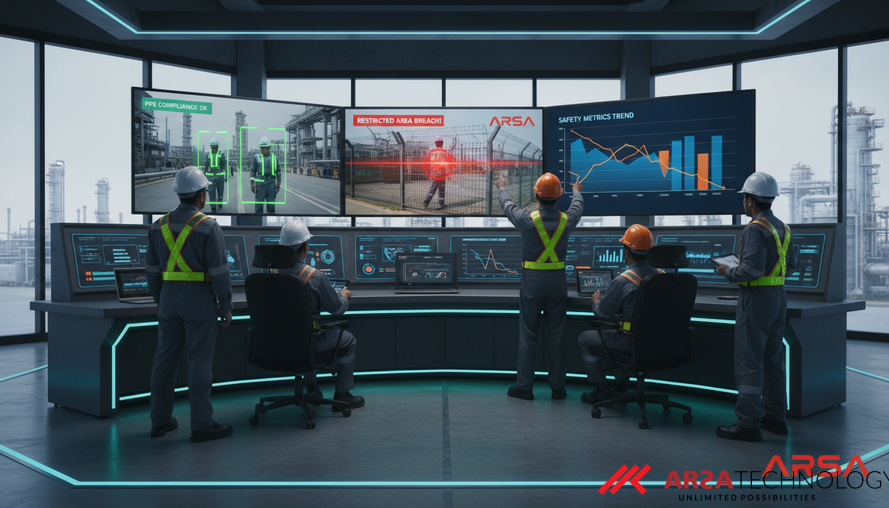
The software offers robust ISO 45001 PPE compliance automation. It leverages computer vision to automatically detect whether personnel are wearing required PPE such as helmets, vests, and masks in designated zones. Beyond PPE, it actively monitors restricted areas, instantly alerting security or operations teams to unauthorized access. This proactive monitoring ensures that safety protocols are upheld without constant human supervision, significantly reducing the risk of incidents. For instance, in a refinery, the system can identify if a worker enters a high-hazard zone without a hard hat, triggering an immediate alert. This level of detail and automation is crucial for maintaining a safe working environment and demonstrating adherence to international safety standards.
2. Streamlined OSHA Recordkeeping with AI Safety Analytics
One of the most significant benefits for compliance leads is the ability to streamline OSHA recordkeeping with AI safety analytics. The Basic Safety Guard software automatically logs all detected safety violations, PPE non-compliance events, and restricted area breaches. This creates an immutable, timestamped record of events, complete with video snippets, which is invaluable for incident investigation and regulatory reporting. This automated data collection drastically reduces the administrative burden associated with manual recordkeeping, minimizes human error, and ensures that all necessary information is readily available for audits. Furthermore, the system can generate comprehensive reports, providing clear evidence of safety performance and compliance efforts to regulatory bodies. Our article on Achieving ISO 45001 Compliance with AI Safety Monitoring Software in Warehouses further illustrates the power of such automation.
3. EU OSHA Safety Reporting Automation and Centralized Monitoring
For multinational corporations operating in Europe, achieving EU OSHA safety reporting automation is critical. ARSA’s software provides a centralized safety monitoring solution that aggregates data from multiple global sites. This allows compliance teams to generate consistent, standardized reports that meet the specific requirements of various jurisdictions. The platform’s ability to provide a comprehensive workplace safety compliance dashboard offers a unified view of safety performance across all facilities, enabling proactive identification of trends, areas for improvement, and consistent enforcement of safety policies. This centralized approach simplifies oversight and ensures that global safety benchmarks are consistently met.
4. Full Data Ownership and On-Premise Security
In the oil-gas sector, data privacy and security are paramount. ARSA’s Basic Safety Guard is designed for on-premise deployment, meaning all video streams, inference results, and metadata remain entirely within your infrastructure. There is no cloud dependency, giving you full data ownership and control. This architecture is ideal for sensitive environments, supporting air-gapped systems where external network dependencies are unacceptable. This commitment to data sovereignty aligns perfectly with strict corporate security policies and regulatory requirements like GDPR, ensuring that sensitive operational data never leaves your control.
5. Seamless Integration and Scalability
The software is hardware-agnostic, allowing deployment on existing servers, private data centers, or edge compute infrastructure. This eliminates the need for costly hardware replacements and ensures a smooth integration with your current IT and SCADA systems via a robust REST API. Whether you need to monitor a single site or scale across multiple global locations and camera networks, the system is designed for horizontal scalability, allowing you to expand analytics capacity by allocating compute resources, not by installing new devices. This flexibility makes it a future-proof investment for evolving operational needs. Our insights on Smart Safety Monitoring for Manufacturing highlight how existing CCTV can be transformed.
Business Outcomes and ROI for Oil-Gas Operators
Deploying ARSA’s ISO 45001 compliant AI safety monitoring software delivers tangible business outcomes:
- Reduced Incident Rates: Real-time alerts and automated monitoring lead to faster intervention, preventing accidents and minimizing their impact.
- Enhanced Compliance: Automated recordkeeping and reporting simplify adherence to ISO 45001, OSHA, and EU OSHA, reducing the risk of fines and reputational damage.
- Operational Efficiency: Automation frees up safety personnel from manual monitoring tasks, allowing them to focus on higher-value activities like training and strategic safety planning.
- Cost Savings: Fewer incidents mean lower insurance premiums, reduced downtime, and avoidance of costly investigations and legal fees.
- Improved Safety Culture: Consistent enforcement and transparent reporting foster a stronger, more accountable safety culture across the organization.
- Audit Readiness: Comprehensive, automatically generated reports provide irrefutable evidence of compliance for internal and external audits.
For a deeper dive into specific applications of automated PPE monitoring, you can read our article on how to Automate PPE Compliance Monitoring with AI.
Frequently Asked Questions
What is ISO 45001 compliant AI safety monitoring software?
ISO 45001 compliant AI safety monitoring software uses artificial intelligence, specifically video analytics, to automatically detect safety hazards, PPE non-compliance, and restricted area breaches in real-time, generating audit-ready reports that align with the ISO 45001 occupational health and safety management standard.
How does ARSA’s solution help with OSHA recordkeeping with AI safety analytics?
ARSA’s Basic Safety Guard software automatically logs all detected safety events and violations, creating a detailed, timestamped record with supporting video evidence. This data is then used to generate comprehensive reports, significantly simplifying and improving the accuracy of OSHA recordkeeping and incident investigations.
Can ARSA’s AI safety monitoring software assist with EU OSHA safety reporting automation?
Yes, by providing a centralized platform for safety data collection and analysis across multiple sites, ARSA’s software enables consistent and standardized reporting. This facilitates the automation of EU OSHA safety reporting, ensuring compliance with regional regulations and providing a unified view of safety performance.
What are the benefits of an on-premise workplace safety compliance dashboard?
An on-premise workplace safety compliance dashboard ensures full data ownership and control, as all sensitive safety data remains within your infrastructure without cloud dependency. This enhances security, privacy, and compliance with strict data sovereignty requirements, while still providing a real-time, comprehensive overview of safety metrics.
Conclusion
The oil and gas industry stands to gain immensely from the adoption of ISO 45001 compliant AI safety monitoring software. ARSA Technology’s Basic Safety Guard (Software) offers a robust, scalable, and secure solution that not only meets but exceeds the rigorous demands of global safety compliance. By automating critical monitoring tasks, providing actionable insights, and ensuring full data ownership, it empowers compliance leads to build safer, more efficient, and audit-ready operations.
To explore how ARSA Technology can tailor an AI safety monitoring solution for your specific oil-gas operations, we invite you to contact ARSA solutions team today. You can also learn more about all ARSA products, including our ARSA Face Recognition & Liveness API, which offers additional security layers for identity management.
Stop Guessing, Start Optimizing.
Discover how ARSA Technology drives profit through intelligent systems.