

Identity fraud statistics are easy to find and hard to compare. Four recent sources, read side by side, give the clearest public picture so far. US consumers reported losing more than $12.5 billion to fraud in 2024, a 25% increase on 2023 (Federal Trade Commission). In Europe, an estimated 42.5% of detected fraud attempts against financial institutions used AI, and 29% of those attempts succeeded (Signicat). Less than a quarter of the organisations Signicat surveyed had put measures in place against AI-driven identity fraud.
METHODOLOGY
Methodology
The report brings together four published sources. Each covers a different population, period and question, so the figures are reported side by side and are never added together or blended.
The Federal Trade Commission published its figures in March 2025. They cover fraud reported by US consumers in calendar year 2024, compared with 2023. These are losses people reported themselves, so they count consumer fraud of every kind, including fraud that has nothing to do with identity verification. Signicat surveyed 1,206 fraud decision-makers in Europe and published the results in May 2024. Its figures are the respondents' own estimates of the attempts they detected. Regula surveyed 850 fraud-prevention decision-makers for a study published in June 2026, and the figures used here are the shares of respondents who rated deepfakes a leading concern. The World Economic Forum's Global Cybersecurity Outlook 2026 is cited through Infosecurity Magazine's report of January 2026, and it measures what business leaders said they had seen and experienced.
| Source | Population | Sample | Period Covered | Published |
|---|---|---|---|---|
| Federal Trade Commission | US consumer fraud reports | Reports filed by consumers | 2024 against 2023 | March 2025 |
| Signicat | European fraud decision-makers | 1,206 | Survey of 2024 | May 2024 |
| Regula | Fraud-prevention decision-makers | 850 | Survey of 2026 | June 2026 |
| World Economic Forum, via Infosecurity Magazine | Business leaders | Not stated in the report | Outlook for 2026 | January 2026 |
Of the four, only the FTC figures measure money lost. The other three measure attempts, outcomes estimated by respondents, or concern. The findings below say which kind of figure each one is.
FINDING ONE
US Consumers Reported Losing $12.5 Billion To Fraud In 2024, Up 25%
The Federal Trade Commission reports that US consumers lost more than $12.5 billion to fraud in 2024, 25% more than in 2023. Investment scams caused the largest losses of any category, at $5.7 billion.
For a budget holder, this is the largest public loss figure that comes from a regulator and is published every year. It covers more than identity fraud. An investment scam usually persuades a real person to move their own money, and liveness detection at onboarding does nothing about that. The figure is still useful because it sets the scale of the fraud economy that identity attacks belong to, and it shows that economy growing by a quarter in a single year.
The figure has limits. It counts only the losses consumers chose to report, so the true total is very likely higher. It also covers only the United States. Buyers in the UK, Singapore, the UAE or Australia should treat it as a signal of direction and look to their own regulators for local totals.
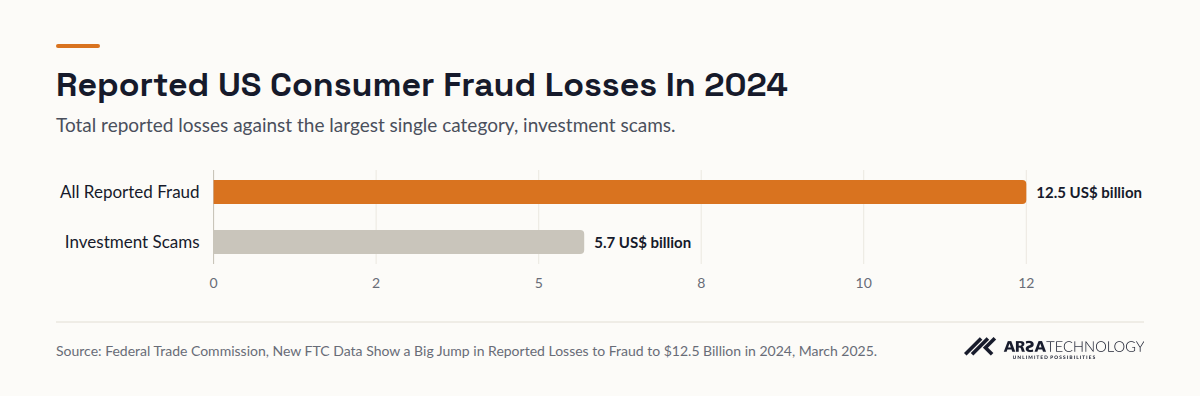
View The Data
| Reported Losses 2024 | |
|---|---|
| All Reported Fraud | 12.5 US$ billion |
| Investment Scams | 5.7 US$ billion |
FINDING TWO
The Share Of Fraud Reports Ending In A Loss Rose From 27% To 38%
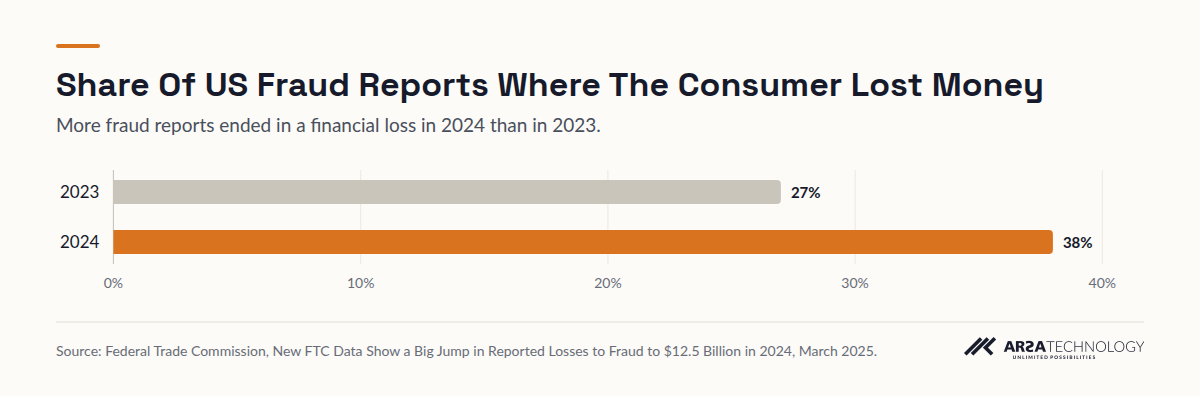
The Federal Trade Commission found that the share of fraud reports in which the consumer lost money rose from 27% in 2023 to 38% in 2024. In other words, attempts are converting into losses more often.
This finding matters more to a fraud team than the headline total does. A rising total could mean only that more people are reporting. A rising share of reports that end in a loss means the attempts themselves are getting more effective. That is the pattern you would expect if fraudsters are getting past the checks meant to stop them, and identity verification is one of those checks.
The FTC data does not say why the share rose. It does not split losses by the method of attack, so it cannot show how much of the rise came from synthetic identities, deepfakes or account takeover. It establishes the trend and leaves the cause open.
View The Data
| Reports With A Loss | |
|---|---|
| 2023 | 27% |
| 2024 | 38% |
FINDING THREE
AI Was Used In An Estimated 42.5% Of Detected Fraud Attempts In Europe
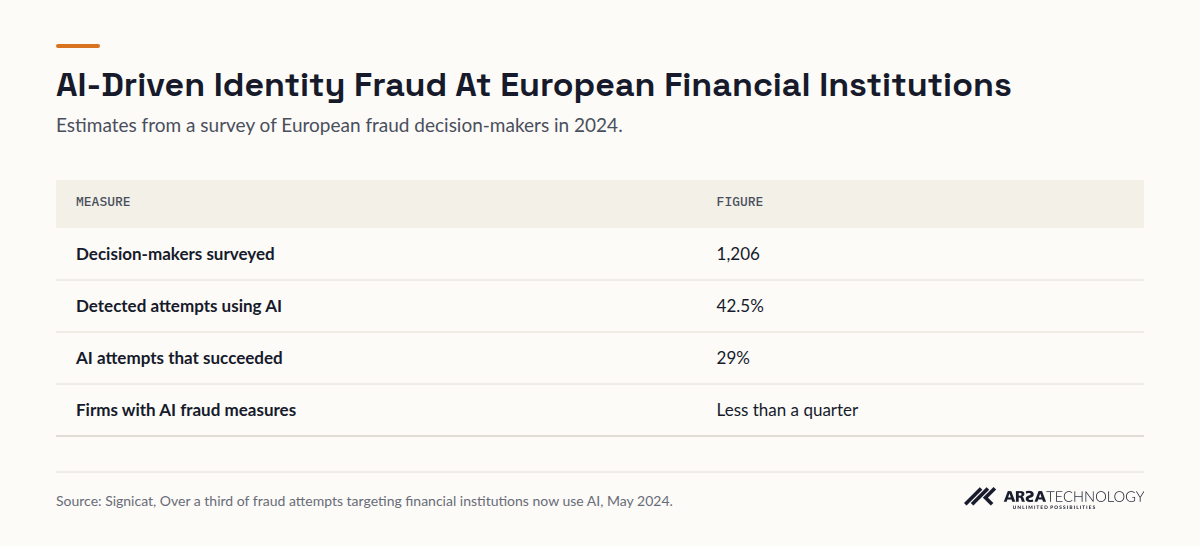
In Signicat's 2024 survey of 1,206 European fraud decision-makers, an estimated 42.5% of detected fraud attempts against financial institutions used AI, and 29% of those AI attempts succeeded. Less than a quarter of the organisations surveyed had put in place measures against AI-driven identity fraud.
This is the finding closest to the question a liveness budget has to answer. AI-generated faces, documents and video injections are what liveness detection is built to catch, and by these respondents' estimates they already made up a large share of the attempts they saw. The success rate is the part to put in front of a finance director, because it is a rate of attacks getting through, where most survey figures only measure how often attacks are tried.
Three limits apply. The figures are estimates from respondents, without a measured count behind them. They cover attempts that were detected, so attacks that got through unnoticed are missing from the base. They date from 2024, and with AI tools improving as fast as they are, the share today may well be different. The gap Signicat found between the threat and the defences in place is the most useful part for planning, because it describes the starting point of most of the organisations in the sample.
View The Data
| Measure | Figure |
|---|---|
| Decision-makers surveyed | 1,206 |
| Detected attempts using AI | 42.5% |
| AI attempts that succeeded | 29% |
| Firms with AI fraud measures | Less than a quarter |
FINDING FOUR
Singapore And The UK Reported The Highest Concern About Deepfakes
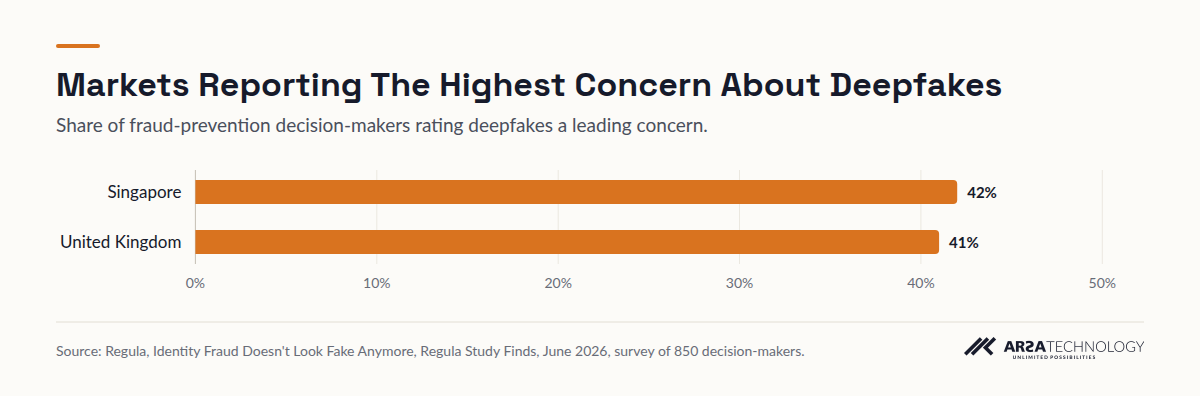
In Regula's 2026 survey of 850 fraud-prevention decision-makers, Singapore (42%) and the UK (41%) reported the highest levels of concern about deepfakes. Both are markets where digital onboarding is the normal way to open financial accounts.
For a buyer in either market, this tells you how peers see the risk. It does not measure losses. Concern tends to follow exposure, so a high share of worried decision-makers suggests deepfake attempts are reaching their onboarding flows often enough to be noticed. It also suggests that auditors and boards in those markets are likely to ask what controls are in place.
The figure measures sentiment and nothing else. An organisation can be highly concerned and well defended, or unconcerned and exposed. The press release names Singapore and the UK as the highest. It gives no full country table, so this report does not rank the other markets.
View The Data
| Concerned About Deepfakes | |
|---|---|
| Singapore | 42% |
| United Kingdom | 41% |
FINDING FIVE
Gaming, Gambling, Banking And Crypto Rate Deepfakes A Leading Concern
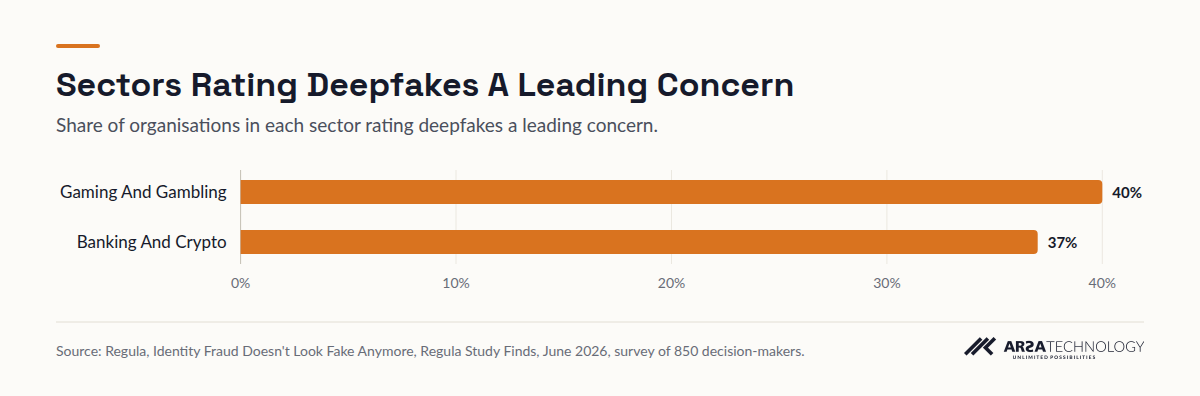
Regula's 2026 survey found that 40% of gaming and gambling organisations and 37% of banking and crypto companies rated deepfakes a leading concern. These are the sectors where an account has value as soon as it is opened.
The pattern makes sense. In gambling, crypto and banking, a verified account gives direct access to money, bonuses or a way to move funds. That makes the onboarding check the attack surface, and a convincing fake face at that moment pays off straight away. Sectors where a fake account gains an attacker less have less reason to invest in synthetic media.
As with the country figures, these are shares of respondents who are concerned. They do not show how often attacks happen or how much they cost. A sector with fewer worried respondents may simply have fewer people responsible for onboarding fraud.
View The Data
| Concerned About Deepfakes | |
|---|---|
| Gaming And Gambling | 40% |
| Banking And Crypto | 37% |
FINDING SIX
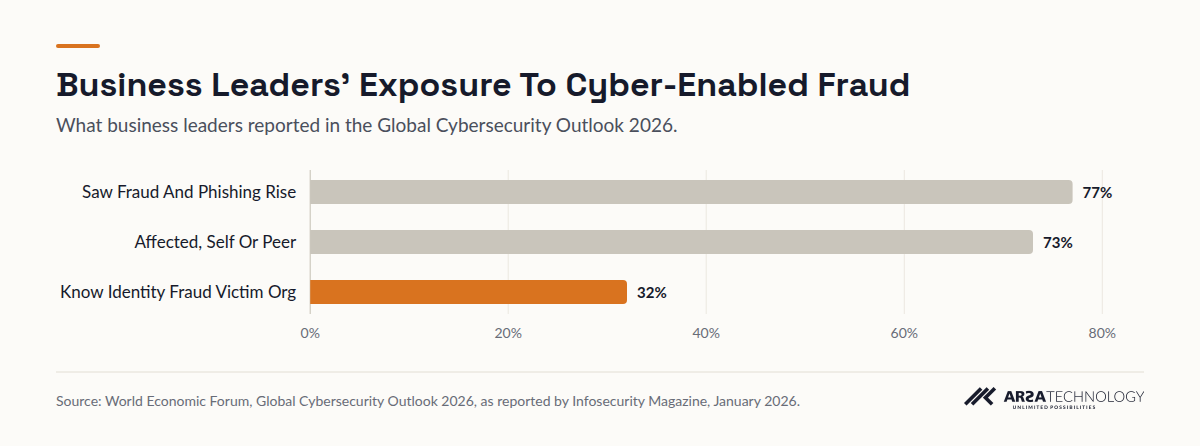
77% Of Business Leaders Saw Cyber-Enabled Fraud And Phishing Rise
In the World Economic Forum's Global Cybersecurity Outlook 2026, reported by Infosecurity Magazine, 77% of business leaders reported an increase in cyber-enabled fraud and phishing. 73% said they, or a business leader they know, had been affected by it, and 32% said they know of an organisation in their network affected by cyber-attacks involving identity fraud. The same report found that cyber-fraud had overtaken ransomware as business leaders' top cybersecurity concern.
This is the board-level view. When fraud outranks ransomware in a survey of executives, an identity verification project is easier to defend as a response to a risk the board already ranks first. The 32% figure is the most specific to identity: about a third of leaders know a peer organisation that has been hit by an attack involving identity fraud.
The figures count experiences people know about, so the same incident can be reported by several respondents. They also group fraud and phishing together. None of them can be turned into a loss figure or an attack rate.
View The Data
| Business Leaders | |
|---|---|
| Saw Fraud And Phishing Rise | 77% |
| Affected, Self Or Peer | 73% |
| Know Identity Fraud Victim Org | 32% |
LIMITS
What The Data Does Not Show
None of the four sources gives a measured, cross-market figure for losses caused specifically by identity verification fraud. The case for liveness detection rests on combining evidence of different kinds, and each kind has a gap of its own.
No Loss Figure For Identity Fraud
The FTC total covers every category of consumer fraud, and its largest category, investment scams, is one that liveness checks do not address. No source in this report puts a figure on money lost through fake identities passing onboarding.
Surveys Measure Perception
The Signicat, Regula and WEF figures come from decision-makers' estimates and concerns. They are useful for direction and for what peers think, and they are weaker evidence than counted incidents. The respondents' estimates cover only the attacks they detected.
Populations Do Not Line Up
The sources cover US consumers, European financial institutions, a group of fraud-prevention decision-makers across several countries, and business leaders worldwide, across 2024 to 2026. Comparing them shows direction. Adding them up, or reading one market's figure as another's, would misread them.
For a business case, the honest approach is to use these figures to show that the threat is large and growing, then measure your own onboarding: how many attempts are rejected at the liveness step, how many fraudulent accounts are found after approval, and what each one costs. A guide to how active liveness challenge-response works and a fintech implementation and troubleshooting guide cover the technical side of that measurement.
WHERE ARSA FITS
How ARSA Approaches Liveness Detection
ARSA's Face Recognition and Liveness SDK runs passive and active liveness inside the customer's own network. Passive liveness checks a single image for printed photos, screen replays and masks. Active liveness asks the user for a randomised sequence of head movements and checks both the order of the movements and the anti-spoof result. The licensed product makes no outbound call at inference time. That matters under UK GDPR, Singapore's PDPA and the UAE's PDPL, all of which treat biometric data with particular care.
ARSA publishes its face verification accuracy with the conditions behind it: 99.45% ± 0.18% on LFW, and 94.41% true accept at a false-match rate of 1 in 10,000 on VGGFace2, for the server model, as set out on the benchmarks page. ARSA delivers outside Indonesia, and where visa conditions prevent its engineers from travelling, a qualified local partner installs under ARSA supervision. A feasibility assessment or a pilot deployment, both listed under services, tests the models on your own onboarding traffic before any wider rollout.
FAQ
Frequently Asked Questions
How Much Does Identity Fraud Cost Each Year?
No public source gives a single global figure for identity fraud alone. The closest regulator figure is from the US Federal Trade Commission: consumers reported losing more than $12.5 billion to all types of fraud in 2024, up 25% on 2023. Identity fraud is one part of that total, and the FTC does not report it separately in these figures.
What Share Of Fraud Attempts Now Use AI Or Deepfakes?
Signicat's 2024 survey of European fraud decision-makers estimated that 42.5% of detected fraud attempts against financial institutions used AI, and that 29% of those succeeded. These are estimates by the respondents, covering only the attempts they detected.
Which Industries Are Hit Hardest By Deepfake Identity Fraud?
Regula's 2026 survey found the highest concern in gaming and gambling (40%) and banking and crypto (37%). In these sectors a verified account gives immediate access to money, which makes the onboarding check the main point of attack. The figures measure concern, so they show where the pressure is felt. They do not give a measured rate of loss.
What Is The Difference Between Active And Passive Liveness Detection?
Passive liveness analyses a single image for signs of a printed photo, a screen replay or a mask, and asks nothing of the user. Active liveness asks the user to perform a randomised movement sequence on video and checks both the sequence and the anti-spoof result. Active is stronger, and passive adds no friction for the user. Many onboarding flows use passive for every user and step up to active when risk is high.
Do These Statistics Prove Liveness Detection Pays For Itself?
No. They show that fraud losses are large and growing, that AI is used in a large share of attempts, and that most organisations had not built defences against it. Payback depends on your own fraud rate at onboarding and the cost of each fraudulent account, which you have to measure on your own traffic.
Why Do Singapore And The UK Show The Most Concern About Deepfakes?
Regula's 2026 survey found that Singapore (42%) and the UK (41%) reported the highest concern about deepfakes, though it did not explain why. Both markets rely heavily on remote digital onboarding for financial services, and that is where face-based attacks are aimed.
For a reader who wants to see how this is done in practice, ARSA's on-premise face recognition and liveness SDK is further reading, and if your onboarding figures look like these, get in touch.