
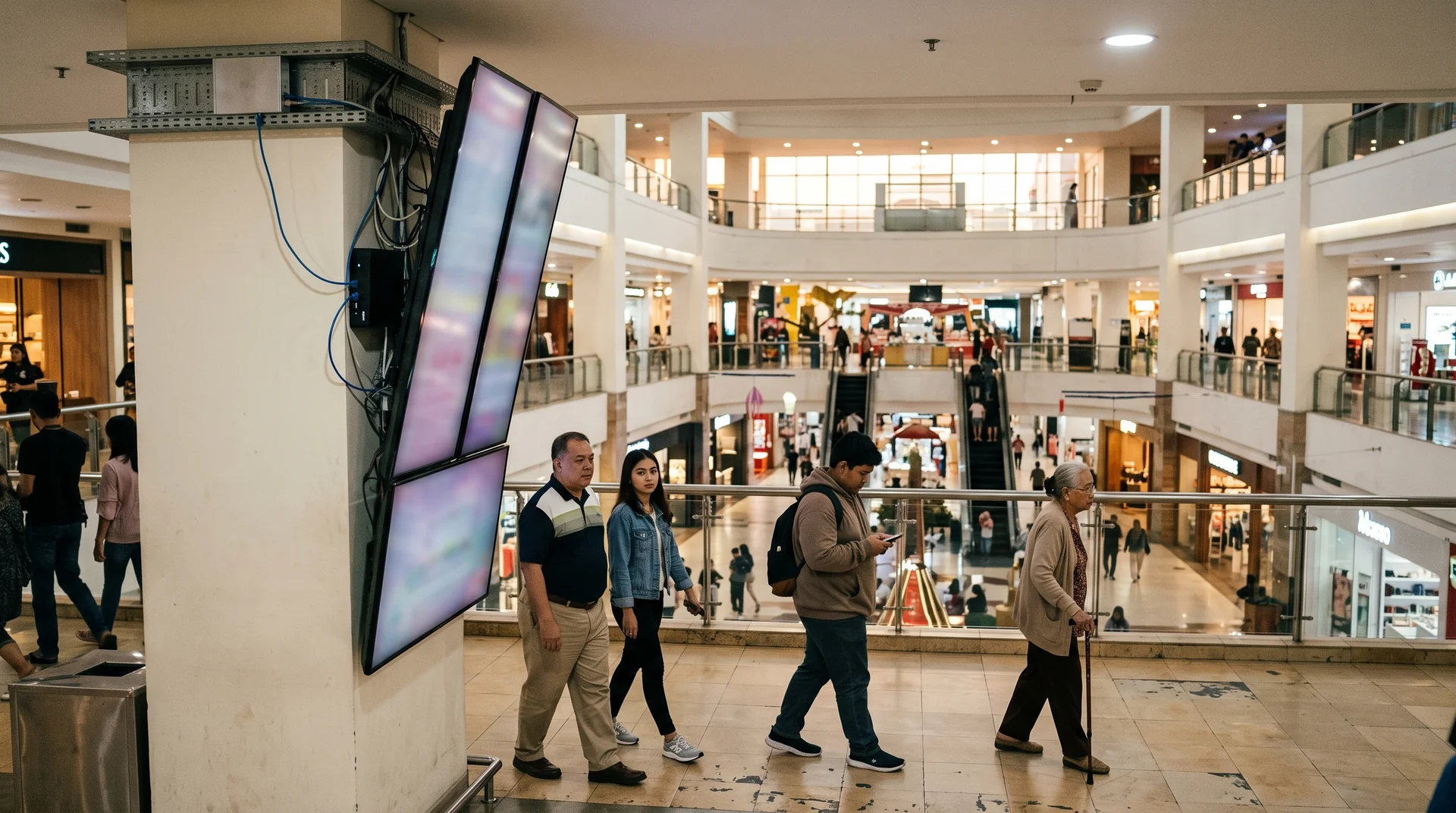

Most operators asking about audience measurement already own the screens. The videotron is installed, the media player is in the enclosure, the playout schedule runs, and the question is what can be added behind glass that is already mounted. That is a different engineering problem from specifying a measured network on paper, because the mounting height, the standoff distance and the ambient light are all fixed before the measurement question is asked.
THE RETROFIT CASE
What Changes When The Screen Is Already Installed
Retrofitting audience measurement means fitting a sensor and an inference unit to a screen whose position you cannot move. Every variable that usually gets designed around, mounting height, viewing distance, sun angle, has already been decided by whoever installed the display.
The unit itself is the easy part. The AI Box Mini mounts behind the display in the same enclosure as the media player, drawing from the existing supply, and it needs 60 mm of depth clearance in a fanless thermal envelope. There is no separate cabinet and no new network run, because processing happens on the device. What takes the engineering time is the camera: where it can see from, how far the nearest real audience stands, and whether there is enough light on a face at that distance.
Existing signage networks tend to fail on one of three fixed conditions. A screen mounted six metres up a pole on a main road has an audience that is too far away for demographic estimation. A lobby screen with a bright window behind the viewer has a face plane that sits in silhouette for four hours a day. A screen in a mall corridor is usually fine on all counts and gets instrumented first. Knowing which of the three a given site is before ordering hardware is the whole exercise.
THE GOVERNING NUMBER
Pixel Density Decides Which Screens Can Be Measured
Audience exposure counting requires 400 PPM, meaning 400 pixels across one metre of the real scene at the far edge of the detection zone. Pixel density falls as one over distance, so doubling the standoff halves it, and no configuration or model change recovers information that never reached the sensor.
That number sets a hard reach for every camera, published in ARSA-CVS-001 on the camera and site requirements page. On a standard 60 degree lens, a 2 MP camera holds 400 PPM to 4.2 m, a 4 MP camera to 5.5 m, a 6 MP camera to 6.7 m and an 8 MP camera to 8.3 m. A narrower lens roughly doubles each figure while halving the width of the area covered, which is often the right trade for a single screen where the audience approaches down one corridor or one platform. The lens and field of view visualizer shows what a given focal length actually covers at the distance you have.
Two constraints travel with the distance figure. Camera tilt for audience work is optimal between 0 and 15 degrees below horizontal and 25 degrees is the maximum, because the metric depends on frontal face visibility and a steeply angled camera sees foreheads. Minimum light at the face plane is 30 lux, and a camera facing directly into outdoor light needs at least 120 dB of wide dynamic range to hold a usable face against the background.
These figures are stricter than the ones used for safety analytics on the same standard. Helmet detection needs 262 PPM and tolerates tilt to 35 degrees, and vest detection needs 153 PPM at up to 40 degrees. Demographic estimation asks more of the image than either, which is why a camera already installed for site security rarely qualifies for audience measurement without being moved or relensed.
WHAT TO CHECK FIRST
Three Conditions That Decide A Screen
Standoff Distance
Measure from the proposed camera position to the point where the real audience stands, then compare it against the working distance for the sensor you intend to buy. Screens above 4 m mounting height with viewers directly beneath them almost always fail on tilt before they fail on distance.
Face Plane Lighting
Take a reading at the height of a viewer’s face, in the worst hour of the day, rather than at the screen. A screen that is bright at night still leaves faces at 10 lux if the surrounding area is unlit, and the screen’s own output does not count as illumination of the audience.
Camera Stream Availability
If you plan to reuse an installed camera, confirm it offers a second concurrent RTSP stream, because your recorder is typically already consuming one. Pull from the camera rather than from the NVR: NVR re-streams are transcoded, frame-dropped and time-shifted.
SITE REQUIREMENTS
The Numbers To Design Against
| Requirement | Value |
|---|---|
| Pixel density for audience exposure count | 400 PPM at the far edge of the detection zone |
| Working distance, 60 degree lens | 4.2 m at 2 MP, 5.5 m at 4 MP, 6.7 m at 6 MP, 8.3 m at 8 MP |
| Camera tilt below horizontal | Optimal 0 to 15 degrees, maximum 25 degrees |
| Minimum light at the face plane | 30 lux, with 120 dB WDR if the camera faces outdoor light |
| Camera floor | 2 MP minimum, 4 MP recommended, 15 fps minimum, ONVIF Profile S, H.264 High Profile |
| Mounting depth behind the display | 60 mm clearance for the AI Box Mini chassis |
| Attention threshold | Sustained frontal orientation above a configured 1.0 to 1.5 seconds |
| Outdoor enclosure | IP66, with IK08 recommended |
Several camera settings that look harmless on a monitor degrade analytics measurably. Smart codec variants such as H.264+ and Zipstream compress the static background where small distant faces have to be resolved and belong off on the analytic stream. Bit rate control should be constant, because variable rate starves the encoder exactly when the scene gets busy. Privacy masks are burned into the image and permanently remove detections, and corridor or rotate mode pushes the framing outside what the models expect.
WHAT YOU GET BACK
The Metrics, And The Ones That Are Not Included
The module reports opportunity to see, attention duration, estimated age band and gender, aggregated across the estate. Impressions and attention are mapped to playout schedules so a figure attributes to the right creative, and delivery is by REST API, webhook, MQTT, CSV or PDF.
Attention is defined as sustained frontal face orientation towards the display beyond a configured threshold, typically 1.0 to 1.5 seconds. A brief glance is logged as an impression and does not reach the attention count. Demographic estimation benchmarks at plus or minus five years on age bands and above 95% on binary gender when the subject is inside the 400 PPM zone in standard ambient light. Outside that zone the subject may still be counted as an impression while the demographic figure degrades, which is why the detection cone is calibrated per screen during commissioning.
Screen status and playback verification sit outside this product. If your buyers require proof that a spot actually played, that evidence comes from your CMS and media player, and you should ask ARSA how the measurement feed lines up with it rather than expecting the appliance to produce it.
Definitions matter commercially here. The OAAA OOH Impression Measurement Guidelines define opportunity to see as presence in the display exposure zone while a viewability condition holds, and the IAB and MRC Attention Measurement Guidelines, finalised at version 1.0 in November 2025, treat attention as a separate measured construct. Agreeing which definition your reporting uses before deployment avoids a dispute with a media buyer afterwards.
PRIVACY
Aggregate Counts, With No Stored Images
The module produces aggregate counts. No images are stored and no identity is created, and all processing happens on the device behind the screen.
This matters in Indonesia, where Law 27 of 2022 on Personal Data Protection, as amended by Law 1 of 2026, classifies biometric data as a specific category of personal data with a higher consent and safeguard burden. Government Regulation 33 of 2026, issued on 16 July 2026, takes effect on 16 January 2027. A system that derives an anonymous age band and discards the frame sits in a different position from one that creates a biometric template, though signage and notification obligations in public space remain the operator’s responsibility and vary by jurisdiction. Confirm your own position with counsel rather than with a vendor datasheet.
COVERAGE AND COST
Instrumenting A Sample Rather Than The Estate
Most networks instrument 10% to 15% of screens across different environment types and extrapolate estate-wide, which keeps the retrofit affordable on a network of any size.
The arithmetic is straightforward. The AI Box Mini is $1,890 and handles up to three cameras. The DOOH Audience Meter licence is $750 per screen perpetual with optional maintenance at $135 per year, or $25 per screen per month on subscription. Where you already run servers with GPU capacity, the same module is available as self-hosted software with a four-camera minimum, aggregating instrumented screens centrally and delivering into the ad server your buyers already read. Either route keeps video inside your infrastructure.
Before hardware, the site question gets answered by survey. A Remote Camera Design Review is $1,500 and returns in one week against your drawings and existing camera positions. An On-Site Camera Survey is $4,500 plus travel for up to 50 cameras. Either fee is deducted in full from the project fee if you contract within 90 days. Both are listed on the services page, and both return a pass or fail per position with priced remediation for anything that fails, so you find out which screens can carry a measurement commitment before you buy anything.
Frequently Asked Questions
What Is Audience Measurement For Digital Signage?
It is the estimation of how many people had an opportunity to see a screen, how long they attended to it, and their approximate age band and gender, aggregated over a time window. For DOOH it replaces traffic estimates and modelled circulation figures with counts taken at the screen itself, which is what a media buyer asks for when they question a rate card.
Can I Add Measurement Without Replacing My Screens Or Media Player?
Yes in most cases. The measurement unit mounts behind the display in the media player enclosure, takes power from the existing supply, and needs 60 mm of depth clearance. The screen, the CMS and the playout schedule stay as they are, and the constraint that actually decides feasibility is the camera position, its distance to the audience and the light on their faces.
Do I Need A Camera On Every Screen?
No. Networks typically instrument 10% to 15% of screens across representative environment types and extrapolate across the estate. Licensing is per screen measured, so one camera measuring one screen is one licence, and the sample rather than the estate sets the cost.
Will This Work On An Outdoor Videotron Six Metres Up?
Usually the camera has to come down from the screen. At six metres above an audience standing close to the pole, the tilt exceeds the 25 degree maximum for face visibility, and the metric depends on frontal faces. The workable arrangement places the camera lower and set back, or targets a different approach path where viewers are inside the working distance at an acceptable angle. A design review settles it against your actual site.
Does The System Need An Internet Connection?
No. Detection, aggregation and the local dashboard all run offline on the device, and connectivity is optional and off by default. Where you want campaign reporting centrally, the analytic metadata, which is counts and events rather than video, is pushed on the schedule you configure.
How Does This Handle Digital Signage Analytics In Real Time?
Live audience statistics, exposure counts per screen and peak viewing period detection run on the local dashboard as they happen, because inference is on the device next to the camera. Estate-level aggregation runs on whatever interval you set for delivery into your reporting stack.
Start With The Screens You Already Own
If your network is installed and the question is which screens can carry a measurement commitment, the sequence is a site check first and hardware second. See what the module reports, what it requires and what it costs on the DOOH Audience Meter product page, then book a design review against your own positions.
Sources: OAAA OOH Impression Measurement Guidelines, IAB and MRC Attention Measurement Guidelines v1.0, November 2025, Indonesia Personal Data Protection under the 2026 Implementing Regulation