
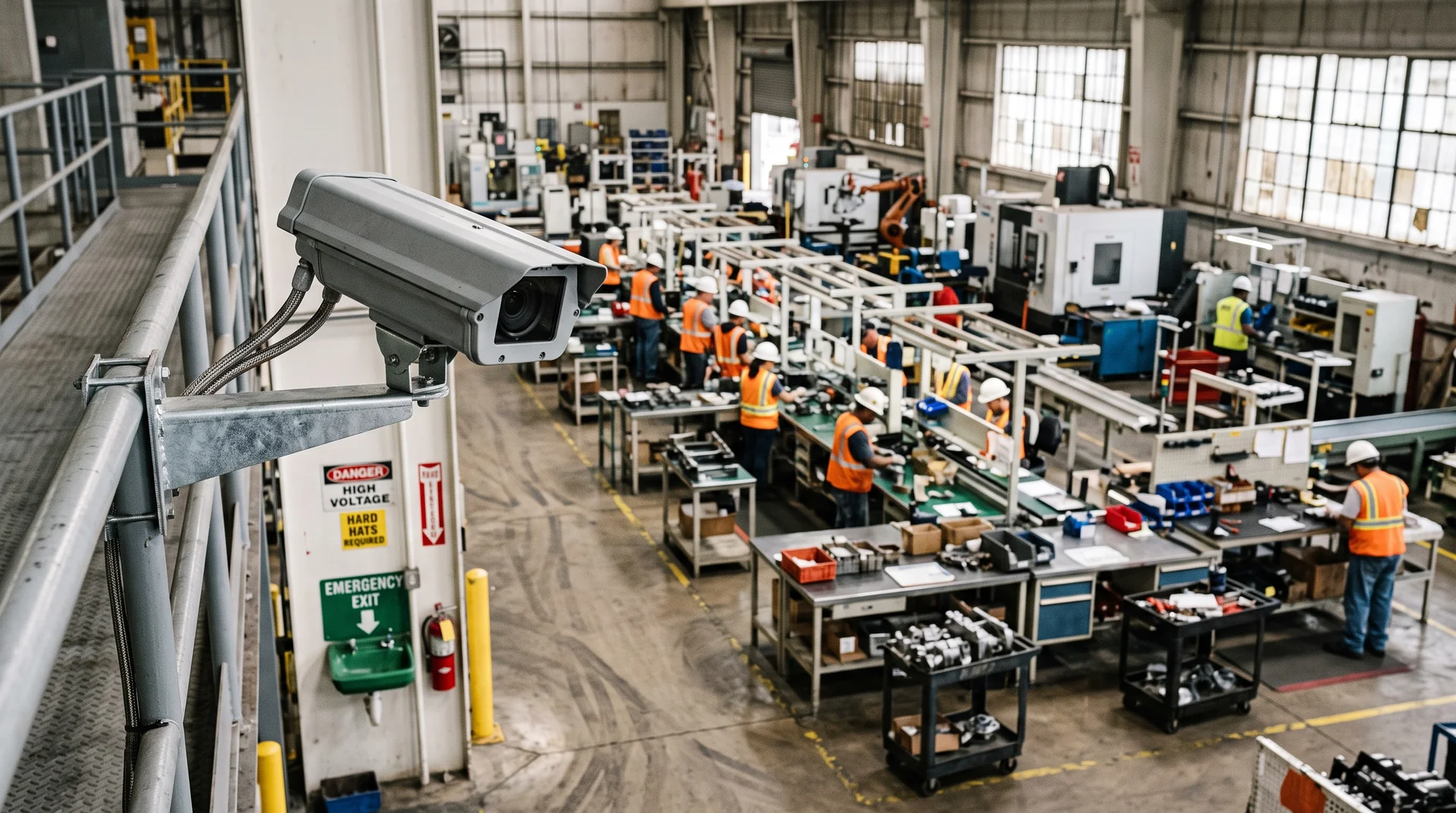

A cloud vision API sends every frame you analyse to a data centre the vendor chooses, and a custom model processes the frame on the network where the camera sits. For a product photo that difference rarely matters. For CCTV of employees, visitors and vehicle plates in London, Singapore, Sydney or Dubai, it usually decides the whole build vs buy question before accuracy or price comes up.
THE DISTINCTION
What Separates A Cloud Vision API From Custom Computer Vision
A cloud vision API is a pre-trained model you call over the internet, and it returns generic labels for whatever image you send it. Custom computer vision is a model trained on your own footage, for your own classes, and deployed on hardware you control.
The autocomplete question “custom vision vs computer vision” comes from Microsoft’s naming. On Azure, the prebuilt image analysis service returns general tags, objects and text. Custom Vision let you upload labelled images and train your own classifier or detector. Both still ran inference in an Azure region. In other words, the “custom” in Azure Custom Vision meant custom classes, and the data still went to Microsoft’s cloud. Microsoft has since announced that Custom Vision will be retired on 25 September 2028, after which calls to the service will fail. It asked customers to have a transition plan in place by 25 September 2026, a date that has now passed.
The comparison this article makes is therefore about location: where the model runs, and where the frames travel to reach it.
DATA RESIDENCY
Where The Frames Go Decides Which Law Applies
Once a camera frame showing an identifiable person leaves your network for a provider abroad, most of the markets ARSA serves treat it as a cross-border transfer of personal data, with obligations that stay with you. Processing on site keeps the frame inside your jurisdiction, so most of that analysis never starts.
In the United Kingdom, the ICO’s guidance on international transfers, updated in January 2026, treats both sending personal data and making it available by remote access to an organisation outside the UK as a restricted transfer. That transfer needs an adequacy decision or a safeguard such as the International Data Transfer Agreement. Footage used to identify a specific person by face is biometric data, which UK GDPR treats as special category data with a higher bar.
Singapore’s PDPA, under section 26, prohibits a transfer abroad unless you can ensure a comparable standard of protection is maintained. Australia’s Privacy Act goes further on liability. Under APP 8 and section 16C, as the OAIC explains, if an overseas recipient mishandles the information you disclosed to it, you are treated as having breached the principles yourself. The UAE’s PDPL, Federal Decree-Law No. 45 of 2021, allows transfers under Article 22 to countries the UAE Data Office approves as adequate. Otherwise it relies on the contract, consent and necessity grounds in Article 23.
Retention matters too. Amazon’s own Rekognition FAQ states that image and video inputs may be stored and used to improve Amazon’s machine learning technologies unless the customer opts out through an AWS Organizations policy. Opting out is possible, but someone has to know to do it, and your privacy notice has to be accurate either way.
In the United States, the same question usually reaches you through customer contracts, public sector procurement terms and sector rules.
THE DECISION
Three Questions That Settle Build Vs Buy
Three questions settle most of these decisions: whether the frames may leave the site, whether a generic label describes what you need to detect, and who is responsible for accuracy after the first year.
Can The Frames Leave The Site
If legal, a works council or a client contract says footage of people stays on premises, a cloud API is ruled out before anyone tests it. A custom model on site means only metadata crosses the network: counts, events and, where you enable them, small cropped images.
Does A Generic Label Fit Your Site
A pre-trained API knows “person”, “car” and “helmet” as they appear in public datasets. A missing chin strap, a vest that is the wrong colour for the zone, or a particular defect on your line are classes the API has never seen. Training on your own footage is what closes that gap.
Who Owns Accuracy In Year Three
A cloud model can change underneath you, or be retired, as Custom Vision shows. A custom model needs an owner too, but the update cadence is something you contract for, and the vendor cannot change it on its own.
THE COMPARISON
Cloud Vision API Vs Custom Model On Your Network
The practical differences show up in bandwidth, ownership and what happens when the internet connection drops. The bandwidth figures below assume continuous streams and come from ARSA’s camera standard. Sampling frames for a cloud API reduces the load, but the frames you do sample still leave the site.
| Factor | Cloud Vision API | Custom Model On Site |
|---|---|---|
| Where inference runs | Vendor’s cloud region | Your network, on an edge appliance or your servers |
| What leaves the site | Images or video frames | Event metadata, plus optional crops |
| Upstream data, one 4 MP camera streamed continuously | Up to 47.5 GB per day | None for inference |
| Twenty 4 MP cameras streamed continuously | About 950 GB per day | None for inference |
| Classes detected | The vendor’s general catalogue | Classes defined for your site |
| Training data | Vendor’s datasets, or yours uploaded to the vendor | Your footage, kept under terms agreed at feasibility |
| Internet outage | Detection stops | Detection continues |
| Model lifecycle | Set by the vendor’s roadmap | Set by a contracted support cadence |
| Cost profile | Low to start, rises with every call | Upfront engagement, then licence and support |
THE CAMERAS
Neither Option Fixes A Camera That Cannot See The Target
Cloud and custom models fail in the same way when the camera does not put enough pixels on the object. Software cannot recover detail that the image never captured.
ARSA’s engineering standard, ARSA-CVS-001, sets the numbers. Helmet detection needs 262 pixels per metre at the target and vest detection needs 153. The optimal tilt is 10 to 25 degrees, with maximums of 35 degrees for helmets and 40 for vests, and anything steeper than 45 degrees is prohibited for PPE. The standard also requires at least 50 lux, cameras of 2 MP minimum with 4 MP recommended, and 15 fps or faster. With a standard lens, a 2 MP camera does helmet detection out to 6.3 metres and a 4 MP camera to 8.4 metres. The accepted reference case is a 3.5 m mount, a 6.0 m standoff and a 22 degree tilt.
Checking this before choosing an architecture is cheap. A Remote Camera Design Review costs $1,500 and takes one week. It marks every camera position pass or fail and prices the fix. An On-Site Camera Survey costs $4,500 plus travel and covers up to 50 cameras. Either fee is deducted from the project if you contract within 90 days. To test a position yourself first, the lens and field of view visualiser shows what a given lens and distance can resolve.
WHEN CLOUD WINS
When A Cloud Vision API Is The Right Call
A cloud API is the sensible choice when the images contain no people, the volume is low, and nothing in your contracts or law restricts where the images go. Reading text on scanned shipping labels, tagging a product catalogue, or a two week prototype to see whether vision helps at all are reasonable uses for one.
ARSA’s own position is that data residency, cost at scale and the risk of a vendor deprecating a model are the three reasons organisations move off cloud APIs. If none of those applies to you, staying on the cloud is reasonable, and a feasibility assessment that concludes this has done its job.
THE ENGAGEMENT
What Building It With ARSA Costs And Takes
ARSA builds custom computer vision in three stages. A feasibility assessment costs from $4,500 and takes two weeks. A pilot costs from $20,000 and runs for eight weeks. A production programme costs from $60,000 to $300,000 or more and takes twelve weeks or longer. The assessment fee is deducted from the project fee if you contract within 90 days.
The assessment produces a written diagnosis, a feasibility judgement against your real site conditions, a cost model, and a go or no-go recommendation. If the answer is no, you receive the reasoning in writing and you do not proceed. Models are built with standard deep learning frameworks and compiled for the hardware you already have where it is sufficient. Otherwise they run on an ARSA AI Box, which is sold from $1,890 plus a per-camera licence. ARSA operates no cloud inference service, so video stays on your network unless you configure it to leave.
On ownership, your data stays yours in every case. A model trained only on your data for your use case is typically yours to use, and the base architecture and pretrained weights remain ARSA’s. The exact terms are agreed before work starts.
ARSA’s deployment references include a restricted area protection system for the Ministry of Defense of the Republic of Indonesia, and licence plate recognition with VIN tamper detection for the Indonesian National Police. For buyers abroad, list prices are in USD and invoices can be issued in USD or EUR. Where visa conditions prevent ARSA engineers from travelling, a qualified local partner installs under ARSA supervision.
FAQ
Frequently Asked Questions
What Is The Difference Between Azure Computer Vision And Custom Vision?
Azure’s prebuilt vision service returns general labels for any image, while Custom Vision trained a classifier or detector on images you labelled yourself. Both ran inference in Microsoft’s cloud. Microsoft will retire Custom Vision on 25 September 2028 and recommends Azure Machine Learning or its generative services as the replacement.
Does Sending CCTV Frames To A Cloud API Count As An International Transfer?
Usually yes, if the frames show identifiable people and the provider processes them outside your country. UK GDPR, Singapore’s PDPA section 26, Australia’s APP 8 and the UAE PDPL each set conditions on that transfer, and under Australian law you stay accountable for the recipient’s handling of the data.
Is A Custom Computer Vision Model More Accurate Than A Cloud API?
For site-specific classes, it usually is, because it learns from footage of your actual conditions. For general objects in clean images, a cloud API can be good enough. On either option, accuracy depends first on camera placement and pixel density.
Can A Custom Model Run On The Cameras We Already Have?
Often it can, provided the cameras meet ARSA-CVS-001 at the distances the task needs. A Remote Camera Design Review checks each position for $1,500 in one week. Where existing compute is not enough, ARSA says so in the assessment, before anything is built.
Does ARSA Build Custom Computer Vision Outside Indonesia?
Yes. International list prices are in USD, invoicing is available in USD and EUR, and where visa conditions prevent ARSA engineers from travelling, a qualified local partner installs under ARSA supervision.
NEXT STEP
Find Out Whether Your Footage Can Stay On Site
If your vision project sends frames somewhere your privacy team has not approved, start with a two week feasibility assessment. It tells you whether a custom model will work on your cameras, what it costs to build and run, and whether a cloud API would serve you just as well. Read how ARSA scopes and delivers this on the Custom Computer Vision Development page.