
The City of Raleigh, the University of British Columbia with NoTraffic, and the Port of Vancouver have each published how they run computer vision on live camera video. In all three, the operation's own limits decided where the video was processed: how fast it had to react, how much video its network could carry, and where its data was allowed to go. None of the three published a latency figure, and a buyer should know that before reading any vendor's claims.
CONTEXT
Why Public Deployments Matter More Than Feature Comparisons
Published deployments show what organisations actually built under real constraints, which a feature comparison cannot. Spending on edge computing is large enough that buyers will meet many claims. IDC puts worldwide edge computing spending at $265 billion in 2025 and expects it to nearly double by 2029, reaching $450 billion at 15% annual growth.
A comparison such as edge AI against cloud AI for enterprise video analytics explains the trade-offs in principle. The three cases below show how organisations made those trade-offs in practice, from what each one chose to publish.
CASE ONE
City Of Raleigh Counts Intersection Traffic From Live Camera Video
Raleigh, North Carolina, counts the vehicles entering and leaving its intersections in real time from its traffic cameras, using refined computer vision models. The NVIDIA Blog reported the work on March 11, 2024.
The Problem
According to the NVIDIA Blog, Raleigh's population has more than doubled in three decades. That growth brought more congestion and more concern for pedestrian safety at its intersections. Traffic engineers needed vehicle counts at intersections, and the cameras were already in place.
The Approach
The city sends live traffic camera video through NVIDIA's video analytics platform. It started with pre-trained computer vision models and had them refined by Quantiphi, an NVIDIA Metropolis partner, to count vehicles entering and exiting intersections in real time (NVIDIA Blog). James Alberque, Geoinformation Systems and Emerging Technology Manager at the City of Raleigh, told the NVIDIA Blog: "We got great accuracy level using NVIDIA pre-trained AI computer vision models for traffic cameras right out of the box."
The Result
By the city's own account, the refined vehicle counting models reached about 95% accuracy (NVIDIA Blog). The account does not say whether the video is processed at the intersection, in a city data centre or in a cloud. It gives no latency, bandwidth or deployed camera count, so a buyer learns what the system does and should ask a vendor directly about everything else.
CASE TWO
NoTraffic Cuts Signal Delays In Tucson And At UBC
NoTraffic's AI Mobility platform runs AI at the intersection to adjust signal timing, and its published results are reductions in delay. The NVIDIA Blog reported them on January 21, 2025.
The Problem
Signal timing that cannot respond to the traffic actually present wastes time for drivers and for pedestrians. A signal controller has to act within the cycle it is running, so a decision that arrives late is no use to it.
The Approach
The NVIDIA Blog describes software and hardware integrated at the edge, at the intersection, making local predictions from sensor inputs. A cloud-based operating system manages the platform and coordinates signals across intersections. At the University of British Columbia, NoTraffic deployed with Rogers. The source does not say exactly which computations run at the intersection and which run in the cloud.
The Result
Across more than 80 intersections in Tucson, Arizona, the platform reduced rush-hour road delays by up to 46%. That followed an earlier deployment on Tucson's West Ajo Way that cut average driver delay by 23% (NVIDIA Blog). At UBC, the same platform cut pedestrian delays by up to 40% across seven campus intersections and reduces carbon dioxide emissions by 74 tons each year, according to the same source.
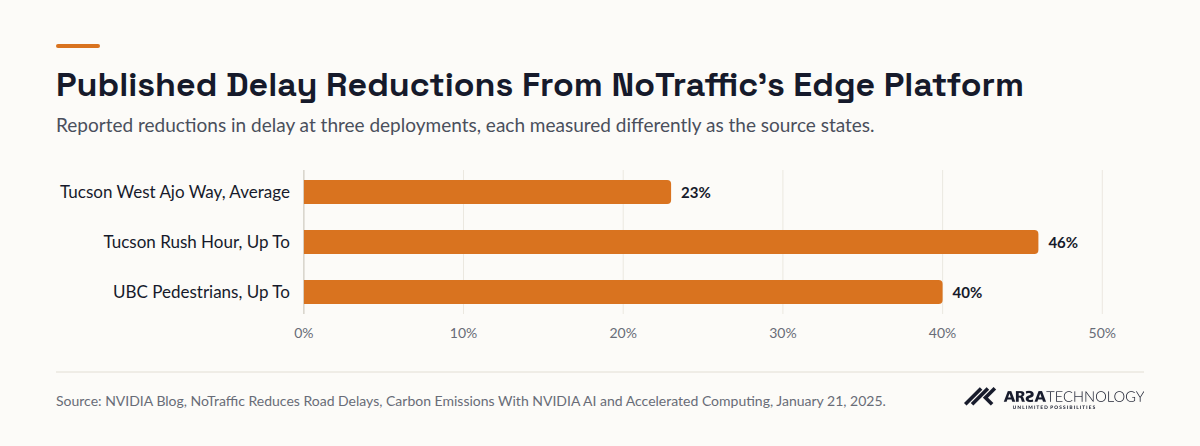
View The Data
| Delay Reduction | |
|---|---|
| Tucson West Ajo Way, Average | 23% |
| Tucson Rush Hour, Up To | 46% |
| UBC Pedestrians, Up To | 40% |
CASE THREE
Port Of Vancouver Tracks Containers At The Edge
The Port of Vancouver processes container tracking video locally at the edge, and its published reasons are bandwidth and data residency. Amazon Web Services described the work with Deloitte in a case study published in August 2021.
The Problem
By 2017, according to AWS, the container examination process had become a major source of complaints. Information was scarce, fragmented and spread across several organisations, and manual steps added cost and time. In 2018 the port and Deloitte introduced a blockchain application to improve visibility.
The Approach
The port added computer vision on AWS Panorama to track the containers selected for examination, reusing its existing IP cameras and feeding the vision data into the blockchain system (AWS). The video is processed locally at the edge and is kept out of the cloud. AWS gives three reasons: the port's operations are spread out, its bandwidth is limited, and it has data residency requirements.
The Result
The AWS case study says container inspection is faster and traffic flows better, with fewer delays and lower costs. It also says edge processing limits how much video about containers, their contents and their condition is transmitted. It gives no figures for any of these outcomes. Those numbers are not public.
READING THE CASES TOGETHER
What The Three Deployments Have In Common
All three run the analytics close to the camera wherever the decision is local, and none publishes a latency or bandwidth figure. Deloitte gives a framework for this: edge AI complements cloud AI, with reaction handled at the edge and learning handled in the core, wherever responses must be immediate.
| Deployment | Where Video Is Processed, As Published | Published Outcome | Latency Or Bandwidth Figure |
|---|---|---|---|
| City of Raleigh | Not stated in the source | About 95% accuracy for vehicle counts, by the city's own unverified account | None published |
| NoTraffic, Tucson | At the intersection, under a cloud operating system | Up to 46% less rush-hour delay across more than 80 intersections | None published |
| NoTraffic, UBC | At the intersection, under a cloud operating system | Up to 40% less pedestrian delay at seven intersections, 74 tons of carbon dioxide avoided yearly | None published |
| Port of Vancouver | Locally at the edge, kept out of the cloud | Faster inspection and fewer delays, no figures given | None published |
Latency Follows The Decision
NoTraffic's signals react inside the intersection's own cycle, so the prediction runs where the signal is. Raleigh's counts feed engineers and signal vendors, who can wait longer for an answer. Before choosing an architecture, work out how quickly your decision really has to happen. A safety alert at a loading bay and a monthly traffic report need very different response times.
Bandwidth Is A Site Constraint
The Port of Vancouver named bandwidth constraints as a reason for keeping video local. A distributed site with many cameras and a limited uplink faces the same arithmetic. Multiply each stream's bitrate by the camera count and compare the total with the uplink before you assume video can travel to a central system.
Residency Can Decide It First
The port also named data residency. Buyers in the UK under UK GDPR, in Singapore under the PDPA and in the UAE under the PDPL should settle where video may be stored and processed before they compare vendors. Edge processing narrows what has to be transmitted. It does not remove the need to govern what is kept on site.
What a buyer should copy is the order these organisations worked in: the constraint first, then the architecture. What remains unknown is just as instructive. No case publishes response times, per-camera bitrates or infrastructure cost. Ask any vendor for measured figures from a site like yours, and treat a latency claim with no test conditions as unverified.
ARSA'S APPROACH
How ARSA Handles Latency And Bandwidth On Site
The ARSA AI Box runs detection on a device on the customer's site, connected to the IP cameras already there over ONVIF or RTSP. Camera video stays on the box. Only the alerts, reports and feeds the customer sets up leave it, along with licence check-ins. The box comes in sizes for 3, 12 or 25 cameras. For organisations with their own GPU servers, the AI Video Analytics Software runs the same analytics on that hardware.
The design matches the pattern in these cases. Detection runs where the event happens, and on a perpetual licence the box keeps detecting, alerting and recording with no network connection. A subscription needs a licence check-in every 7 days. The box records every camera continuously and keeps video for 3 days by default. For sizing, ARSA's camera and network requirements list a main stream of 2.48 Mbps per camera at 2 MP and 4.4 Mbps at 4 MP. Cameras need at least 2 MP at 15 fps, and 4 MP is recommended. Under ARSA-CVS-001, vehicle counting reaches 24.9 m on a 2 MP camera.
Things to ask ARSA include how a camera position scores against ARSA-CVS-001, which a Remote Camera Design Review answers in one week, and whether a pilot deployment fits the site. ARSA delivers outside Indonesia, and where visa conditions prevent its engineers travelling, a qualified local partner installs under ARSA supervision.
FAQ
Edge AI Video Deployment Questions
What Is Edge AI Video Analytics?
Edge AI video analytics runs computer vision models on hardware near the cameras, on the site itself, instead of sending the video to a remote data centre. The Port of Vancouver case shows why organisations choose it: the analysis happens where the video is made, so less video has to cross the network.
Does Processing Video At The Edge Reduce Bandwidth?
Yes, when only events and metadata leave the site instead of continuous video. AWS says the Port of Vancouver's edge processing limits how much container video is transmitted. The saving grows with the number of cameras and the bitrate of each stream.
Do Public Edge AI Case Studies Publish Latency Figures?
Rarely, and none of the three cases here does. NoTraffic's account describes local predictions at the intersection, and Raleigh's describes real-time counting, but neither gives a response time in milliseconds or seconds. Ask a vendor for measured latency under stated conditions.
Can Edge AI Use The Cameras A Site Already Has?
Often, yes. The Port of Vancouver reused its existing IP cameras, according to AWS, and Raleigh used its traffic cameras. Whether a given camera works depends on its resolution, frame rate, mounting height and angle for the detection you need.
Does Edge AI Replace The Cloud?
Usually it complements the cloud. Deloitte describes reaction at the edge and learning in the core, and NoTraffic runs local predictions under a cloud operating system that coordinates its intersections (NVIDIA Blog).
To see how on-site detection works on existing cameras in practice, read about the ARSA AI Box Series. If you want to know how your own cameras would perform, send a few clips for a free AI assessment by an ARSA engineer.