
This glossary is for product, IT and operations leaders who are bringing in outside computer vision engineers and meet these terms in a proposal, a statement of work or a vendor call. The terms run in alphabetical order. They cover the roles on a team, the ways an engagement can be set up, the contract terms on ownership and handover, and the technical words that decide whether a model works on real cameras.
A
Acceptance Test
A written check that a delivered model or feature must pass before the client accepts it. It is stated as a measurable result on agreed data and agreed hardware, such as a detection rate on a named test set at a stated frame rate on the target board.
In a fixed-price project the acceptance tests are what the price is fixed against. If a test is vague, both sides end up arguing about it at handover.
Related: Fixed-Price Project, Validation Set, Statement Of Work.
Annotation Guidelines
The written rules that labelers follow when they mark objects in images or video. They say what counts as a helmet, how tightly to draw a box, and what to do with a person who is half hidden.
Two labelers without shared guidelines produce inconsistent ground truth, and a model learns that inconsistency faithfully.
Related: Data Labeling, Ground Truth.
B
Background IP
The tools, code libraries and trained models a supplier owned before the engagement started and brings into the work. They are usually licensed to the client and stay with the supplier.
Ask for background IP to be listed by name in the contract. Without that list, nobody can say later which parts of the delivered system the client owns outright.
Related: Intellectual Property Assignment, Pretrained Weights.
Benchmark Dataset
A fixed public collection of labeled images that researchers use to compare models under identical conditions.
A benchmark score tells you how a model performs on that collection. Your camera angles, lighting and objects can differ a great deal from it, so ask for results on your own footage as well.
Related: Validation Set, Data Drift.
Build Pipeline
The scripted, repeatable steps that turn source code and a trained model into the software that ships on a device. It runs from model conversion and compression through packaging and automated tests.
For an OEM the build pipeline is the part the firmware team has to own once the engagement ends, so put it on the handover list by name.
Related: Knowledge Transfer, Target Hardware, Handover.
C
Change Request
A written proposal to change the agreed scope of work. It states the effect on cost, timing and acceptance tests, and both sides agree it before the work continues.
Change requests stop scope from drifting quietly. They also keep the original acceptance tests valid for the work that did not change.
Related: Statement Of Work, Fixed-Price Project.
Computer Vision Engineer
An engineer who builds the models that detect, track, classify or recognize things in images and video. The work covers the data plan, labeling, training, evaluation and error analysis.
The role overlaps with machine learning engineer. What sets it apart is depth in image data, camera geometry, optics and video, which is where most field failures start.
Related: Machine Learning Engineer, Edge Engineer, Error Analysis.
Confidence Threshold
The score a model's detection must reach before the system reports it as real. Raising the threshold cuts false alarms and misses more true events. Lowering it does the reverse.
The threshold is a business decision as much as a technical one. Set it on your own footage once you know which kind of error costs you more.
Related: False Positives And False Negatives.
D
Data Drift
The gradual change in what cameras see after deployment, such as new uniforms, seasonal light, a repainted floor or a camera knocked off its angle. It lowers a model's accuracy even though no code has changed.
Drift is the most common reason a model that passed its pilot weakens a year later. The contract should name who measures it after handover.
Related: Retraining, MLOps.
Data Labeling
Marking objects, regions or events in images or video so that a model can learn from them. People do it with labeling tools, sometimes helped by an earlier model's suggestions.
Labeling is often the largest single block of effort in a vision project. Agree in writing who labels, who checks the labels and where the footage is stored while that happens.
Related: Annotation Guidelines, Training Data.
Data Processing Agreement
The contract that sets out how a supplier may handle personal data on the client's behalf. It covers what data, for what purpose, the security required, and deletion or return at the end.
Footage showing faces or number plates is usually personal data. UK GDPR requires a written contract whenever a processor handles personal data for a controller. Singapore's PDPA, the UAE's PDPL and Australia's Privacy Act each place their own duties on organizations whose data is handled by service providers or sent abroad.
Related: Repository Access, Training Data.
Dedicated Team
A group of engineers from a supplier who work on one client's product for an agreed period. They join the client's planning, repositories and reviews, and a lead on the supplier's side runs them day to day.
A dedicated team suits a roadmap that keeps changing, because the client resets the priorities every sprint and the team keeps what it has learned about the product.
Related: Staff Augmentation, Engagement Model, Tech Lead.
Definition Of Done
The shared checklist a piece of work must meet before a sprint counts it as finished. A typical list: code reviewed and merged, tests passing, model evaluated on the agreed data, and documentation updated.
For model work, write the evaluation step into the definition of done. Otherwise "done" can mean only that training finished.
Related: Sprint, Acceptance Test.
E
Edge Deployment
Running a model on a device at or near the camera, such as an appliance, a gateway or an embedded board, so that video is processed on site.
Edge deployment keeps footage local and works without an internet link. The price is tighter compute and memory, and that limit shapes every model decision from the first sprint.
Related: Edge Engineer, Target Hardware, Model Optimization.
Edge Engineer
An engineer who takes a trained model to the device it will run on. The work is converting and optimizing the model, profiling it on the target board, and building the video pipeline around it.
A model that runs well on a training workstation can be far too slow on a camera or gateway. The edge engineer closes that gap.
Related: Computer Vision Engineer, Inference, Latency.
Engagement Model
The working and commercial structure of an engineering engagement: who sets the priorities, how the scope is fixed and how the work is billed.
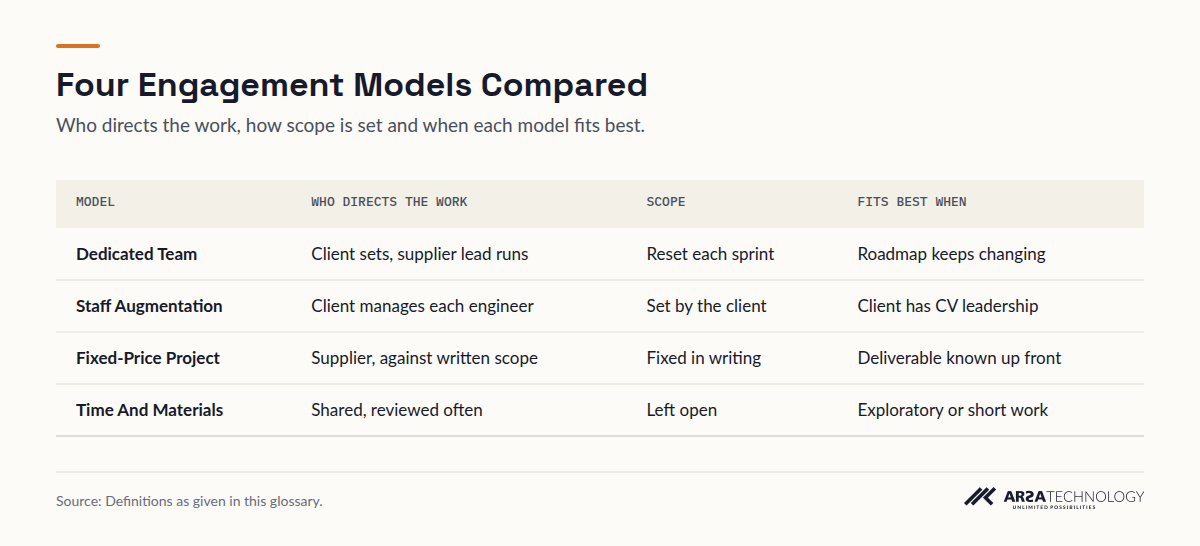
Four models come up most often. The table below compares them on the points buyers usually ask about.
View The Data
| Model | Who Directs The Work | Scope | Fits Best When |
|---|---|---|---|
| Dedicated Team | Client sets, supplier lead runs | Reset each sprint | Roadmap keeps changing |
| Staff Augmentation | Client manages each engineer | Set by the client | Client has CV leadership |
| Fixed-Price Project | Supplier, against written scope | Fixed in writing | Deliverable known up front |
| Time And Materials | Shared, reviewed often | Left open | Exploratory or short work |
Related: Dedicated Team, Staff Augmentation, Fixed-Price Project, Time And Materials.
Error Analysis
Sorting a model's mistakes by cause, such as small targets, glare, occlusion or a class that was labeled inconsistently, to decide what to fix next.
Good error analysis tells you whether the next fix is more data, better labels, a different camera position or a different threshold. Ask to see it at every milestone.
Related: False Positives And False Negatives, Computer Vision Engineer.
F
False Positives And False Negatives
A false positive is an alert for something that did not happen. A false negative is a real event the model missed.
Decide which error costs your operation more before tuning starts. A safety team may accept extra false alarms, while a busy control room may not.
Related: Confidence Threshold, Error Analysis.
Feasibility Assessment
A short study before any build that checks the site, the cameras, the available data and the target hardware, and ends in a written go or no-go recommendation.
A no-go from a feasibility assessment is a useful result. It costs far less than a pilot that fails for reasons anyone could have seen in advance.
Related: Proof Of Concept, Pilot.
Field Of View
The width of the scene a camera sees, set by the lens focal length and the sensor size. A wider field of view covers more ground and puts fewer pixels on each target.
You can try lens and distance combinations with the lens and field of view visualizer before committing to a camera position.
Related: Pixels Per Meter.
Fixed-Price Project
An engagement in which the supplier delivers a written scope against acceptance tests and milestones, for a price agreed in advance.
It suits a deliverable you can describe up front, such as a pilot, a model port to new hardware or one defined feature. It is often a sensible first step before a longer team engagement.
Related: Statement Of Work, Acceptance Test, Change Request.
Frames Per Second
The number of images per second that a camera stream delivers, or that a model processes.
Too few frames and fast events fall between them. The ARSA-CVS-001 camera standard asks for at least 15 fps for video analytics.
G
Ground Truth
The set of labels accepted as correct for a collection of images, against which a model's output is scored.
Every accuracy figure is only as good as the ground truth behind it. Ask who labeled the test set and whether they followed the same guidelines as the training set.
Related: Annotation Guidelines, Validation Set.
H
Handover
The point at which responsibility for the code, models, build pipeline, documentation and system access passes from the supplier to the client.
List every handover item in the contract by name. Anything left off the list tends to stay on the supplier's laptops.
Related: Knowledge Transfer, Build Pipeline, Repository Access.
I
Inference
Running a trained model on new images to produce detections or classifications.
Training happens occasionally, while inference runs all day on every camera. Inference speed is therefore what sets the hardware requirement.
Related: Edge Deployment, Latency, Frames Per Second.
Intellectual Property Assignment
A contract clause that transfers ownership of the code, models and documents created during an engagement from the supplier to the client.
Without the clause, ownership is less certain than many people assume. The US Copyright Office's circular on works made for hire explains that work by an independent contractor counts as made for hire only in limited categories and with a written agreement. UK and Australian copyright law generally leave a contractor's work with the contractor unless it is assigned in writing.
Related: Background IP, Pretrained Weights.
K
Knowledge Transfer
The planned work of teaching the client's own engineers to run, change and retrain what was built. It includes walkthroughs, written design decisions, paired sessions and a documented build pipeline.
Knowledge transfer belongs in the schedule from the start. If it is squeezed into the last week, the client inherits code nobody in house understands.
Related: Handover, Build Pipeline.
L
Latency
The time from a frame being captured to its result being available, for example an alert reaching an operator's screen.
Video analytics alerts usually arrive within seconds. That suits supervision, review and reporting. Stopping a machine needs a functional safety system designed for that job.
Related: Inference, Edge Deployment.
M
Machine Learning Engineer
An engineer who builds and runs models for any kind of data, such as text, tables or time series, along with the infrastructure to train and serve them.
For a vision product, check that a candidate has shipped models on camera footage. General machine learning experience does not always cover camera geometry, lighting and video streams.
Related: Computer Vision Engineer, MLOps.
Milestone
A dated point in the plan with a deliverable the client can see working, such as a demo on recorded footage or a build running on the target board.
Milestones tied to demos make progress visible. Milestones tied only to reports make it easy to fall behind without anyone noticing.
Related: Statement Of Work, Sprint.
MLOps
The practices and tooling that version data and models, retrain them, deploy new versions and monitor them in production.
Without MLOps, every model update is a manual one-off job and nobody can say which model version is running at which site.
Related: Data Drift, Retraining.
Model Optimization
Making a trained model smaller and faster for its target hardware while keeping the accuracy loss acceptable. Common methods are quantization, pruning (removing parts of the model that contribute little) and conversion to the device's runtime format.
Every optimization step should be measured on your own validation set, because a speed gain can hide an accuracy drop on exactly the cases you care about.
Related: Quantization, Edge Engineer.
O
Overlap Hours
The part of the working day when the client's team and a remote engineering team are both online. It is used for stand-ups, design reviews and decisions.
Agree the overlap hours in writing at the start, and keep the rest of the day for focused build work coordinated through the issue tracker.
Related: Dedicated Team, Sprint.
P
Pilot
A working system running on a bounded scope at a real site and measured against agreed KPIs, before a full rollout.
A pilot answers the question a proof of concept cannot: whether the system holds up on live cameras, with real operators and real integration.
Related: Proof Of Concept, Acceptance Test.
Pixels Per Meter
The number of image pixels that cover one meter of the scene at the target's distance from the camera. It is the usual way to state whether a target is large enough in the frame to detect.
Each detection task needs its own density. The ARSA-CVS-001 camera standard sets 262 PPM for safety helmets and 153 PPM for hi-vis vests. The full figures are on the system requirements page.
Related: Field Of View, Target Hardware.
Pretrained Weights
The parameters a model has already learned from a large general dataset, before it is fine-tuned on the client's own data.
Pretrained weights are often the supplier's background IP or come under a third-party licence. Check that the licence allows commercial use on your product.
Related: Background IP, Intellectual Property Assignment.
Proof Of Concept
A short test of whether an approach can work at all, usually run offline on recorded footage.
A proof of concept says little about live operation, integration or drift. Treat a good result as permission to plan a pilot.
Related: Pilot, Feasibility Assessment.
Q
Quantization
Storing a model's numbers at lower precision, for example 8-bit integers in place of 32-bit floating point values, so that it runs faster and uses less memory.
Quantization is often what makes a model fit an embedded board. Measure accuracy before and after it on your own validation set.
Related: Model Optimization, Target Hardware.
R
Repository Access
Permission for each named engineer to use the client's code hosting, issue tracker and infrastructure. It is granted at onboarding and removed when the engagement ends.
Granting access per engineer gives you an audit trail of who can see the code and the footage, and makes offboarding a checklist item.
Related: Handover, Data Processing Agreement.
Retraining
Training a model again on newly labeled data, to recover accuracy lost to drift or to add new classes.
Agree who triggers retraining, who labels the new data and who approves the new model before it reaches production.
Related: Data Drift, MLOps.
S
Source Code Escrow
An arrangement in which a supplier's source code is deposited with an independent third party and released to the client under agreed conditions, such as the supplier ceasing to trade.
Escrow matters when you license software rather than own it. When the client owns the code outright, escrow adds little.
Related: Background IP, Intellectual Property Assignment.
Sprint
A fixed working period of one to a few weeks. It starts with planning, ends with a review of what was finished, and the cycle then repeats.
With an outside team, the sprint review is where the client sees evidence of progress. Ask for a demo of running software at each one.
Related: Definition Of Done, Milestone.
Staff Augmentation
Adding individual engineers from a supplier to the client's own team, with the client managing their daily work.
Compared with a dedicated team, staff augmentation leaves architecture, planning and code review with the client. It works best when the client already has strong computer vision leadership in house.
Related: Dedicated Team, Engagement Model.
Statement Of Work
The document that lists the deliverables, acceptance tests, milestones, assumptions and exclusions of an engagement.
The exclusions matter as much as the deliverables. They say what the supplier will not do, such as camera installation or integration with a particular system.
Related: Fixed-Price Project, Change Request.
T
Target Hardware
The exact device the model must run on in production, including its processor, any accelerator, its memory and its operating system.
Name the target hardware on day one. A model designed for one board can need weeks of rework to fit another.
Related: Edge Deployment, Model Optimization.
Tech Lead
The supplier's senior engineer who owns the architecture, the plan and the communication. The tech lead reviews every merge and is the client's single point of contact.
A good tech lead writes down every decision that changes scope, cost or architecture, so the reasoning survives the engagement.
Related: Dedicated Team, Change Request.
Time And Materials
Billing by the time engineers actually spend plus agreed expenses, with the scope left open.
Time and materials suits exploratory or short tasks. On longer work it needs regular reviews of progress against goals, so that open scope does not become open-ended.
Related: Engagement Model, Fixed-Price Project.
Training Data
The labeled images and video a model learns from.
Training data should come from conditions like the ones the model will meet in deployment. The contract should say where it is stored and who may use it afterwards.
Related: Data Labeling, Validation Set, Data Processing Agreement.
V
Validation Set
Labeled images held back from training and used only to measure the model.
For a credible result, the validation set should come from the client's own cameras and never be used for training. Otherwise the score measures memory.
Related: Benchmark Dataset, Ground Truth, Acceptance Test.
ARSA
How ARSA Runs A Dedicated Engineering Team
ARSA offers its computer vision engineers, edge engineers and a tech lead either as a monthly dedicated team with a three-month minimum or as a fixed-price project against a written scope, acceptance tests and milestones. The client owns the code and the models built for it.
The engineers are the same people who build ARSA's own edge products. Their delivered work includes a restricted-area protection system for Indonesia's Ministry of Defense and plate and VIN tamper recognition for the National Police. The team is based in Indonesia at UTC+7, which gives about three hours of overlap with Central European working hours, and it works in the client's own repositories, issue tracker and chat. Each engineer is given access individually, and that access is removed when the engagement ends. When a model has to learn from production footage, training runs on infrastructure the client controls. ARSA delivers outside Indonesia, and where visa conditions prevent its engineers travelling, a qualified local partner installs under ARSA supervision. Other services are listed on the services page.
FAQ
Questions On The Terms Buyers Mix Up
What Is The Difference Between Staff Augmentation And A Dedicated Team?
With staff augmentation you manage the engineers yourself, while a dedicated team comes with its own lead who runs the daily work. In both cases the engineers join your tools and sprints. Staff augmentation suits a company that already has computer vision leadership in house. A dedicated team suits one that needs the architecture and planning covered as well.
Is A Computer Vision Engineer The Same As A Machine Learning Engineer?
A computer vision engineer is a machine learning engineer who specializes in images and video. The specialism covers camera geometry, lighting, labeling of visual data, and tracking objects across frames. For a product that runs on cameras, those skills decide whether a model survives the field.
When Is A Fixed-Price Project Better Than A Dedicated Team?
A fixed-price project is better when you can describe the deliverable and its acceptance tests before work starts. Typical examples are a pilot, a model port to new hardware or one defined feature. When priorities change from sprint to sprint, a dedicated team fits better, because a fixed scope would need constant change requests.
Who Owns A Model Built By An Outside Engineering Team?
The contract decides, so the answer depends on its intellectual property assignment clause and its list of background IP. Code and models created for you can be assigned to you outright. Pre-existing tools and pretrained weights usually stay with the supplier or a third party under licence. Read both clauses before work starts.
What Is The Difference Between A Proof Of Concept And A Pilot?
A proof of concept tests whether an approach can work at all, usually on recorded footage. A pilot runs a working system on live cameras at a real site, measured against agreed KPIs. Passing a proof of concept tells you a pilot is worth planning. It does not tell you the pilot will pass.
What Should A Knowledge Transfer Plan Include?
A knowledge transfer plan should cover the code walkthroughs, the written design decisions, the documented build pipeline, and how to retrain and redeploy a model. Schedule paired sessions in which your engineers make a real change while the supplier's engineers watch. Then confirm at handover that your team can rebuild and ship the system on its own.
For a reader who wants to see how this is done in practice, the page on ARSA's dedicated AI engineering team sets out the roles, the two engagement models and the ownership terms, and you are welcome to get in touch through it.