
What Gulf Heat-Safety Rules Mean For Construction Site Compliance Records
Every Gulf state now stops outdoor work during the hottest part of the summer day, but no two states use the same window. Qatar's runs from 10:00 am to 3:30 pm, while the UAE's runs from 12:30 pm to 3:00 pm. Inspections still find breaches. Saudi Arabia's labour inspectors recorded 1,910 midday work ban violations in a single summer, after more than 17,000 field visits. For a main contractor working across the region, a heat-safety programme counts at inspection only if the site can show records that back it.
METHODOLOGY
Methodology
This report uses six public sources, and each figure below is credited to the publisher whose page carries it. They cover the period from 2020 to the 2026 summer season.
The ban windows for the UAE, Saudi Arabia, Qatar, Kuwait and Oman come from Clyde & Co's comparative guide to the GCC midday work ban, published in mid 2026, and describe the 2026 season. Qatar's heat-index rule comes from The Peninsula Qatar, reporting the Labour Ministry in June 2026. The UAE's compliance figure comes from Gulf News, June 2026, which quotes the Ministry of Human Resources and Emiratisation (MOHRE). Saudi Arabia's enforcement figures come from Gulf News, September 2025, and cover 15 June to 26 August 2025. The global and regional heat exposure figures come from the International Labour Organization (July 2024). Some of its exposure data refers to 2020. The market size comes from P&S Intelligence (October 2025), which estimates 2025 and forecasts to 2032.
The compliance and violation figures are official counts reported in the press. Neither ministry's raw inspection data was available to check.
FINDING ONE
Five GCC States Enforce Midday Bans On Five Different Clocks
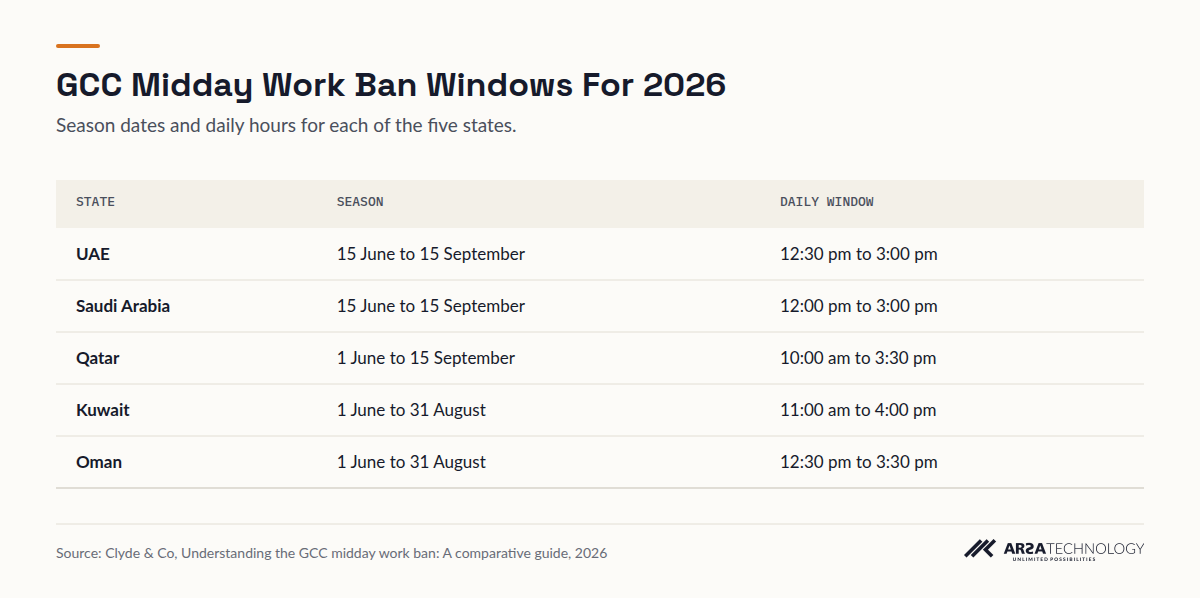
According to Clyde & Co, the UAE bans midday outdoor work from 15 June to 15 September, between 12:30 pm and 3:00 pm. Saudi Arabia uses the same dates with a window of 12:00 pm to 3:00 pm. Qatar starts earlier and stops later, from 1 June to 15 September, between 10:00 am and 3:30 pm. Kuwait runs from 1 June to 31 August, between 11:00 am and 4:00 pm. Oman runs from 1 June to 31 August, between 12:30 pm and 3:30 pm.
View The Data
| State | Season | Daily Window |
|---|---|---|
| UAE | 15 June to 15 September | 12:30 pm to 3:00 pm |
| Saudi Arabia | 15 June to 15 September | 12:00 pm to 3:00 pm |
| Qatar | 1 June to 15 September | 10:00 am to 3:30 pm |
| Kuwait | 1 June to 31 August | 11:00 am to 4:00 pm |
| Oman | 1 June to 31 August | 12:30 pm to 3:30 pm |
For a contractor with projects in more than one state, this has practical consequences. One shift pattern cannot satisfy all five rules. A crew schedule that is lawful in Dubai would break the rule in Doha, where the ban starts two and a half hours earlier. The season boundaries differ too, so a site in Kuwait resumes normal hours in September while a site in Riyadh is still restricted. Each project needs its own calendar, and its records need to show that the site kept to that calendar.
The comparison has a limit. It covers the statutory windows only. Exemptions, such as work that cannot technically be stopped, vary by state and are set out in each state's own rules. The guide should be read alongside them.
FINDING TWO
Qatar Suspends Work Above 32.1°C WBGT, Whatever The Time Of Day
The Peninsula Qatar reports that Qatar's labour ministry requires work to stop at any site where the wet bulb globe temperature (WBGT) index exceeds 32.1°C, regardless of the time of day. WBGT combines air temperature, humidity, radiant heat and air movement, so it reflects the heat a body actually experiences more closely than a thermometer reading does.
This adds a second test on top of the clock. A Qatari site can follow its 10:00 am to 3:30 pm ban perfectly and still be required to stop at 9:00 am on a humid morning. A Qatari site therefore has to keep two records: when work stopped by schedule, and what the heat index read when work continued. A heat-safety file that holds only shift times cannot show compliance with the WBGT rule.
The source does not say how often the threshold is crossed outside the ban window. It also does not say how measurements should be logged. Contractors should take the measurement method from the ministry's own guidance.
FINDING THREE
Enforcement Figures Show High Reported Compliance Alongside Repeated Breaches
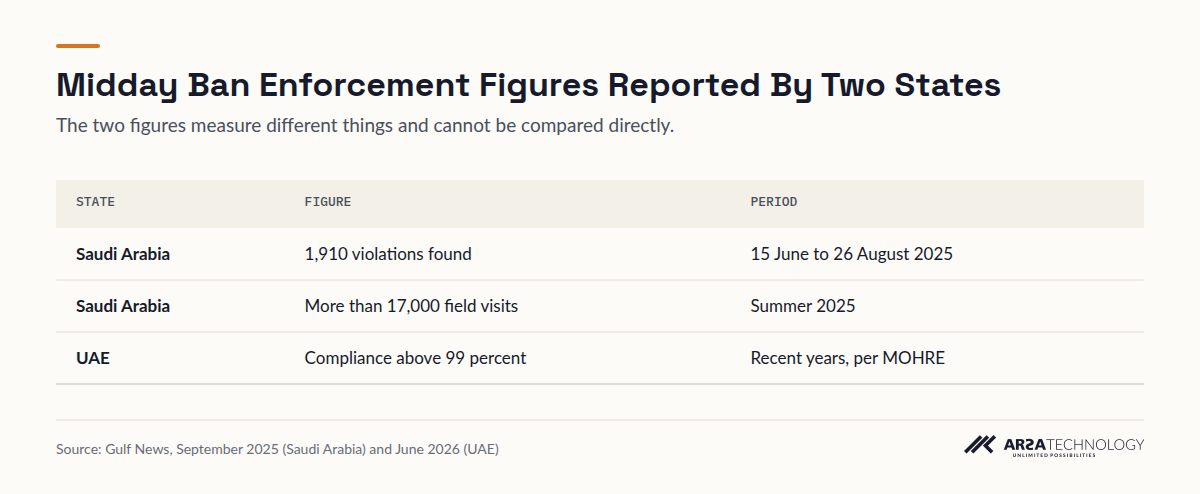
Gulf News reports that 2026 was the 22nd consecutive year of the UAE's midday work ban, and that MOHRE has recorded compliance rates above 99 percent in recent years. In Saudi Arabia, Gulf News reported that labour inspectors recorded 1,910 midday work ban violations between 15 June and 26 August 2025, after more than 17,000 field visits.
View The Data
| State | Figure | Period |
|---|---|---|
| Saudi Arabia | 1,910 violations found | 15 June to 26 August 2025 |
| Saudi Arabia | More than 17,000 field visits | Summer 2025 |
| UAE | Compliance above 99 percent | Recent years, per MOHRE |
The two figures measure different things, so they cannot be compared directly. The UAE figure is a compliance rate. The Saudi figure is a count of violations against a count of visits. Together they show that regulators are inspecting at scale, and that breaches are still found every summer even where reported compliance is high. For a buyer, the point is simple. An inspection is likely, and the contractor that can produce dated, specific records answers the inspector faster than one rebuilding a summer from memory and supervisors' notes.
Neither source breaks the violations down by sector. The construction share of the 1,910 Saudi violations is unknown.
FINDING FOUR
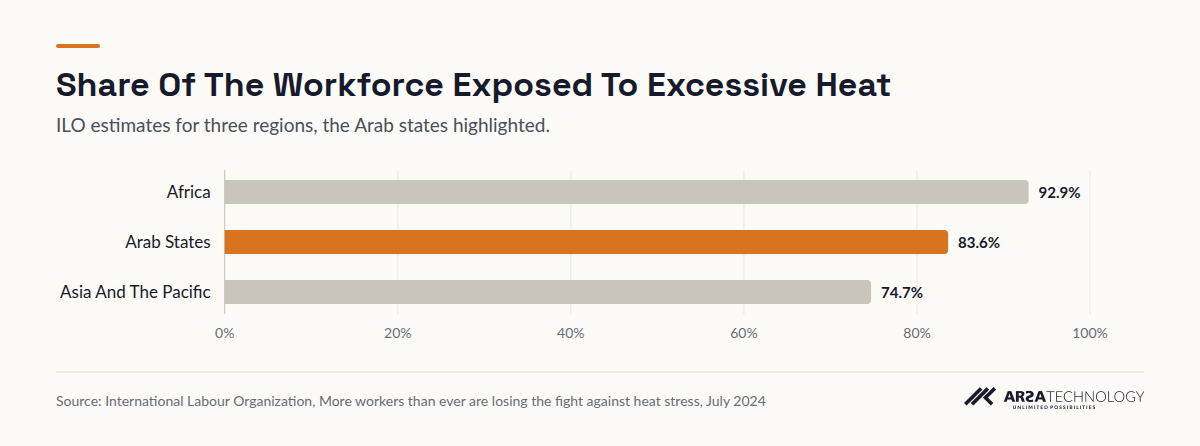
The ILO Finds 83.6 Percent Of The Arab States' Workforce Exposed To Excessive Heat
The International Labour Organization found that 83.6 percent of the workforce in the Arab states is exposed to excessive heat. The figure is 92.9 percent in Africa and 74.7 percent in Asia and the Pacific. Globally, the ILO reports that 231 million workers were exposed to heatwaves in 2020, and that nine out of ten workers worldwide were exposed to excessive heat even outside a heatwave.
View The Data
| Workforce Exposed | |
|---|---|
| Africa | 92.9% |
| Arab States | 83.6% |
| Asia And The Pacific | 74.7% |
The Arab states figure covers the whole workforce, office workers included, so the share among outdoor construction crews is likely higher. The ILO does not give a construction-only figure for the region, and this report does not estimate one. What the data does establish is that heat exposure in the Gulf is a condition of most working life there. Regulators treat it that way, which is why the bans return every year.
FINDING FIVE
Heat Causes An Estimated 22.85 Million Workplace Injuries And 18,970 Deaths A Year
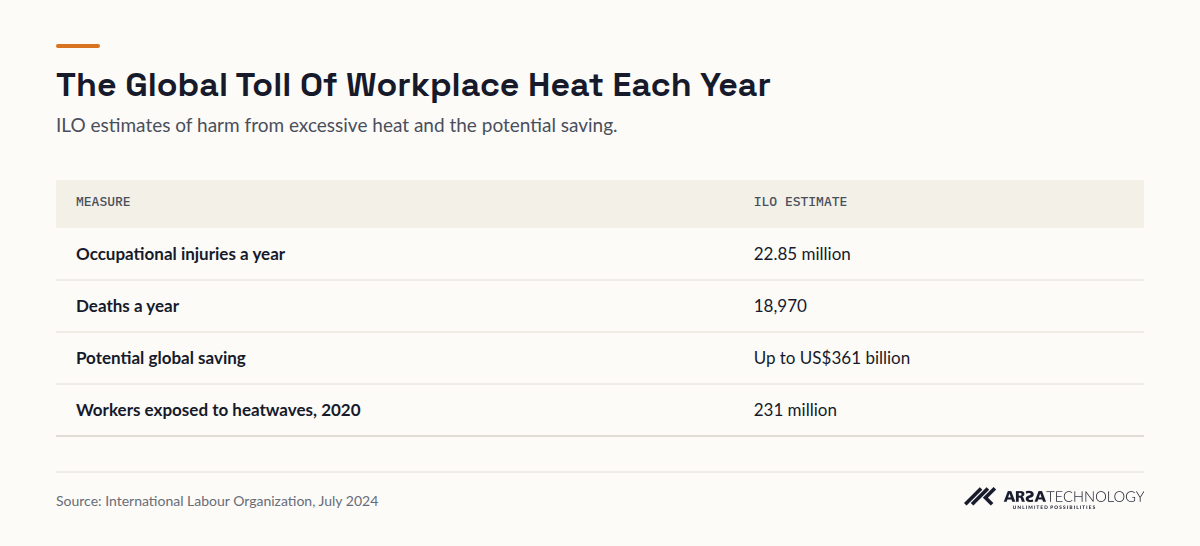
The ILO estimates that excessive heat causes 22.85 million occupational injuries and 18,970 deaths worldwide each year. It also estimates that better occupational heat safety and health measures could save up to US$361 billion globally.
View The Data
| Measure | ILO Estimate |
|---|---|
| Occupational injuries a year | 22.85 million |
| Deaths a year | 18,970 |
| Potential global saving | Up to US$361 billion |
| Workers exposed to heatwaves, 2020 | 231 million |
The injury figure matters for compliance records because heat rarely appears as the recorded cause of an incident. A worker who is dehydrated and fatigued loses concentration, removes a helmet in the afternoon sun, or steps inside a crane's lift area without looking. The incident report records a fall, a struck-by or a missing helmet. When a site's PPE and exclusion-zone records are read against the time of day and the heat index, they can show whether lapses cluster in the hottest hours. The ILO figures are global, and none of them is broken down for the Gulf or for construction.
FINDING SIX
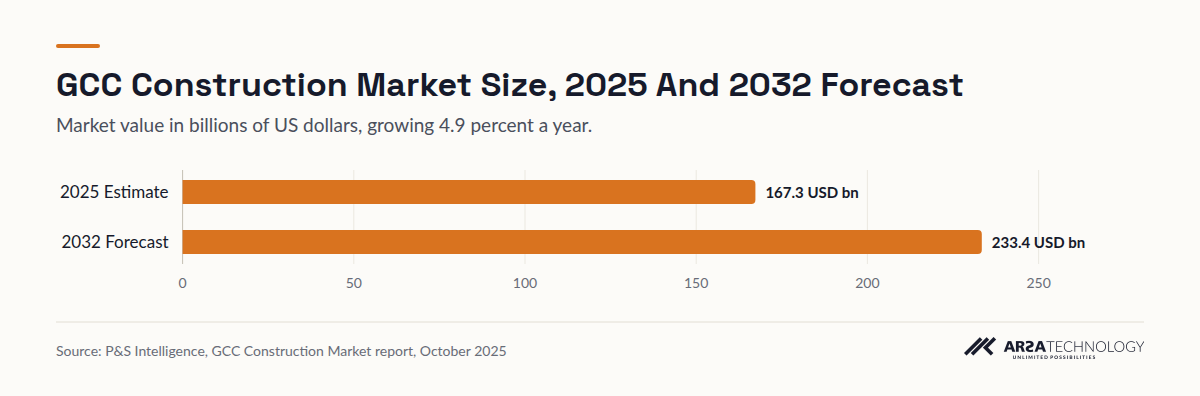
A GCC Construction Market Of USD 167.3 Billion Is Moving Toward Digital Records
P&S Intelligence estimated the GCC construction market at USD 167.3 billion in 2025. It projects annual growth of 4.9 percent, reaching USD 233.4 billion by 2032. The same report notes that the UAE and Saudi Arabia have mandated Building Information Modelling (BIM) for major public sector projects, one driver of digitalisation across the region.
View The Data
| Market Size | |
|---|---|
| 2025 Estimate | 167.3 USD bn |
| 2032 Forecast | 233.4 USD bn |
More projects mean more crews, more subcontractors and more inspections under the same heat rules. The BIM mandates show that public clients in both countries already expect project information in structured digital form. It is reasonable to expect safety evidence to move the same way, from paper checklists toward timestamped, exportable logs. This is an inference, and the market report does not make it. No source here says a regulator requires digital safety records.
GAPS
What The Data Does Not Show
None of these sources measures how heat rules affect safety outcomes on Gulf construction sites in particular. There is no published figure linking ban compliance to lower injury rates in the region. There is no construction-only breakdown of the Saudi violations. There is also no independent check of the UAE's compliance rate. The ILO exposure and harm figures are regional or global, and some refer to 2020. Qatar's WBGT rule is reported in one news source rather than taken from the ministry's own text. The market forecast is a private estimate.
These sources also say nothing about what an inspector accepts as evidence. Requirements differ by state and by authority, and a contractor should confirm them with its own HSE adviser and legal counsel in each jurisdiction.
THE RECORD
What A Defensible Heat-Season Record Holds
A heat-season compliance file is defensible when it can show what the schedule required, what the conditions were, and what actually happened on site, each with a time attached. The three parts below are separate records, and the gaps between them are where inspection questions usually land.
The Schedule
The shift plan for each site, matched to that state's ban window and season dates, with every exemption and its reason. For a group running sites in several states, this means one calendar per jurisdiction, built from the windows in Finding One.
The Conditions
Heat measurements taken by whatever method the authority expects. In Qatar that means WBGT readings that show whether the site crossed 32.1°C. Cameras and video analytics do not supply this record. It comes from heat-stress instruments and the people responsible for reading them.
The Site Events
What happened on the ground during working hours: PPE worn or missing, people entering exclusion zones around cranes, excavations and working plant, each with a time, a place and evidence. This is the record most sites keep worst. A supervisor sees part of a shift, and paper checklists are filled in after the fact.
ARSA'S ANGLE
Where Camera Analytics Fits, And Where It Stops
Camera analytics can produce the third record, site events, from the cameras a site already runs. It does not measure heat. ARSA's Basic Safety Guard checks helmets, high-visibility vests and safety boots, and raises an alert when a person enters an exclusion zone drawn around a crane, an excavation or working plant. Every event is logged with its time, camera, zone and a snapshot, and exports as CSV, Excel or PDF, so an HSE team can set PPE and zone records beside its shift and WBGT logs.
It does not read temperature or WBGT, and it does not track hours worked. It also cannot judge compliance with a heat rule. That judgement stays with the site's HSE team and the inspector. Detection runs on an AI Box on site, so video is processed in the country where it was recorded and only events go on to a head-office dashboard that can show several sites at once. Video is recorded continuously and kept 3 days by default (configurable from 1 to 90 days), so a site that expects an inspection should export its event logs on a routine.
Every AI Box or server sits in a temperature-controlled room or enclosure, which matters on a Gulf site where site offices run hotter than the hardware allows. Camera positions are checked against ARSA's camera and site standard in a Remote Camera Design Review before anything is installed. For helmet checks that means at least 262 pixels per metre at the worker and a tilt of 10 to 25 degrees. ARSA delivers in the UAE, Saudi Arabia and Qatar. Where visa conditions prevent ARSA engineers travelling, a qualified local partner installs under ARSA supervision.
FAQ
Gulf Heat-Safety Compliance FAQ
When Does The GCC Midday Work Ban Apply?
It depends on the country. According to Clyde & Co, the UAE's ban runs from 15 June to 15 September, 12:30 pm to 3:00 pm. Saudi Arabia's covers the same dates, 12:00 pm to 3:00 pm. Qatar's runs from 1 June to 15 September, 10:00 am to 3:30 pm. Kuwait's runs from 1 June to 31 August, 11:00 am to 4:00 pm, and Oman's over the same dates, 12:30 pm to 3:30 pm.
Does Qatar's WBGT Rule Replace Its Midday Ban?
No, it applies on top of it. The Peninsula Qatar reports that work must stop at any site where WBGT exceeds 32.1°C, whatever the time of day, so a Qatari site has to watch both the clock and the heat index.
What Records Should A Contractor Keep For A Heat-Safety Inspection?
Keep three: the shift schedule against the local ban window, the heat measurements, and the site's safety events with times attached. Requirements differ by authority, so confirm the exact evidence expected with an HSE adviser in each state where you operate.
Can Video Analytics Measure Heat Stress On A Construction Site?
No. Camera analytics detects PPE and people entering exclusion zones, and it logs those events with timestamps. Heat stress needs WBGT or similar instruments, and the two records are kept side by side.
Can AI Monitoring Use A Construction Site's Existing CCTV Cameras?
Usually, yes, if the cameras are IP cameras streaming over RTSP or ONVIF at 2 MP and 15 fps or better, with 4 MP recommended. Position matters as much as resolution. Many security cameras mounted high on scaffolding or a crane are too steep or too far away for helmet checks, so each camera should be checked before deployment.
How Many Midday Ban Violations Do Gulf Inspectors Find?
Saudi Arabia's inspectors recorded 1,910 violations between 15 June and 26 August 2025, across more than 17,000 field visits, according to Gulf News. The UAE reports compliance above 99 percent in recent years. Neither figure is broken down for construction.
For a reader who wants to see how this works on a live project, AI video analytics for construction sites covers PPE checks, exclusion zones and camera placement on a rising build. To see it run on your own cameras, send a few clips from them for a free AI assessment by an ARSA engineer.