
I’m drafting the article now. The research turned up enough sources: the MRC OOH Standards, the OAAA guidance, UK Route and Outsmart Playout, Australia’s MOVE and the ICO guidance.
How DOOH Operators Verify Campaign Delivery With Audience Data
A proof of play log tells an advertiser that a creative ran on a given screen at a given second. It says nothing about whether anyone was standing in front of that screen at the time. This guide covers what a buyer of digital out-of-home inventory should ask an operator for before paying, and what camera-based audience data can and cannot add to that answer.
THE GAP
What Proof Of Play Proves, And What It Leaves Open
Proof of play confirms that a spot was delivered. Audience data estimates who had the chance to see it. An advertiser needs both. A log of 4,000 plays on a screen facing an empty corridor is a complete record of a campaign that nobody saw.
Proof of play comes from the operator’s content management system and media players. Industry guidance compiled by the OAAA and its partner bodies separates two documents. Proof of play is the confirmed venue list with its initial playback counts. Proof of performance is the verified venue list with final playback showing that the contract terms were met (OAAA, DOOH: Measuring Success). The OAAA has also noted that operators still verify their own playout across much of the market, and it argues for independent checks down to the individual play (OAAA).
Audience is a separate question with a separate standard. The Media Rating Council’s Out-of-Home Measurement Standards, Phase 1, were published in April 2024 with DPAA, Geopath and the OAAA taking part. They set out a ladder that runs from location traffic through gross impressions to viewable impressions, also called opportunity to see, and then to likelihood to see (MRC Phase 1). Each rung asks for more evidence that a person was present while the display was on and visible. A play log by itself does not reach the first rung.
Other markets are joining the two data sets. In the UK, Route is building a link between its audience data and Outsmart’s Playout data. Its stated aim is to report delivered audiences in place of planned ones (Outsmart, April 2026). In Australia, MOVE is now the industry’s common currency for planning, buying and reporting (Mediaweek).
THE ADVERTISER’S SIDE
What To Demand Before Paying For Inventory
Ask the operator for four things: the play log, the audience count for the same time windows, the definitions behind both numbers, and the conditions under which the count holds. Disputes over a DOOH invoice usually start with the last two.
Plays Matched To Audience Windows
The audience count should be reported against the schedule your creative ran on. If the play log is broken down by spot and the audience report by day, the two cannot be reconciled for your campaign, and the operator is asking you to take the overlap on trust.
Definitions You Can Audit
Get the definitions of an impression and of attention in writing: what counts as present, which way a face must point, and for how long. Two vendors can both report “attention” and be measuring different things. A cost per thousand built on the looser definition looks cheaper than it is.
The Measured Sample Named
Most networks put sensors on part of the estate and extrapolate to the rest. Ask which screens carry sensors and which environments they stand for. Then ask which of your plays ran on measured screens and which ran on screens whose audience was modelled.
HOW ARSA MEASURES
How The DOOH Audience Meter Produces Its Numbers
The ARSA DOOH Audience Meter counts impressions and attention at each instrumented screen and estimates age band and gender anonymously. It then aggregates the results by time window so they can be mapped to the playout schedule. It does not write the proof of play log, which stays with the operator’s content management system.
There are two ways to deploy it. On the edge route, an AI Box Mini fits in the media player enclosure behind the display. It needs 60 mm of depth clearance, takes power from the existing supply and needs no new network run. On the self-hosted software route, the analytics run on the operator’s own servers and instrumented screens stream back over the existing network. In both cases no images are stored and no identity is created.
An impression is logged when a face is detected inside the 400 PPM measurement cone, facing the display, for a sustained duration. Attention is the stricter test: the face must stay turned frontally towards the screen for longer than a configured threshold, typically 1.0 to 1.5 seconds. A brief glance counts as an impression and is left out of the attention figure. This split resembles the MRC distinction between opportunity to see and likelihood to see. Before treating any vendor’s numbers as trading currency, ARSA’s included, ask whether the method has been audited against those standards.
Results are exported as CSV or PDF, or pushed by REST API, webhook or MQTT into the ad server or reporting platform the buyer already reads. The software platform keeps an immutable audit log under role-based access control. An advertiser can reasonably ask the operator what that log records and whether the entries covering their campaign can be shared.
| Item | Value |
|---|---|
| Impression rule | Face detected in the 400 PPM cone, facing the display, sustained |
| Attention rule | Frontal orientation past a threshold, typically 1.0 to 1.5 s |
| Age estimate | Within 5 years, inside the 400 PPM zone in standard ambient light |
| Gender estimate | Above 95% binary, under the same conditions |
| Viewing distance | Up to 4.2 m on a 2 MP camera with a 60 degree lens, 8.3 m on 8 MP |
| Light at the face plane | 30 lux minimum, WDR 120 dB where the camera faces outdoor light |
| Camera angle | 0 to 15 degrees below horizontal optimal, 25 degrees maximum |
| Depth behind display | 60 mm minimum for the AI Box Mini |
| Output | CSV, PDF, REST API, webhook, MQTT |
| Images stored | None |
THE LIMITS
Where The Numbers Stop Being Valid
Audience figures hold only inside the camera geometry they were measured under. Outside the 400 PPM zone, the accuracy figures above no longer apply.
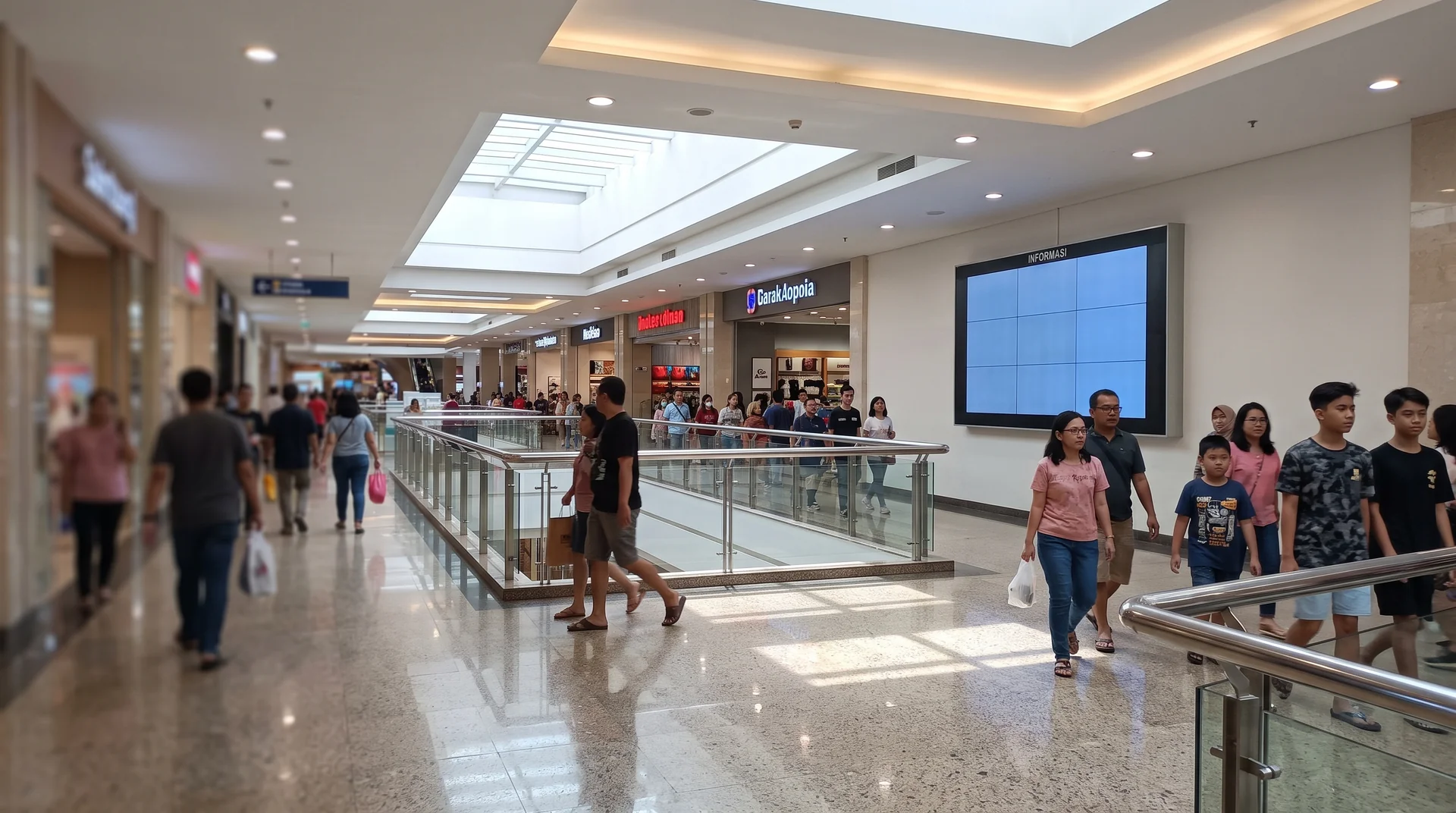
Pixel density falls as distance grows. Under ARSA’s camera standard, ARSA-CVS-001, a 2 MP camera with a standard 60 degree lens reaches 400 PPM out to 4.2 m. A 4 MP camera reaches 5.5 m, a 6 MP camera 6.7 m and an 8 MP camera 8.3 m. A roadside billboard read by drivers from thirty metres away is beyond what a face-based meter can see, and an operator selling that inventory with camera-measured attention should be asked how. The meter fits screens that people view at walking distance, such as mall concourses, transit stations and retail entrances.
Angle and light set the other two boundaries. A camera tilted more than 25 degrees below horizontal loses the frontal view that attention depends on. Below 30 lux at the face plane, demographic estimates lose their stated accuracy. Then there is the sample. Most networks instrument around 10 to 15% of screens and extrapolate, so every extrapolated figure is a model and should be labelled as one in the report.
Operators can check each screen position before committing. ARSA’s Remote Camera Design Review costs $1,500 and takes one week. An On-Site Camera Survey costs $4,500 plus travel and covers up to 50 cameras. Either fee is deducted from the project fee if the project is contracted within 90 days.
PRIVACY
What Privacy Law Asks Of The Operator
A camera pointed at the public brings the operator under data protection law, even when the output is only aggregate counts. In the UK, the ICO’s guidance on video surveillance covers facial recognition. It treats facial images that are processed to identify a person as biometric data under UK GDPR (ICO). Singapore’s PDPA and the UAE’s PDPL impose their own duties to notify people and to have a purpose for collecting their data.
The ARSA meter produces aggregate counts only, stores no images and creates no identity. Notices, signage and any impact assessment remain the operator’s responsibility, and they vary by jurisdiction. An advertiser putting a brand on a measured screen is entitled to ask to see them.
FAQ
Frequently Asked Questions
What Is Proof Of Play In DOOH Advertising?
Proof of play is the operator’s record that a specific creative ran on a specific screen at a specific time. It is produced by the content management system and media players and usually lists screen, timestamp, duration and completion. On its own it shows that the spot was delivered. It does not show that anyone saw it.
Does The ARSA DOOH Audience Meter Generate Proof Of Play Logs?
No. The meter measures impressions, attention and anonymous demographics, aggregated by time window. The operator maps those windows to the playout schedule from their own content management system, so the play log and the audience figures come from two systems that are joined in reporting.
How Is Attention Different From An Impression?
Attention requires a face to stay turned towards the screen past a set threshold, typically 1.0 to 1.5 seconds. An impression only requires a face detected in the measurement cone facing the display. Attention is the smaller and more demanding number, which is why the definition behind it matters when you compare vendors.
Does An Operator Need A Sensor On Every Screen?
No. Most networks instrument a representative 10 to 15% of screens across their environment types and extrapolate to the rest of the estate. Buyers should ask for measured and modelled figures to be reported separately.
What Does Audience Measurement Cost Per Screen?
The DOOH Audience Meter licence is $25 per screen per month billed annually, or $750 perpetual with optional maintenance of $135 a year. On the edge route, the AI Box Mini costs $1,890 and handles up to three cameras. The self-hosted software has a four-camera minimum.
Does ARSA Deliver Outside Indonesia?
Yes. International list prices are in USD, and invoicing is available in USD or EUR. Where visa conditions prevent ARSA engineers from travelling, a qualified local partner installs the system under ARSA supervision. AI Box units ship from Surabaya in three to four weeks, and the buyer handles import duty, VAT and customs clearance.
NEXT STEP
See The Audience Meter Report A Campaign
The demo dashboard shows impressions, attention rate and demographic splits the way a campaign report would show them. Pricing, site requirements and deployment steps are on the DOOH Audience Meter page. For a wider look at how screen audiences are counted, see how to measure a digital billboard audience.