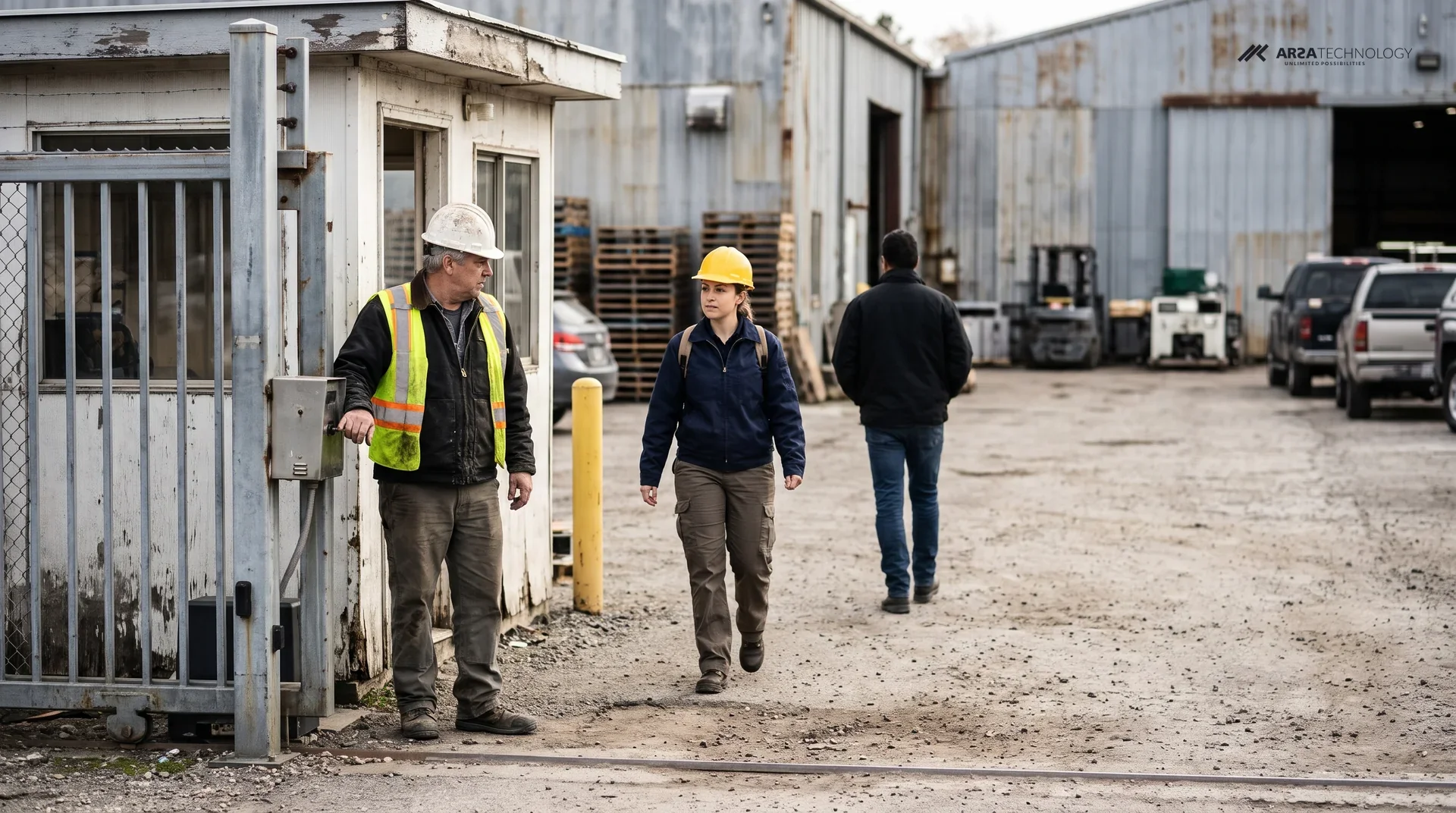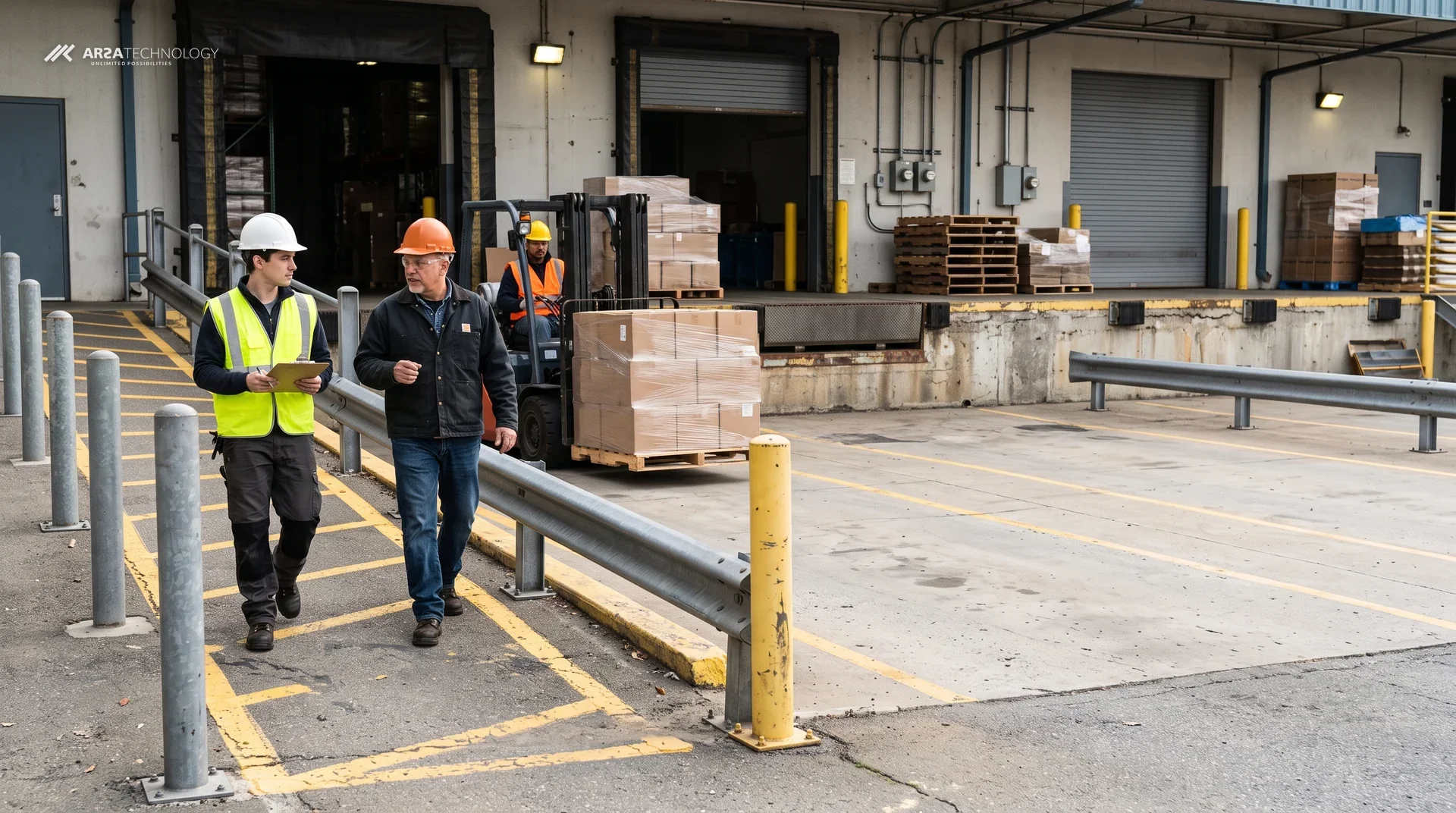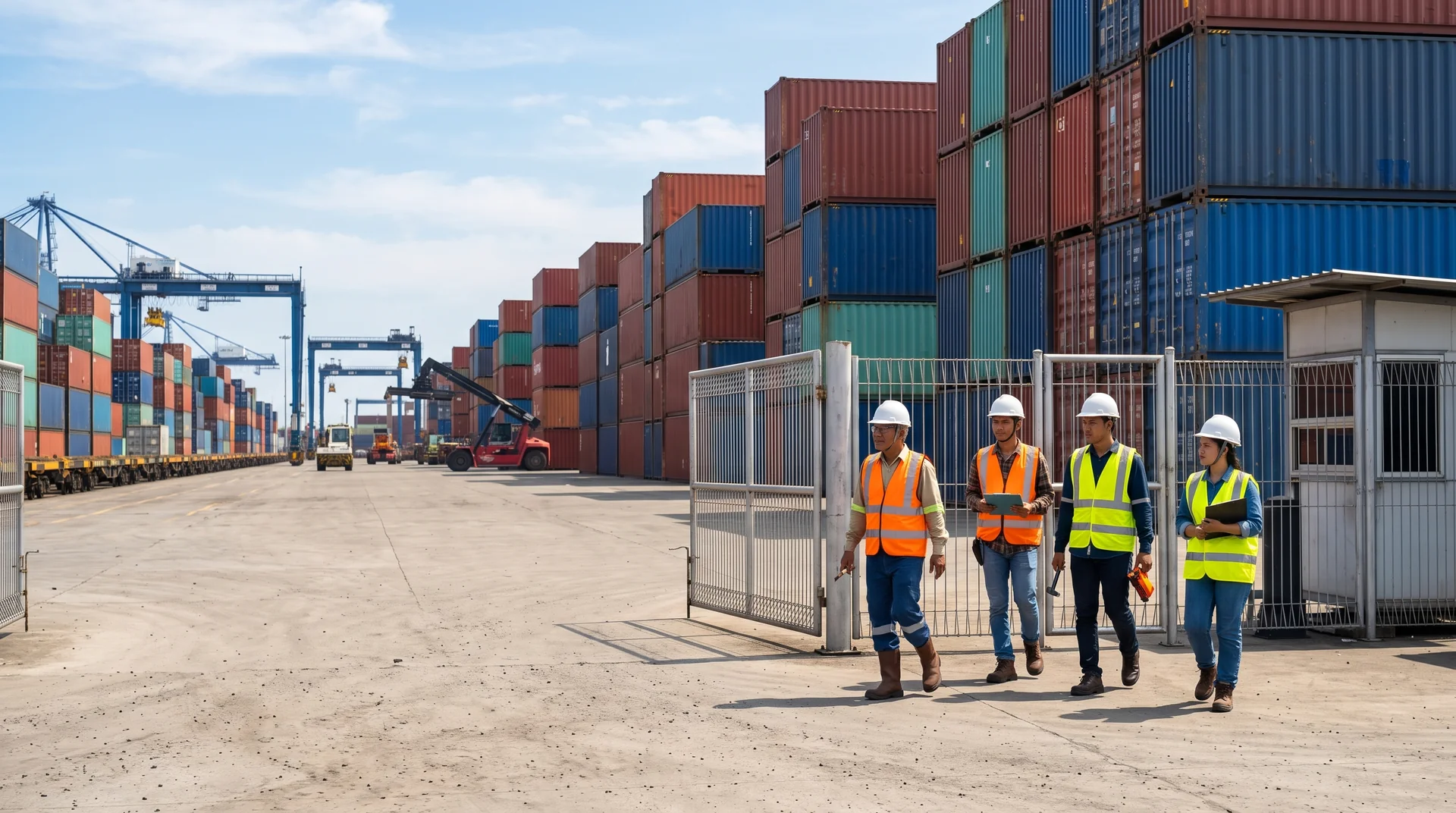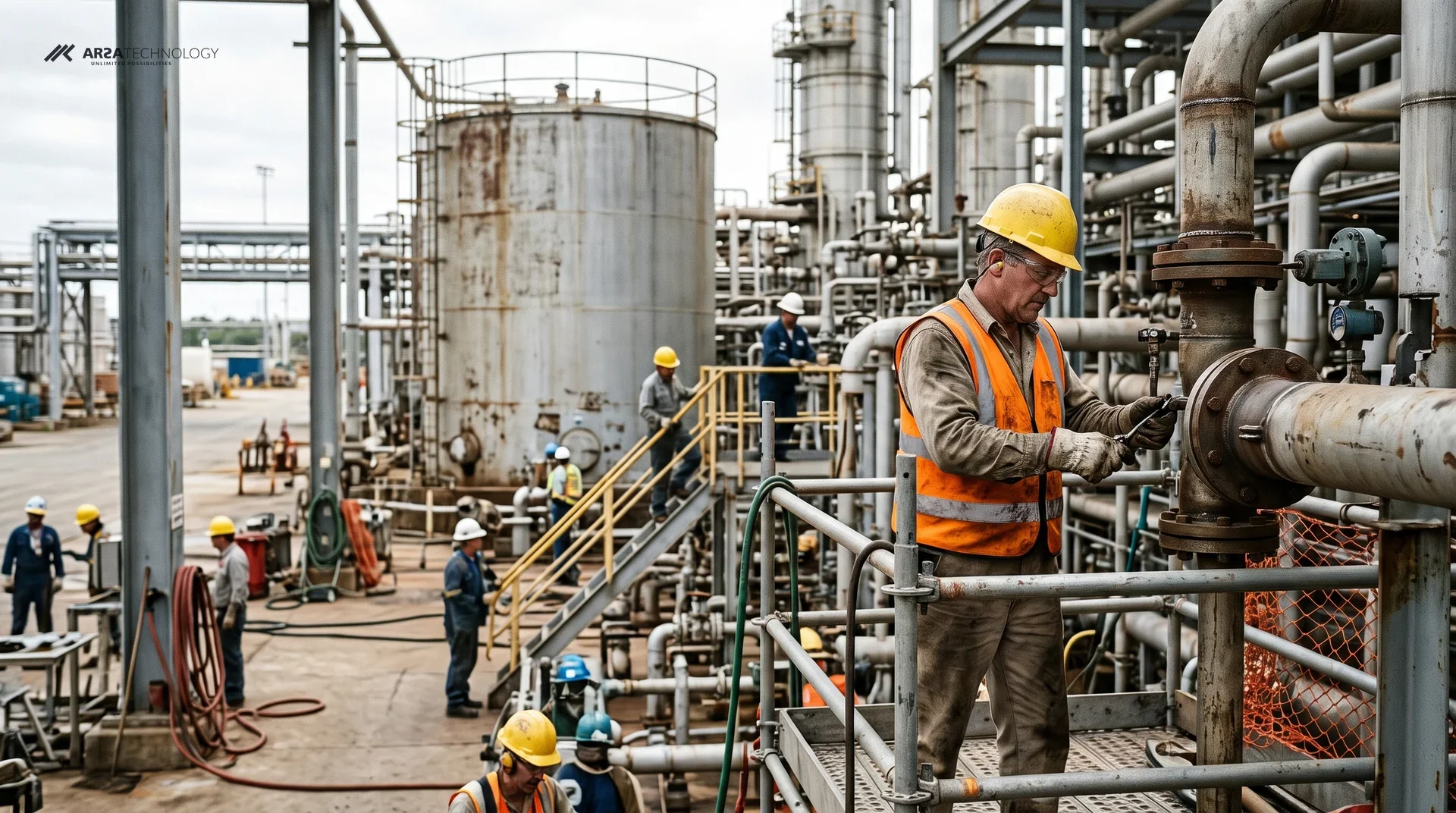

An illustrative scenario. The site and people are composites.
For most of the year, a refinery on the US Gulf Coast knows almost everyone who comes through its gates. Then a turnaround starts, and within days the people on site outnumber the permanent staff several times over: scaffolders, boilermakers, insulators and inspection crews from many contractors. This scenario follows one such site as it designs camera-based PPE monitoring for the surge. Every number is worked out in the open, so you can rerun it with your own.
THE SITE
A Refinery Whose Headcount Jumps For Six Weeks
The site is a mid-sized Gulf Coast refinery with 450 permanent workers. For a planned turnaround of 6 weeks it adds 1,200 to 1,800 contract workers, runs 2 shifts, and admits everyone through 6 turnaround gates beside the laydown yards and unit access roads. The EHS manager's problem is simple to state. In steady state, supervisors know their crews and spot a missing hard hat on sight. During the turnaround, the safety team learns about missing PPE from a write-up after the fact, if at all.
The public record shows why that matters. The U.S. Bureau of Labor Statistics puts petroleum and coal products manufacturing at 1.0 total recordable cases per 100 full-time workers in 2024, and 0.4 per 100 for cases with days away from work. Those are low rates for steady operations. Contract work is a different picture: the BLS counted 829 fatal work injuries to contracted workers in 2015, up from 802 in 2014, and found that just under 60 percent of construction laborers who died from a work injury that year were contracted workers.
The industry also remembers what crowded periods around process units can turn into. The U.S. Chemical Safety Board found that the March 2005 Texas City disaster killed 15 workers and injured 180 during the startup of the refinery's ISOM unit. All 15 deaths happened in or near trailers placed as close as 121 feet from a blowdown drum that vented to the atmosphere. Hard hats would not have changed that outcome. The CSB concluded that thorough implementation of the Process Safety Management standard would likely have prevented the accident. The lesson for this scenario is narrower: during startups and turnarounds, more contract workers are close to process units, and controls that work in steady state get stretched. PPE monitoring is one small layer under process safety. It does not replace it.
THE CONSTRAINTS
What The Site Cannot Change
Five constraints shape the design, and none of them can be negotiated away.
First, the existing cameras were installed for security. Most look steeply down on the gates from high poles, which suits deterrence but hides the vest front and most of the helmet. Second, video may not leave the refinery. Corporate IT keeps the process control network separate and will not route camera traffic to any outside service. Third, there is no new server room. The only space is a rack in the temperature-controlled IT room of the control building. Fourth, the site's electrical area classification decides where any camera housing may go, so new cameras sit at the gates and at the edges of laydown areas wherever possible. Fifth, the regulator is OSHA. Under its Process Safety Management standard, the host employer has duties toward contractors working in and around covered processes, including telling them about the process hazards and keeping track of how safely they work. The EHS team wants records that support that file.
Privacy settles one more choice. Most of the people on site are employed by other companies, and collecting consent from each of them for face recognition is impractical in a six-week surge. The system runs anonymously, which is its default.
THE DESIGN
One 25-Camera Server, Every Camera Checked Against ARSA-CVS-001
The design is Basic Safety Guard on one AI Box Server, which handles up to 25 camera streams, placed in the control building's IT rack. It reads 14 to 24 cameras: 1 or 2 at each of the 6 gates, plus 8 to 12 at work area approaches. It checks helmets, high-visibility vests and safety boots against the items each zone requires, raises an alert when a person enters a marked hazard area, and keeps the video on site.
Camera placement follows ARSA's camera and site standard, ARSA-CVS-001. Helmet detection needs 262 pixels per metre at the worker, which a 2 MP camera with a 60 degree lens reaches out to 6.3 m and a 4 MP camera to 8.4 m. Vests need 153 PPM, reached at 10.9 m and 14.5 m. Each gate therefore gets a new 4 MP camera on the approach lane, using the standard's accepted reference case: a 3.5 m mount, a 6.0 m standoff and a 22 degree tilt. Tilt stays within the 10 to 25 degree optimum, never past 35 degrees for helmets or 40 for vests, and anything steeper than 45 degrees is ruled out. A gate wide enough for two lanes of people gets a second camera. The lens and field of view tool shows how the coverage wedge changes with lens choice.
The steep security cameras are not wasted. Restricted-zone intrusion needs only 71 PPM and accepts tilt up to 55 degrees, so several of them can watch hazard areas such as an exchanger bundle pull or a crane lift zone. They raise entry alerts there, and the PPE checks stay with the gate cameras.
Light and weather complete the design. Every PPE zone needs at least 50 lux at the worker. On the night shift, vest detection needs white light, because infrared produces a monochrome image. Outdoor camera cabinets are IP66 and IK08. The cameras meet the standard's floor of 2 MP at 15 fps, with 4 MP recommended. They sit on an isolated VLAN with no internet route, and the server pulls streams directly from the cameras because many NVR re-streams are transcoded and frame-dropped. The server runs on a UPS with at least 15 minutes of hold-up, in a room kept under 35 °C. Video is recorded on site and kept for 3 days by default, and detection, alerts and the dashboard all work without an internet connection.
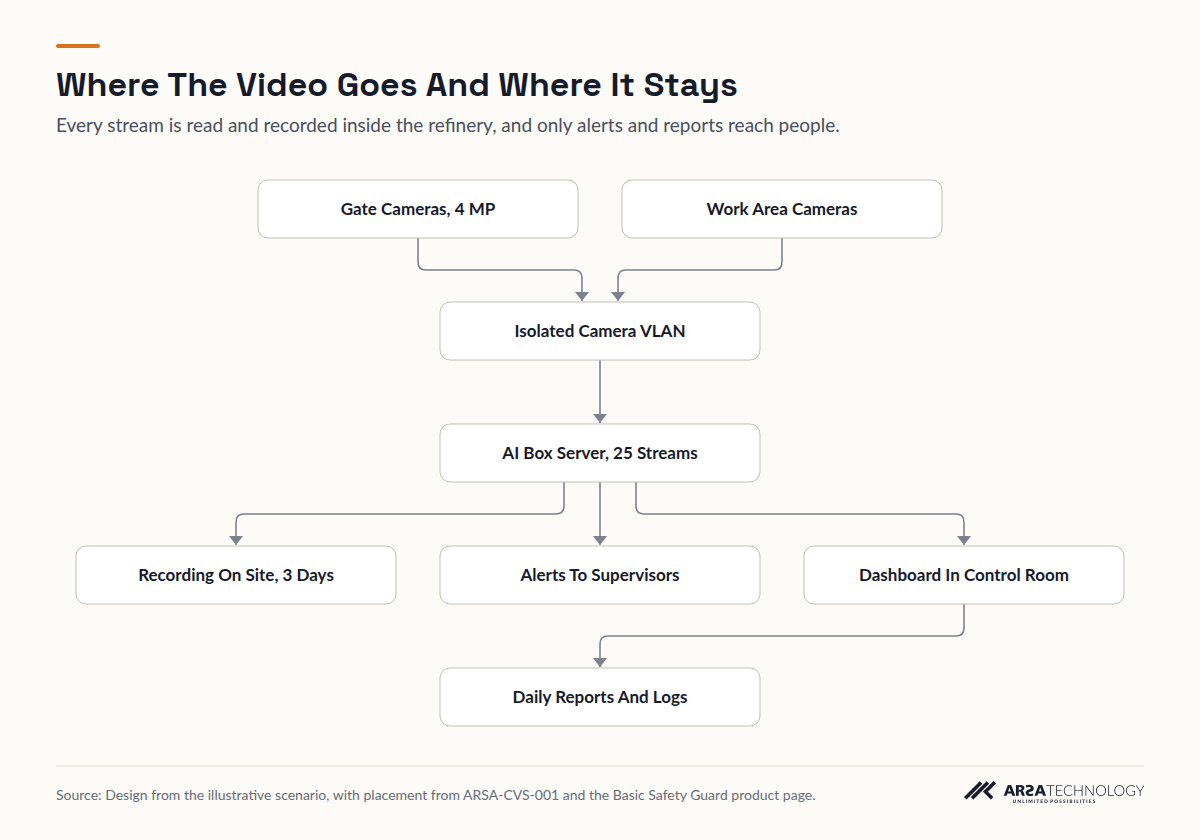
Read As Text
- Gate Cameras, 4 MP leads to Isolated Camera VLAN
- Work Area Cameras leads to Isolated Camera VLAN
- Isolated Camera VLAN leads to AI Box Server, 25 Streams
- AI Box Server, 25 Streams leads to Recording On Site, 3 Days
- AI Box Server, 25 Streams leads to Alerts To Supervisors
- AI Box Server, 25 Streams leads to Dashboard In Control Room
- Dashboard In Control Room leads to Daily Reports And Logs
THE ROLLOUT
From Camera Review To The First Contractor Shift
The rollout runs backwards from the mobilisation date, because the system has to be tuned on the steady-state workforce before the surge arrives.
It starts with a Remote Camera Design Review of the existing camera schedule, which ARSA returns within one week with a pass or fail for every position. An On-Site Camera Survey of up to 50 cameras follows during turnaround planning. It covers the gate lanes and the laydown areas and is repeated after dark to measure light. The site then installs the new gate cameras, lighting, cabinets, VLAN and server. A pilot at one gate comes next, run on the permanent workforce: the team draws zones, sets the required items for each one and tunes sensitivity camera by camera. Zones that pass are recorded as accepted in the Site Acceptance Record, and only those zones count. Handover trains gate supervisors and the EHS team on alerts and reports.
ARSA delivers outside Indonesia. Where visa conditions keep ARSA engineers from travelling, a qualified local partner installs under ARSA supervision. The services ARSA offers are listed on its services page.
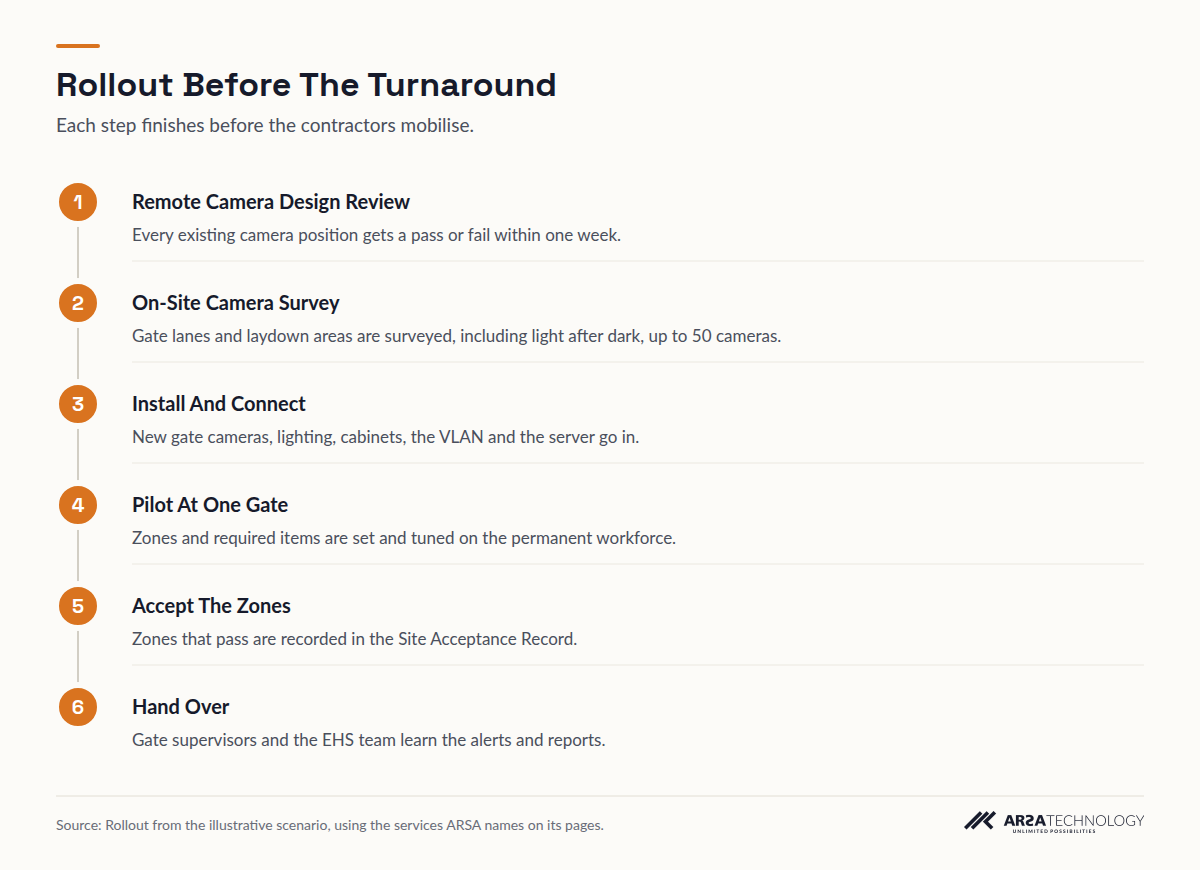
Read As Text
- Remote Camera Design Review Every existing camera position gets a pass or fail within one week.
- On-Site Camera Survey Gate lanes and laydown areas are surveyed, including light after dark, up to 50 cameras.
- Install And Connect New gate cameras, lighting, cabinets, the VLAN and the server go in.
- Pilot At One Gate Zones and required items are set and tuned on the permanent workforce.
- Accept The Zones Zones that pass are recorded in the Site Acceptance Record.
- Hand Over Gate supervisors and the EHS team learn the alerts and reports.
A DAY IN OPERATION
A Night Shift In Week Three
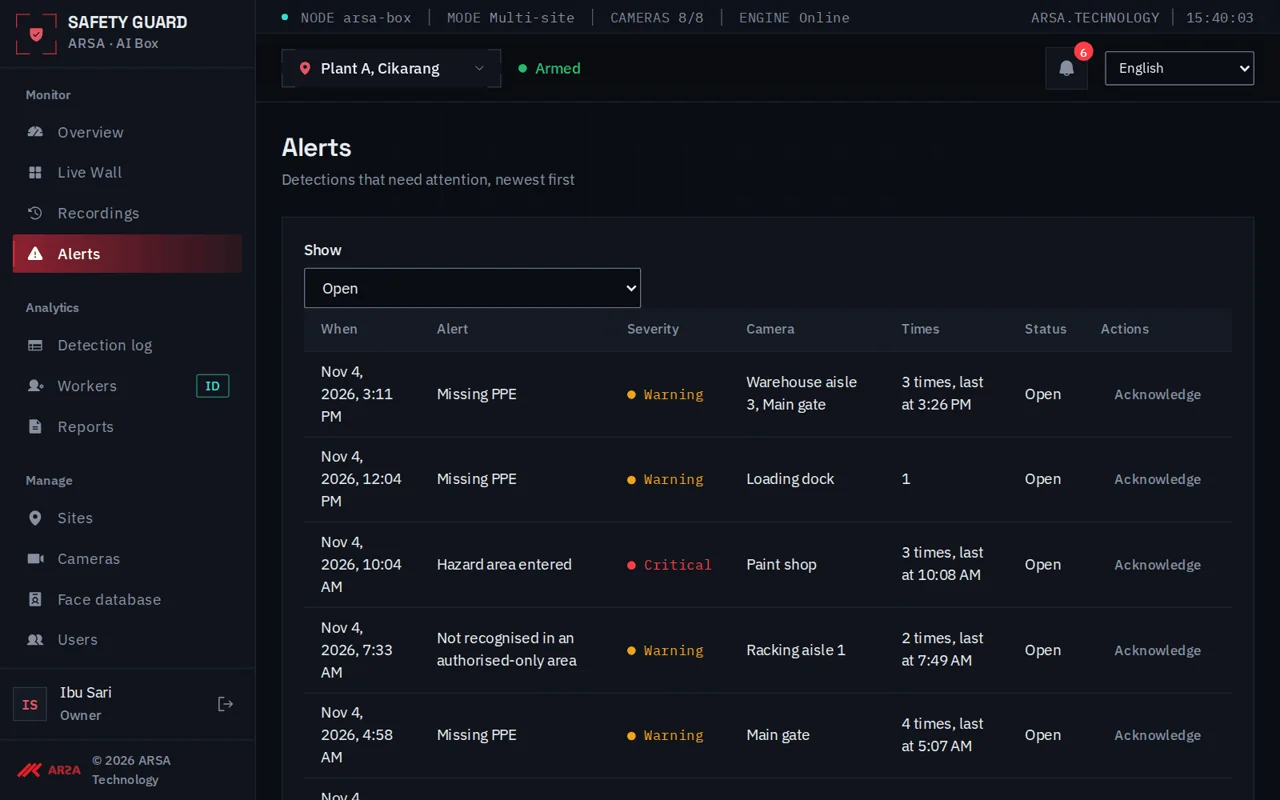
Near the end of a night shift in week three, the next crews start arriving at a gate. One worker comes through the approach lane without a vest. The alert reaches the gate supervisor's phone and the dashboard within seconds, with the camera, the zone and a snapshot. The supervisor stops the worker at the turnstile and sends them to the PPE trailer. The system does not identify the person. People do that, as they always have.
Later, someone steps inside the barricade around an exchanger bundle pull. The hazard area alert goes to the area supervisor, and a relay sounds a local siren. A person still has to act on it, because the alert does not stop the crane.
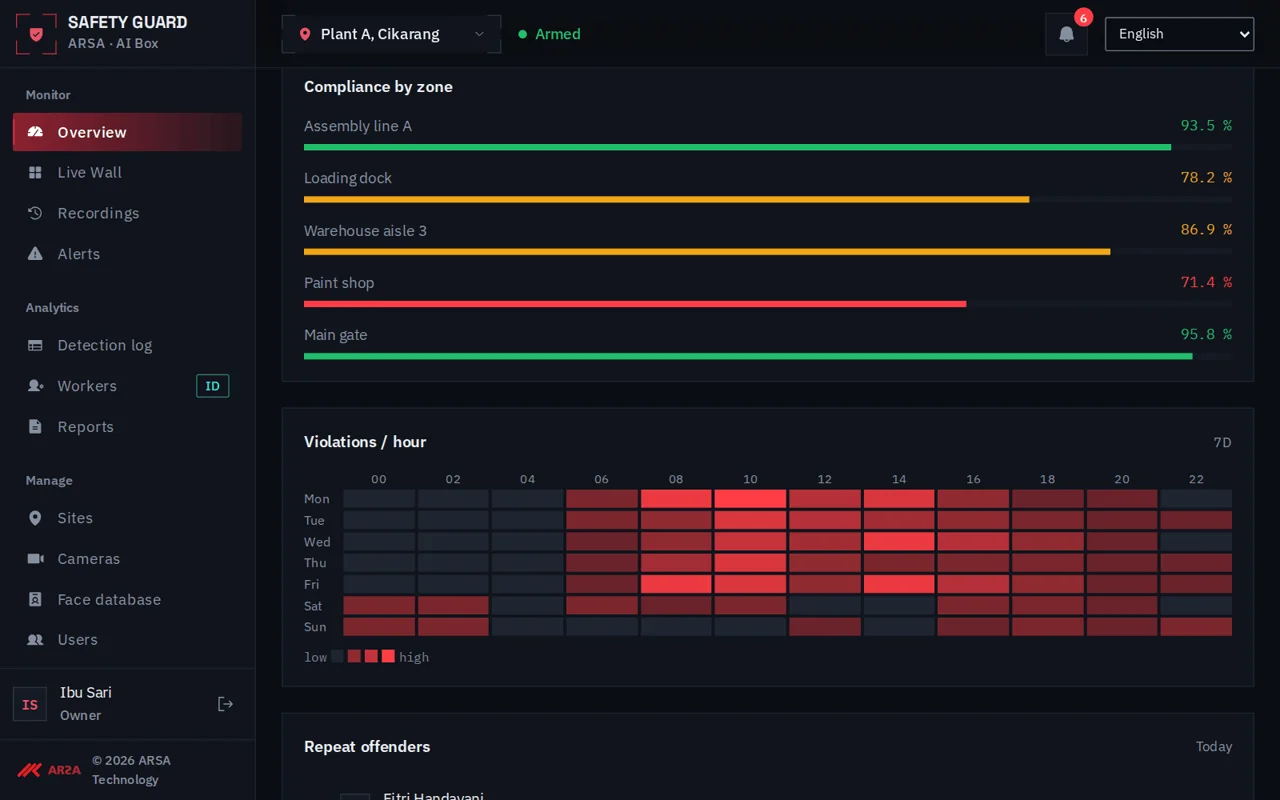
In the morning, the EHS manager opens compliance by zone and the time-weighted compliance index. The violations-by-hour heatmap shows a dip at one laydown area after the midday break. The daily e-mailed report goes to the contractor coordinators, and the exported log goes into the contractor safety performance file. The conversation with that crew's foreman happens that day, with the data in hand, instead of after an incident.
WHAT IT COULD CHANGE
The Outcomes, Worked As Ranges
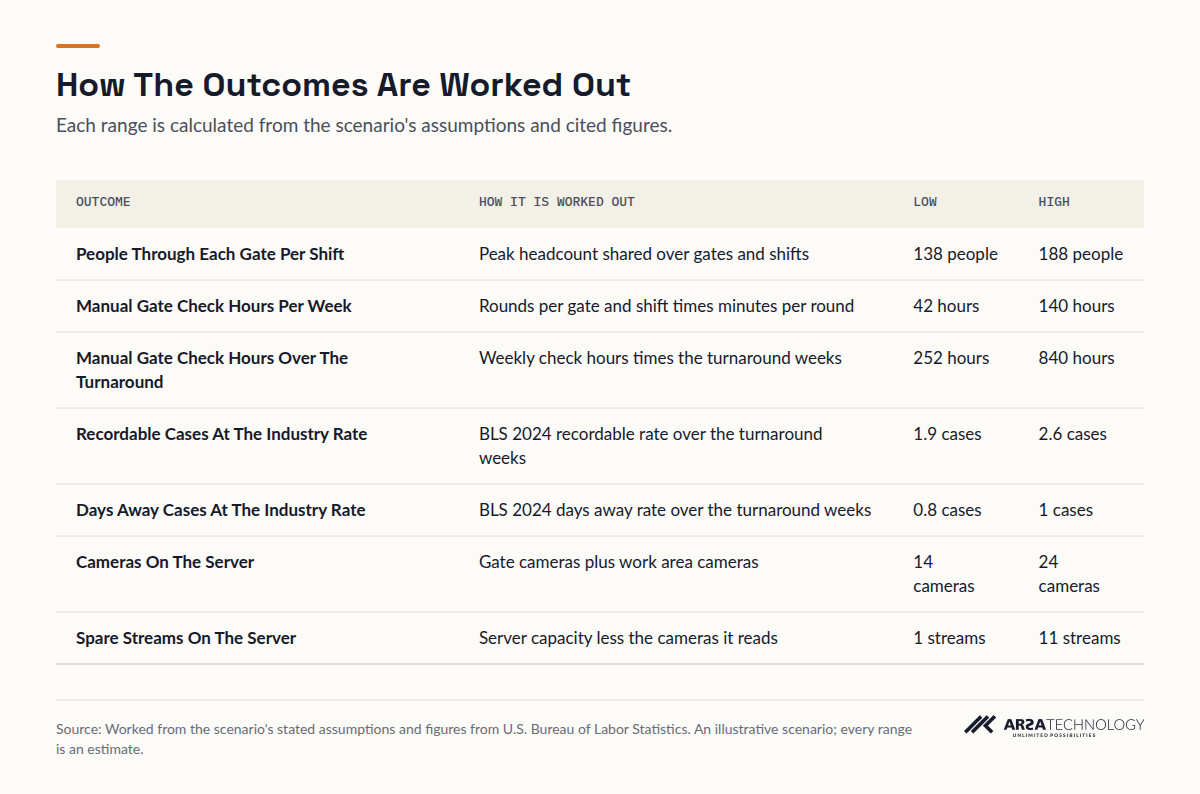
At the turnaround peak, each gate passes 138 to 188 people per shift, which is more than a guard can check by eye while also managing badges. If the site ran manual PPE rounds at every gate, 2 to 4 rounds per shift of 15 to 25 minutes each, those rounds would take 42 to 140 hours a week, or 252 to 840 hours over the 6 weeks. With the gate cameras running, that time goes into acting on alerts and walking the work areas the cameras cannot see.
The injury figures show the size of the exposure. They are not a forecast of what the system prevents. If the whole surge workforce were injured at the refining industry's 2024 average, the turnaround would expect 1.9 to 2.6 recordable cases and 0.8 to 1.0 cases with days away from work. That is a floor, because turnaround work carries more risk than steady operations. On the hardware side, the design needs 14 to 24 cameras, which leaves 1 to 11 spare streams on the 25-camera server for extra lanes or hazard areas.
View The Data
| Outcome | How It Is Worked Out | Low | High |
|---|---|---|---|
| People Through Each Gate Per Shift | Peak headcount shared over gates and shifts | 138 people | 188 people |
| Manual Gate Check Hours Per Week | Rounds per gate and shift times minutes per round | 42 hours | 140 hours |
| Manual Gate Check Hours Over The Turnaround | Weekly check hours times the turnaround weeks | 252 hours | 840 hours |
| Recordable Cases At The Industry Rate | BLS 2024 recordable rate over the turnaround weeks | 1.9 cases | 2.6 cases |
| Days Away Cases At The Industry Rate | BLS 2024 days away rate over the turnaround weeks | 0.8 cases | 1 cases |
| Cameras On The Server | Gate cameras plus work area cameras | 14 cameras | 24 cameras |
| Spare Streams On The Server | Server capacity less the cameras it reads | 1 streams | 11 streams |
THE LIMITS
What The System Does Not Do Here
The standard detections are helmets, vests and boots, with gloves and goggles still in beta. Flame-resistant clothing, gas monitors and harness tie-off are not among them. Detecting another item is a custom addition that the site would scope with ARSA, and it would need its own testing. PPE can only be checked where a camera meets the standard, so the steep cameras inside units cover entry alerts and nothing more. Counting unique people across cameras is new and still being calibrated.
ARSA's benchmark page publishes one PPE result: on the public SHWD dataset, 98.2% of hard-hat decisions were correct, with people too small or hidden to check reported as unknown. That is a laboratory result on public worksite images, and it says nothing about a refinery gate at night. On this site, accuracy is known only after zones are accepted and the pilot is measured.
Four things move the ranges: the real contractor peak, the number of manual rounds the site would actually run, the minutes each round takes, and how many gates need a second camera. In the first weeks the site should measure alerts per gate per shift, the time from alert to acknowledgement, compliance by zone and hour, and how many manual rounds it still needs.
THE CHECKLIST
The Turnaround PPE Monitoring Design Checklist
The checklist below collects the requirements this scenario needed, so a site team can tick them off before mobilisation.
For how the same approach fits a plant in steady operation, see AI safety monitoring for manufacturing.
FAQ
Turnaround PPE Monitoring Questions
How Do You Monitor PPE Compliance During A Plant Turnaround?
Put cameras that meet the PPE placement standard on every turnaround gate, and send their alerts to the people who can stop a worker there. Manual rounds cannot keep up when each gate passes well over a hundred people a shift. Camera checks at the gates, plus supervisors walking the work areas, cover both places.
Can Existing Refinery Security Cameras Be Used For PPE Detection?
Usually only for hazard area alerts. Security cameras tend to sit high and steep, and PPE detection is ruled out past 45 degrees of tilt. Restricted-zone intrusion tolerates up to 55 degrees, so those cameras can still watch barricaded areas.
Does The Video Leave The Refinery?
No. In this design, detection, recording and the dashboard run on a server in the control building, and the cameras sit on an isolated VLAN. Only alerts and reports go to supervisors' phones and e-mail.
Does It Check Flame-Resistant Clothing?
No. The standard detections are helmets, vests and boots, with gloves and goggles in beta. Flame-resistant clothing would be a custom addition, scoped and tested on site.
Does PPE Detection Work On The Night Shift?
Yes, where there are at least 50 lux at the worker. Vest detection at night needs white light, because infrared produces a monochrome image and hides the vest colour.
For how this works in practice, see the PPE detection camera system. To find out whether your own gate cameras would pass, send a few clips from them for a free AI assessment by an ARSA engineer.